
Indology And Rationality
Added to library: September 1, 2025
Summary
Here is a comprehensive summary of Johannes Bronkhorst's "Indology and Rationality," based on the provided text:
Core Argument:
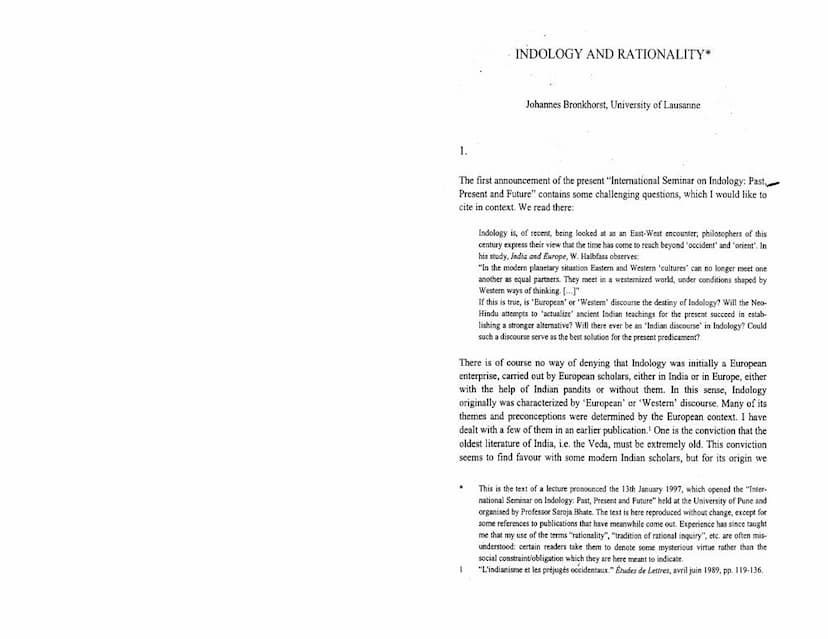
Bronkhorst argues that rationality, defined as a readiness to accept and engage with criticism across all domains, including tradition and religion, is a crucial and often overlooked element of scholarly discourse. He posits that India possesses a long and significant rational tradition, and that acknowledging this tradition, alongside a critical examination of its origins and development, is vital for the future of Indology. He contends that Indology, while historically a Western enterprise, should strive to become a global, mutually critical endeavor.
Key Themes and Arguments:
-
The Nature of Indology and "Western Discourse":
- Bronkhorst acknowledges that Indology originated as a European endeavor, shaped by European preconceptions and interests (e.g., the perceived extreme antiquity of the Vedas, the notion of India as a land of spiritual wisdom).
- However, he rejects the idea that Indology is exclusively "Western discourse." He draws parallels with other global developments (scientific revolution, industrial revolution, computers) that originated in the West but transcend their cultural origins and can be more fruitful elsewhere.
- Scholarly discourse itself, he argues, is global and not inherently tied to any single culture.
-
Defining Rationality:
- Bronkhorst defines rationality not as adherence to logical rules or economic rationality, but as the social constraint/obligation to accept and deal with criticism. This is inspired by Karl Popper's usage.
- He emphasizes that rationality is a vital ingredient of scholarly and scientific discourse and is distinct from mere tradition, revelation, or insight.
- He notes that while the European Middle Ages had a tradition of rationality, other factors were needed for the scientific revolution, suggesting that rationality alone isn't a guarantee of progress.
-
The Indian Rational Tradition:
- Bronkhorst asserts that India has a long and significant rational tradition that has not received sufficient attention. He questions whether rational traditions are common to all cultures, suggesting they may be the exception, citing China as an example where technological progress occurred without a strong rational tradition.
- He controversially suggests that Western scholars might have taken Indian rationality for granted due to their own rational heritage, potentially limiting their perspectives.
- He argues that the presence of a strong rational tradition in India should be a cause for surprise, not acceptance as self-evident.
-
The Question of Origins:
- Bronkhorst addresses the scholarly tendency to seek origins, particularly in Indology, and suggests this is a "scholarly universal," though he acknowledges its problematic aspects (e.g., the idea that understanding beginnings grants privileged access to the whole).
- He argues that understanding origins is crucial for understanding how things came to be, not just what they are. This is particularly important for understanding institutions and traditions that evolve over time.
- He applies this to the question of when and why India's rational tradition began.
-
The Absence of Rationality in Vedic Literature:
- Bronkhorst finds rationality, as he defines it, to be absent in Vedic literature, including the Upanishads.
- He describes Upanishadic debates as contests of knowledge rather than argumentation, where conviction is not sought through logical reasoning, and the teacher's word is accepted without challenge.
- He suggests that the rational tradition in India likely began later, possibly with the classical philosophers.
-
The Rise of Rationality in Classical India:
- Bronkhorst highlights the intense intellectual interaction between different schools of thought in classical India (e.g., Buddhists and Naiyayikas) as evidence of a strong rational tradition.
- He uses Uddyotakara's critique of Buddhist doctrine, which involved searching for supporting or refuting texts, as an example of taking opponents' positions seriously and the theoretical possibility of changing one's mind.
-
Methodological Implications of Rationality:
- The assumption of rationality in Indian philosophy has methodological consequences, such as the expectation of coherence. When elements seem incoherent, scholars might attribute them to earlier, pre-rational stages.
- However, Bronkhorst cautions against applying this method universally, as not all Indian traditions or periods were equally rational. He uses the example of Kashmir Shaivism, which joined the rational tradition later (around the 10th century CE).
-
Case Studies: Samkhya and Bharthari:
- Samkhya: Bronkhorst discusses the apparent contradictions in classical Samkhya, particularly regarding the multiplicity of souls (purusas) and the uniqueness of Prakriti. He suggests that early Samkhya might have been more cosmological and less concerned with individual psychology, and that later developments, possibly influenced by the rational tradition, created these inconsistencies. He argues that the adherence to these inconsistencies might have had internal, "rational" reasons within the system's logical proofs.
- Bharthari: He analyzes Bharthari's philosophy of language, noting a similar confusion between individual and universal perspectives. He suggests that Bharthari, like classical Samkhya, might have been speaking on different levels of reality simultaneously, making him vulnerable to criticism. He contrasts this with later thinkers who "rationalized" these ideas.
-
The Yogacara School of Buddhism:
- Bronkhorst examines the idealism of the Yogacara school, noting that its concept of "mind only" does not necessarily imply solipsism or idealism in the Western sense.
- He highlights the difficulty of reconciling the idea of individual minds creating the world with a shared reality, suggesting that earlier Yogacara might not have faced this issue as acutely as later interpretations.
-
Conclusion and the Future of Indology:
- Bronkhorst reiterates that India possesses a rich rational tradition that deserves study.
- He emphasizes that this shared tradition of rationality should facilitate collaboration between scholars from different backgrounds.
- He concludes that no one has privileged access to the object of study; mutual criticism and a willingness to consider evidence and arguments from all directions are essential for progress. He advocates for a diverse Indology that embraces mutual criticism and seeks to understand different perspectives.
In essence, Bronkhorst calls for a more nuanced and globally engaged approach to Indology, one that recognizes and critically examines the indigenous rational traditions of India and moves beyond a simple East-West dichotomy.