
Hothal Nigabhari Aur Odh Aam Ki Suprasiddh Lokkatha Ka Vastusamya Evam Iske Adhar Par Vichar
Added to library: September 1, 2025
Summary
Here's a comprehensive summary of the provided Jain text:
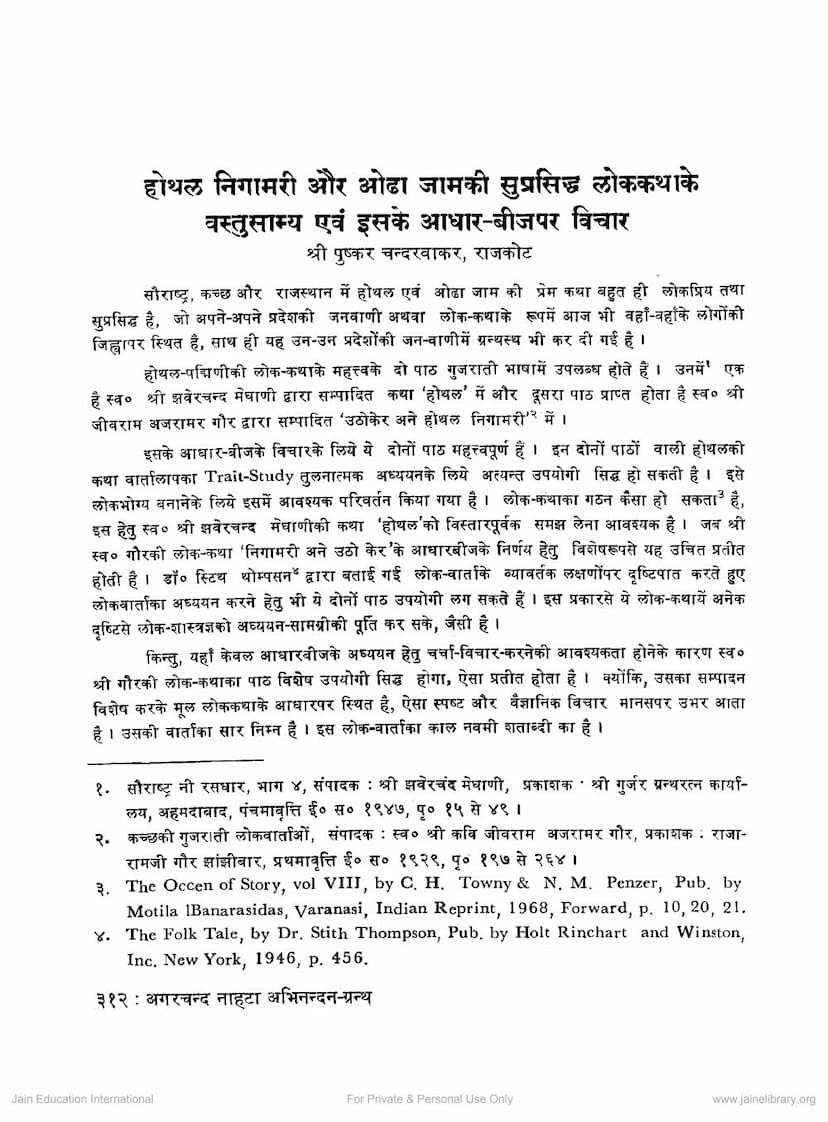
The article, "Hothal Nigabhari aur Odh Aam ki Suprasiddh Lokkatha ka Vastusamya evam Iske Adhar par Vichar" (A Comparative Study of the Famous Folk Tale of Hothal Nigabhari and Odha Jam, and Reflections on its Basis) by Pushkar Chandarvakar, explores the popular folk tale of Hothal and Odha Jam prevalent in Saurashtra, Kutch, and Rajasthan. The author highlights the tale's enduring presence in the oral traditions and written literature of these regions.
The paper focuses on two specific Gujarati versions of the Hothal-Padmini folk tale: one edited by the late Jhaverchand Meghani in 'Hothal' and another by the late Jivram Ajmar Gor in 'Uthoker ane Hothal Nigamari'. Both versions are deemed important for understanding the tale's core elements, with a comparative study of their dialogues being particularly useful for making the story accessible to the public. The article emphasizes the importance of Meghani's tale for understanding the structure of folk tales in general, while Gor's version is considered more valuable for analyzing the root basis of the "Nigamari ane Utho Ker" tale, especially when viewed through the lens of Dr. Stith Thompson's typological characteristics of folklore.
The author then delves into the narrative of the Odha Jam and Hothal tale, positing it to be from the 9th century.
Key Plot Points of the Hothal and Odha Jam Tale:
- Hothal's Origins: Hothal's foster father was Sanghan Nigamra. She was found in the Hothal forest and, due to her immense beauty, was believed to be from a wealthy family or even an Apsara (celestial nymph).
- Hothal's Reluctance: Despite numerous marriage proposals, Hothal expressed her unwillingness to marry to her foster father.
- Encounter with Odha Jam: Hothal, disguised as a male, encountered Odha Jam, who had been exiled by his brother. They met while Hothal was on a mission to raid cattle.
- Developing Affection: They spent eight days together, during which their love affair began.
- The Bathing Scene and the Condition: After their separation, Hothal bathed in a lake. Odha Jam, who had lost his horse, climbed a hill and saw Hothal bathing. He sat on her clothes. Hothal asked him to return them, but he refused. Hothal then stated that she would return his clothes only if he promised to marry her.
- Hothal's Marriage Conditions: Hothal proposed three conditions for marriage:
- She would not come to his home after marriage, and he would have to live wherever she resided.
- Her true identity and name were to be kept secret from everyone.
- If these conditions were violated, she would immediately leave him.
- Marriage and Secluded Life: Odha Jam accepted these conditions, and they were married. They lived in mountain caves for ten years and had two sons, Jabra and Jaisang.
- The Peacock Incident and Odha Jam's Longing: One day, Odha Jam's son Jabra injured a peacock. Odha Jam saw this as a reminder of his homeland and family, causing him to become melancholic. Hothal noticed his sadness and inquired about the cause. Odha Jam confessed his longing for his homeland and relatives.
- Return to Odha Jam's Homeland: They decided to visit Odha Jam's country, with the agreement that Hothal would remain unrecognized and Odha Jam would not speak about her. In his homeland, Odha Jam's brother, who had lost his wife, ceded his rule to Odha Jam. Odha Jam returned to his former house with Hothal.
- Secrecy and Gossip: Hothal continued to maintain her seclusion, leading to speculation among Odha Jam's relatives that he had kept a concubine. Gossip began to circulate about the unknown woman from a "lowly lineage."
- Revelation of the Secret: One day, while intoxicated, Odha Jam revealed Hothal's identity, calling her a celestial Apsara with many Siddhis (supernatural powers) and the adopted daughter of Sanghan Nigamra, who had raided the cattle of Ghaddula Sodha of Bambhansar. He also stated they were married.
- Hothal's Departure: Upon hearing this, Hothal immediately wrote four letters:
- She was leaving him for breaking their agreement.
- She would always watch him, but he would not see her.
- She would protect him and their two sons from afar.
- She would attend their sons' weddings to fulfill her maternal duties.
- Odha Jam's Despair and Sons' Marriages: Hothal departed, leaving Odha Jam distraught and near madness. When their sons grew up, they were betrothed and married to two Sodha chieftains' daughters from Hal. Hothal reappeared at their weddings to fulfill her roles. The elder daughter-in-law asked for a valuable necklace, which Hothal granted. The younger daughter-in-law requested to live under her mother-in-law's care and constant proximity.
- Hothal's Permanent Return: Hothal accepted the younger daughter-in-law's request and permanently returned to live with Odha Jam.
Comparison with the Urvashi-Pururavas Myth:
The article then draws a significant parallel between the Hothal and Odha Jam tale and the ancient Vedic myth of Urvashi and Pururavas.
-
Shared Themes:
- An immortal woman marries a mortal man.
- The celestial being sets conditions for marriage.
- The conditions are broken, and the celestial being departs.
- The celestial being may transform or remain in seclusion.
- The mortal man grieves.
- The celestial being eventually shows compassion.
- A reunion occurs.
-
Specific Parallels:
- Hothal, like Urvashi, is considered an Apsara.
- Both couples marry through Gandharva marriage.
- Urvashi also set conditions for Pururavas (e.g., not seeing her naked, not embracing her more than three times a day, not forcing coitus against her will).
- The breaking of these conditions led to Urvashi's departure, mirroring Hothal's departure.
- Pururavas, like Odha Jam, went mad from separation and sought Urvashi.
- Urvashi eventually returned to Pururavas.
Origin and Dissemination of the Tale:
The author argues that the Urvashi-Pururavas myth, originating in the Rigveda and further elaborated in the Satapatha Brahmana, is the root of the Hothal story. While Urvashi-Pururavas is a puranic myth, Hothal is a local legend from the 9th century. The tale's enduring appeal lies in its theme of divine love.
The article notes that this "Swan Maiden" motif, as described by Dr. Stith Thompson, is universal and found across cultures, appearing in Greek mythology ("Cupid and Psyche"), German folklore ("Swan Maiden"), French ("Melusina"), Scottish ("The Seal Woman"), and Gypsy tales ("The Wind Maiden"). It also finds echoes in Indian literature like the Kathasaritsagar and even the Bhagvata Purana (Krishna stealing the Gopis' clothes).
The author suggests that the Urvashi-Pururavas myth traveled from India to the West and East, influencing various folk traditions. The article cites N.M. Penzer's work, which posits that the "Swan Maiden" motif originated in India and spread to Europe. The myth is also found in Japan ("Hikohoko-demi") and has parallels in the story of Shantanu and Ganga in the Mahabharata and the tale of Dhandhal in Rajasthan.
In conclusion, the article positions the Hothal and Odha Jam folk tale as a significant local legend deeply rooted in the ancient and universally appealing myth of Urvashi and Pururavas, demonstrating the powerful and enduring nature of the theme of divine love and the consequences of breaking sacred vows.