
Historio Cultural Data As Available From Samaraiccha Kaha
Added to library: September 1, 2025
Summary
Here is a comprehensive summary of the provided text, "Historio-Cultural Data as Available from Samaraiccha Kaha" by Rasesh Jamindar:
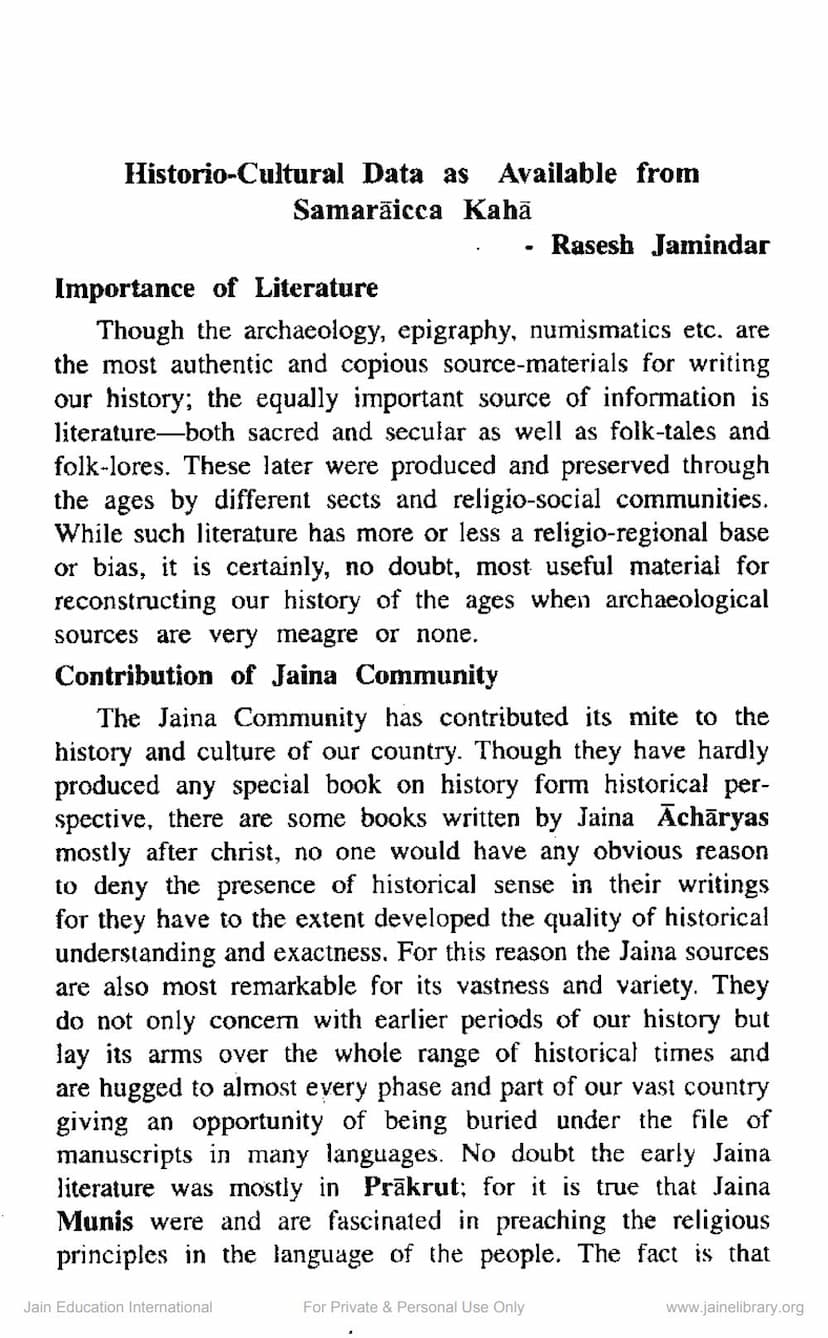
This text, authored by Rasesh Jamindar, explores the rich historical and cultural information that can be gleaned from the Jain text "Samaraiccha Kaha" (SK). The book emphasizes the importance of literature, alongside archaeology and epigraphy, as a vital source for reconstructing history, especially when other sources are scarce.
The Contribution of the Jain Community: The author highlights the significant, though often indirect, contributions of the Jain community to Indian history and culture. While Jains may not have produced dedicated historical works in a modern sense, their religious and secular literature, often written in Prakrit (the language of the people), offers valuable insights into various periods and regions of India. The Jain tradition's emphasis on Shastradana (donation of scriptures) and the preservation of knowledge through Jnanabhandaras (libraries of manuscripts) has been crucial in safeguarding this historical material. These Jnanabhandaras, often established alongside Upashrayas (Jain monastic dwellings), have made rare manuscripts accessible to scholars and have contributed to the national heritage by fostering learning.
The Role of Jain Munis and their Literature: Jain Munis, through their peripatetic lifestyle (Vihara) and periods of stationary observance (Chaturmas), encountered diverse customs, cultures, monuments, and inscriptions. This exposure, combined with access to temple libraries, inspired them to document their observations. Their writings, often disguised as religious stories (Dharmakathas), provide detailed descriptions of religious and historical sites, temples, images, and inscriptions related to temple construction and idol consecration. These travelogues, even when viewed from a religious perspective, offer historically important material for understanding geography, toponymy, political activities, and societal structures.
"Samaraiccha Kaha" (SK) as a Source: The book specifically focuses on "Samaraiccha Kaha" (SK), an 8th-century AD work by Acharya Haribhadra. SK is described as a Dharmakatha (religious story) that blends adventure with religious admonition. Its central theme is that human life is rife with misery, vices like jealousy and enmity, and that a pious and moral life is the path to overcome them. The text warns against negligence in moral living, suggesting that it leads to negative consequences, including animalistic or hellish rebirths, reflecting the prevalent belief in the theory of rebirth during that era.
Socio-Political and Administrative Insights from SK: SK provides a wealth of socio-cultural and political information, particularly concerning Rajasthan during the 8th century AD:
- Administration: The text suggests a monarchical system of government, likely hereditary, with the existence of provinces ruled by Viceroys. The tradition of a Yuvaraja (heir-apparent) and the training imparted to them for administration are also evident. The presence of ministers serving as state advisors and a cabinet system indicates a structured governance. The relationship between the king and feudal lords appears close, with even former adversaries being treated with respect.
- Local Organization: The smallest administrative unit was the village or town, with officials like Nagarmahantaka (akin to a mayor or panchayat president) and Karnika in charge of towns, and Drangswami heading village administration. These officials held judicial powers. The Gramasabha (village assembly) played a role in resolving minor disputes, with experienced and wise individuals likely being elected. A joint committee of Karnika and Panchkula (possibly a people's representative) suggests a system of arbitration.
- Superstition and Religious Practices: The text indicates the prevalence of superstition and blind faith, with mentions of supernatural beings like Pisacha and Rakshasi. It also points to the worship of heavenly elements, natural objects, and goddesses. While direct references to Shiva are absent, his importance alongside goddesses is implied. The significance of Upavasa (fasting) for warding off future miseries is highlighted, along with instances of severe vows. Occasional human sacrifice and offerings for desires are also mentioned.
- Rebirth and Spirituality: The concept of rebirth is central to SK and was widely prevalent in Indian religions, including Jainism. Performing religious duties, charity (Dana), penance (Tapa), and spiritual practices (Sadhana) in this life were believed to lead to happiness and wealth in the next. The text also notes the inclination of learned individuals towards a saintly life.
- Astronomy and Religion: Astronomy played a role in religious life, with astrologers consulted for auspicious timings (Muhurta) for sacred activities like marriages.
- Four Cardinal Principles of Religion: Dana, Shila, Tapa, and Bhavana are identified as the four key tenets of religion. The importance of Sadhu Dharma, Yati Dharma, Bhavana Dharma, Dana Dharma, Shila Dharma, and Tapo Dharma is also evident. Concepts like mantras, Namaskara, karmas, and Anuvrata were integral to religious practice.
Social Stratigraphy and Marriage Customs: SK offers insights into the social hierarchy, with kings, Brahmins, and saints holding high status, followed by merchants and government servants. Lower strata included groups like Chandala and fishermen. Notably, the text does not explicitly mention the four-fold Varna system. Youth of both sexes had some freedom in choosing partners, but parental consent was essential. Dowry system and the tradition of a fire altar during marriages were prevalent. The exchange of gifts like fruits, flowers, garlands, and paintings between lovers was also common. Parental approval was also sought for important life decisions beyond marriage.
Miscellaneous Aspects:
- Dreams: Dreams were considered significant and believed to be true.
- Wealth and Theft: People hid wealth, possibly due to fear of theft, which was a known societal issue, with death sentences imposed for such offenses.
- Currency: The "Dinar" was the official currency, used in financial transactions and treasury matters, though its denominations are not specified.
- Poisoning: A peculiar custom of administering poison during disputes or disagreements is documented, often mixed with food.
- Entertainment: Gambling and games like archery and riddle-telling were forms of entertainment.
- Onomastics: SK contains numerous personal and place names, many fictional. These names, whether real or imagined, reflect the thoughts and societal patterns of the author's time. Names were often emotional, qualitative, or derived from deities, celestial bodies, flowers, and natural elements.
- Flora and Fauna: The text mentions various animals like horses, elephants, parrots, and lions, as well as trees like mango and coconut.
In conclusion, Rasesh Jamindar's analysis of "Samaraiccha Kaha" demonstrates its immense value as a historical and cultural document, particularly for understanding the society, administration, religious practices, and customs of Rajasthan and India in general during the 8th century AD. The book underscores the rich legacy of Jain literature in providing these crucial historical insights.