
Historical Development Of Jaina Philosophy And Religion
Added to library: September 1, 2025
Summary
Here's a comprehensive summary of the provided Jain text, "Historical Development of Jaina Philosophy and Religion" by Sagarmal Jain, focusing on the period from the 3rd to 10th Century A.D. and its broader historical context:
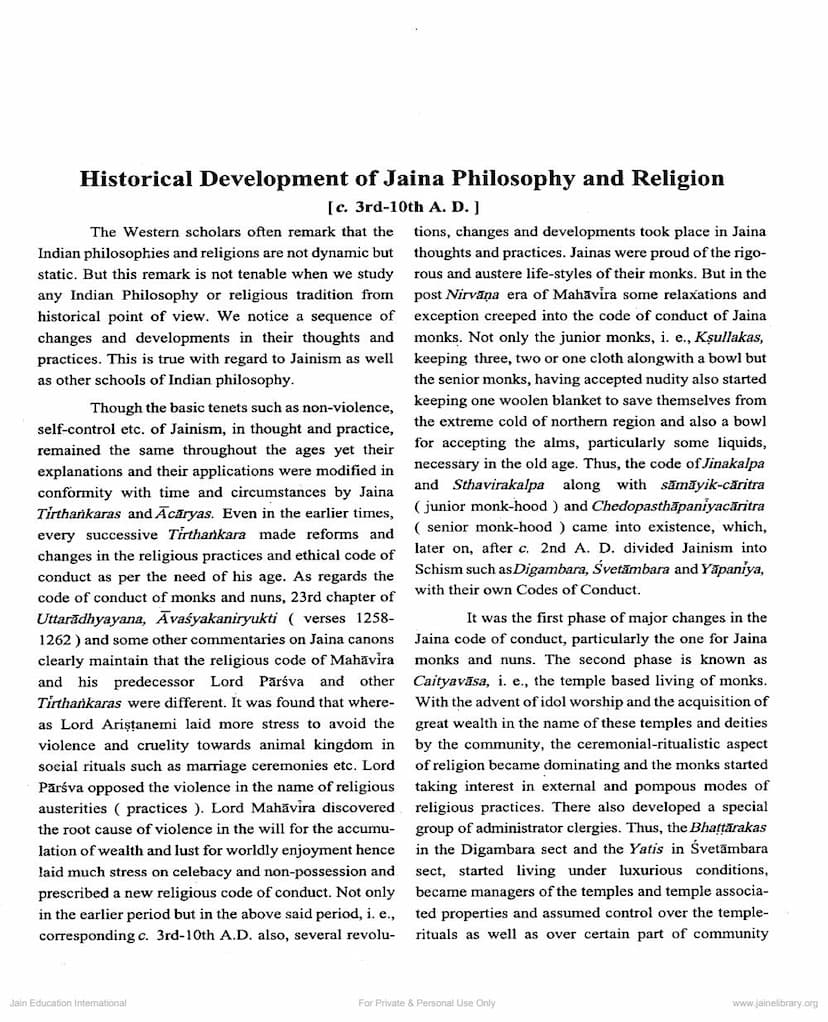
The book argues against the notion that Indian philosophies and religions are static, asserting that Jainism, like other Indian traditions, underwent significant historical development in its thought and practices. While core tenets like non-violence and self-control remained constant, their explanations and applications evolved over time, influenced by successive Tirthankaras and Acharyas.
The text broadly categorizes the historical development of Jaina philosophy and religion into three ages:
-
The Agama Age (c. 5th B.C. - 3rd A.D.): This period saw the composition of most Āgamic literature, primarily focused on moral conduct and ethical preaching. While some philosophical discussions existed, they were scattered. Notable works like Viśeṣāvaśyakabhāṣya are exceptions, containing more philosophical depth. The foundational objective of early Jainism was to escape the cycle of birth and death by eradicating desires and attachments, which were seen as the root cause of suffering. Spirituality was understood as realizing higher values and inner purity.
-
The Age of Critical Presentation of Anekāntavāda (c. 4th - 6th A.D.): This era witnessed the critical elaboration of Anekāntavāda (non-absolutism) as a core Jaina doctrine, with significant contributions from scholars like Siddhasena Divākara and Samantabhadra. They refined concepts like Pañcajñāna (five-fold knowledge) and engaged in critical debates with other schools of thought, establishing Jainism's non-absolutist perspective as the most logical. The period also saw the development of the concept of the soul as the sole enjoyer and doer of its fate, with attachment and delusion identified as the primary causes of bondage and suffering. The doctrine of karma, as the binding principle that veils the soul's natural faculties, and its eight types (knowledge-obscuring, perception-obscuring, feeling-producing, deluding, age-determining, body-determining, status-determining, and obstructive) were central. Liberation (Moksha) was defined as the soul's complete perfection and purification. The path to liberation was understood as the integration of Right Faith (Samyak Darśana), Right Knowledge (Samyak Jñāna), and Right Conduct (Samyak Caritra).
-
The Age of Systematization of Jaina Philosophy (c. 7th - 10th A.D.): This period focused on organizing and systematizing Jaina philosophical thought. Significant developments included the refinement of the Pañcajñāna theory, the emergence of the Pramāṇa (theory of valid cognition) concept (adopted and synthesized with Jaina epistemology), and the detailed discussion of Anekāntavāda and Syādvāda (conditional predication). The concept of Saptabhangi (seven-fold predication) was systematically presented. Metaphysical doctrines like Pañcāstikāya (five constituents of the universe) and Ṣaḍdravya (six substances) were further developed and refined. The doctrine of Gunasthāna (stages of spiritual development), comprising fourteen stages, emerged and was detailed. The text also notes the development of the concepts of bahirātmā, antarātmā, and paramātmā as stages of spiritual quest.
Key Developments and Changes:
- Schism and Liberalization: The period saw significant changes in the code of conduct for monks and nuns. The ideal of nudity and strict asceticism began to relax, leading to the acceptance of clothing, blankets, and begging bowls. This liberalization, especially the practice of Caityavāsa (temple-based living), contributed to the division of Jainism into Śvetāmbara, Digambara, and Yāpanīya sects. This shift also saw the rise of administrator clergies (Bhaṭṭārakas and Yatis) living in luxurious conditions.
- Revolutions and Reformations: Movements led by figures like Kundakunda (Digambara) and Haribhadra (Śvetāmbara) attempted to revive rigorous practices against the backdrop of temple-based living. Later centuries saw further reform movements like Kharataragaccha, Tapagaccha, Lonkāgaccha, Sthānakavāsi, Terāpanthi (Śvetāmbara), and Bānārasimata Digambara Terapantha, Taranapantha (Digambara), indicating Jainism's dynamic nature. The influence of Hindu devotionalism and Tantrism led to ritualistic idol worship, while Muslim influence contributed to the rise of non-idol-worshipping sects.
- Doctrine of Knowledge (Jñāna): The Pañcajñāna theory evolved from a preliminary conception during Pārśva's time to detailed discussions in later Āgamas. The understanding of knowledge shifted, with a growing emphasis on the discrimination between the self and the non-self as the core of Right Knowledge.
- Pramāṇa (Valid Cognition): The concept of Pramāṇa was adopted from other Indian philosophical traditions and synthesized with Jaina epistemology. Notably, Smṛti (memory), Pratyabhijñā (recognition), and Tarka (induction) were established as independent Pramāṇas, a significant contribution to Indian logic.
- Anekāntavāda and Syādvāda: The principle of non-absolutism (Anekāntavāda) originated from Mahavira's emphasis on careful speech and conditional statements (Vibhajjavāda). It evolved through various Nayas (standpoints) and the doctrine of Anuyogadvāras (gateways of investigation). The Saptabhangi doctrine systematically presented the seven-fold conditional predication. These doctrines promoted tolerance and reconciliation of conflicting viewpoints.
- Metaphysics (Astikāya and Ṣaḍdravya): The Pañcāstikāya doctrine, believed to originate from Pārśva's tradition, was integrated into Mahavira's teachings. The concept of Ṣaḍdravya (six substances) was formulated by adding time to the Pañcāstikāya. The classification of living beings (Ṣadjivanikāya) also developed, with a significant emphasis on the inherent life in elements like earth, water, fire, and air, leading to the core Jaina principle of Ahiṁsā (non-violence).
- Gunasthāna (Stages of Spiritual Development): The theory of fourteen Gunasthānas emerged after the compilation of Tattvārthasūtra (c. 3rd A.D.), with detailed expositions in later works. These stages represent the soul's journey from ignorance to omniscience.
- Bhakti and Ritualism: While early Jainism was ascetic and non-ceremonial, the period saw the adoption of Hindu devotional practices, idol worship, and rituals. Tirthankaras began to be adored for worldly attainments, and various Hindu deities were integrated into Jaina worship. The influence of the Hindu caste system also became apparent. While this led to ritualistic practices, it also coincided with the composition of significant Jaina literature and the development of fine arts.
In conclusion, the book highlights that Jainism, far from being static, was a dynamic religion that adapted and evolved in its philosophy and practices. Its early liberal and assimilating approach, rooted in Anekāntavāda, enabled it to reconcile conflicting philosophical ideas. However, the later adoption of certain Hindu rituals and social customs also marked a significant shift in its historical trajectory.