
Hemaraj Pandes Caurasi Bol
Added to library: September 1, 2025
Summary
Here's a comprehensive summary of the provided text about Hemaraj Pandes Caurasi Bol:
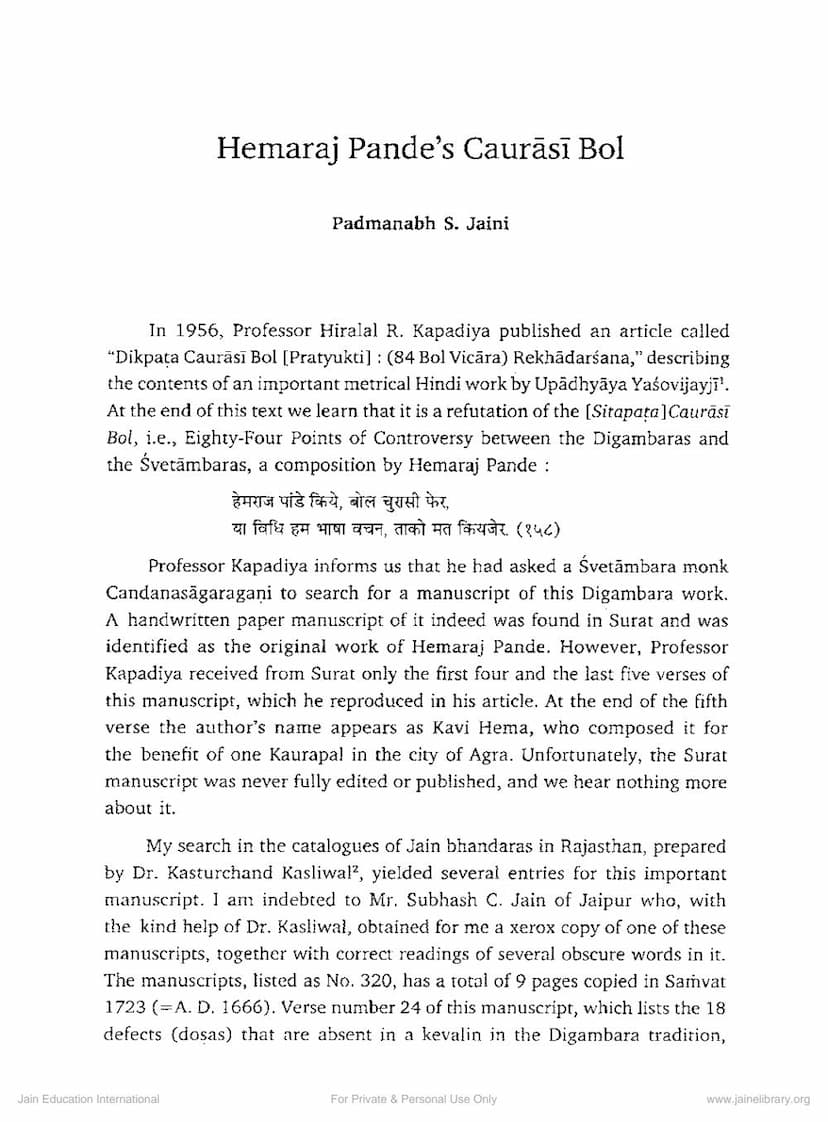
This document, authored by Padmanabh S. Jaini, discusses "Hemaraj Pandes Caurasi Bol" (Eighty-Four Points of Hemaraj Pande), a significant work in Jain polemics, particularly between the Digambara and Svetambara traditions.
Origin and Discovery of the Text:
- The text was first brought to scholarly attention by Professor Hiralal R. Kapadiya in an article describing Upadhyaya Yasovijayji's metrical Hindi work, "Dikpata Caurāsī Bol [Pratyukti]".
- Yasovijayji's work is identified as a refutation of Hemaraj Pande's "Sitapata Caurāsī Bol," which outlines 84 points of contention between the Digambaras and Svetambaras.
- Kapadiya sought a manuscript of Hemaraj Pande's work and found a handwritten paper manuscript in Surat. However, only the first four and last five verses were reproduced in his article. The manuscript was attributed to Kavi Hema and dedicated to Kaurapal in Agra. This Surat manuscript was never fully edited or published.
- The author, Padmanabh S. Jaini, also searched for manuscripts and, with the help of Dr. Kasturchand Kasliwal and Mr. Subhash C. Jain, obtained a copy of a manuscript dated Samvat 1723 (A.D. 1666).
- Crucially, verse 24 of this manuscript, listing 18 defects absent in a Digambara kevalin, is found quoted in Yasovijayji's work (verse 19). This confirms the identity of Hemaraj Pande's work as the basis for Yasovijayji's refutation.
Author and Context:
- Hemaraj Pande is identified as the author of the Hindi translation of Kundakunda's "Pravacanasāra," known as "Bālāvabodha," completed in Agra in Samvat 1709 (A.D. 1653).
- According to Dr. Kasturchand Kasliwal's biography, Hemaraj Pande wrote approximately 15 other works, including the Caurasi Bol, which was also completed in 1653.
- The Caurasi Bol itself is a composition of 91 verses in various Hindi meters, presenting 84 points. The number 84 is likely chosen to correspond with the 84 lakh (hundred thousand) varieties of yonis (life forms) in which a soul may be reborn.
Key Disputed Points (Pūrvapakṣa):
The Caurasi Bol attributes 84 specific beliefs to the Svetambaras, which the Digambara perspective (represented by Hemaraj Pande) refutes. The author lists a selection of these points:
Introduction (Verses 1-18): A brief account of the origin of the Svetambara sect during the time of Acarya Bhadrabahu.
Specific Disputed Beliefs:
- Kevalin's Sustenance: The Svetambaras believe a kevalin (omniscent being) partakes of food (kevali-bhukti) and needs to answer calls of nature (nihara). Digambaras strongly refute this, asserting a kevalin is free from such physical needs and impurities.
- Kevalin's Suffering: The Svetambaras suggest a kevalin can suffer from disease (roga) and attacks (upasarga). Digambaras deny this, stating a kevalin is pure and free from such afflictions.
- Jina's Education and Renunciation: The text questions the Svetambara view that a Jina (like Vardhamana) attends school even with avadhi-jñāna at birth, or that a Jina distributes gifts for an entire year before renunciation.
- Devotional Garments and First Sermon: It critiques the idea that Indra places a divine cloth (devadūsya) on a Jina's shoulder after renunciation, and that Mahavira preached his first sermon to gods in the absence of ganadharas.
- Mahavira's Conception and Birth: The text addresses the Svetambara belief that Mahavira's mother, Trishala, was not his natural mother, as he was conceived in the womb of Devānanda. It also discusses the miraculous transfer of the embryo by Harinegameśi, which Digambaras consider an anomaly (acherā).
- Twin Births and Marriages: The Caurasi Bol highlights Svetambara beliefs that the first Tirthankara, Adinath, was born with a twin sister and they became husband and wife, and that Adinath also married a widow. Digambaras reject these practices, particularly vidhavā-vivāha.
- Kevalins' Interactions: It questions the belief that one kevalin (like Bahubali) would respectfully greet another kevalin (like Rishabh).
- Gautama and Non-Jain Mendicants: The text criticizes the notion that Gañadhara Gautama paid respects to a non-Jain mendicant.
- Stri-mukti (Women's Liberation): A significant point of contention is the Svetambara belief that a woman can attain moksa in her current life. Digambaras generally deny this, believing women must be reborn as men to achieve liberation.
- Malli and Nemi as Women: The text challenges the Svetambara claim that Tirthankara Malli was a woman.
- Bhogabhumi and Karmabhumi Interactions: It discusses the Svetambara narrative of twins born in Hari varsa (a bhogabhumi) being brought to Bharata varsa (karmabhumi), having their bodies altered, ruling as king and queen in Mathura, eating meat, and being reborn in hell, which the Svetambaras consider a miracle. Digambaras view this as a violation of established rules for bhogabhumi beings.
- Muni's Requisites and Non-Violence: The Caurasi Bol disputes the Svetambara allowance for munis to keep multiple requisites (upakaranas) without breaking the vow of non-possession (aparigraha-mahavrata).
- Time as a Substance: It addresses the belief that time (kala) is not a separate substance (dravya).
- Ganadhara of Munisuvrata: The text questions the Svetambara assertion that the ganadhara of Tirthankara Munisuvrata was a horse.
- Meat Consumption by Munis: It refutes the idea that a muni can partake of meat under certain conditions.
- Alms Gathering and Residence: The Caurasi Bol criticizes the practice of munis begging from different houses and eating at their residence.
- Retaliation for Criticism: It challenges the notion that it is not a sin to beat someone who reviles one's doctrine.
- Bharata and Brahmi: The text addresses the story of Chakravarti Bharata wanting to make his sister Brahmi his wife.
- Bharata's Kevalajnana: It questions the belief that Bharata attained kevalajnana while still a householder.
- Draupadi's Polyandry: The text disputes the Svetambara view of Draupadi as a virtuous wife despite having five husbands.
- Disciple Attaining Kevalajnana: It critiques the story of a mendicant disciple attaining kevalajnana while carrying his teacher on his shoulders.
- Mahavira's Marriage and Son-in-law: The Caurasi Bol refutes the claims that Mahavira was married and that his son-in-law, Jamali, disputed with him.
- Kapila's Dance: It questions the Svetambara account of Kapila, a kevalin, dancing.
- Vasudeva's Wives: The text discusses the Svetambara claim that Vasudeva had seventy-two thousand wives.
- Bahubali's Height: It addresses the Svetambara description of Bahubali being taller than five bow-lengths.
- Sudra Alms Reception: It questions the allowance for a muni to receive food from a Sudra.
- Divine-Human Conjugal Relations: The text refutes the belief that heavenly beings (devas) can have conjugal relationships with human females.
- Sulasa's Sons: It challenges the story of Sulasa producing thirty-two sons from one fetus.
- First Vasudeva's Birth: The text addresses the claim that the first Vasudeva, Triprishtha, was born from a nanati (daughter-in-law).
- Mahavira's Travels and Preaching: It questions the belief that Mahavira visited non-Aryan regions and preached to mlecchas in the fourth kala.
- Fasting and Medicine: The text refutes the idea that there is no fault if a fasting person takes medicine.
- Cakravarti's Wives: It questions the Svetambara number of wives for a Chakravarti (sixty-four thousand).
- Nudity in Samavasarana: The text disputes the Svetambara view that the nudity of a Jina in the samavasarana is invisible.
- Nudity and Passions: It refutes the idea that nudity (digambara) causes passions.
- Yati's Stick and Ornaments: The text questions the allowance for a yati (ascetic) to keep a walking stick and ear ornaments.
- Marudevi's Moksa: It refutes the belief that Marudevi attained moksa while riding an elephant.
- Weak Muni's Food: The text questions the allowance for a weak muni to take food outside the fixed times.
- Householder's Kevalajnana: It refutes the idea that a householder can attain kevalajnana without formal renunciation.
- Candala's Moksa: The text questions the possibility of a person born as a candala becoming a muni and attaining moksa.
- Image Worship: It refutes the Svetambara acceptance of worshipping an ornamented image of a Jina.
- Moksa without Renunciation: The text challenges the possibility of moksa without giving up clothes and ornaments.
- Sun and Moon Greeting Mahavira: It refutes the belief that the sun and moon greeted Mahavira in their original forms.
- Digambara Fault List Modifications: The Caurasi Bol criticizes the Svetambara modification of the Digambara list of 18 defects, for instance, not considering a kevalin free from hunger and thirst.
- Atisaya Modifications: It disputes the Svetambara changes to the list of 34 atisayas (special attributes) of a Tirthankara.
- Camara's Actions: The text questions the Svetambara account of Camara, the king of vyantaras, conquering the king of Saudharma heaven and then seeking refuge at Mahavira's feet.
- Jina's Nirvana: It refutes the Svetambara belief that a Jina's body does not evaporate entirely upon nirvana.
- Offering Women to Munis: The text criticizes the idea of a householder offering a woman to a muni suffering from lust.
- Kevalin's Body Causing Harm: It refutes the belief that even a kevalin's body can cause destruction of beings.
- Gods Worshipping Jawbone: The text questions the Svetambara claim that gods worshipped Mahavira's jawbone after his death.
- Mahavira Shaking Meru: It refutes the idea that Mahavira shook Mount Meru with his toe at his birth ceremony.
- Number of Dreams: The text challenges the Svetambara view of only fourteen dreams foretelling a Tirthankara's birth (instead of sixteen).
- Gangadevi's Lifespan: It questions the claim that Gangadevi lived for fifty-five thousand years.
- Bharata's Attachment: The text refutes the idea that Chakravarti Bharata was unattached while ruling his kingdom.
- Number of Bhogabhumi: It questions the Svetambara number of bhogabhumi (ninety-six).
- Water from Leather Bag: The text disputes the allowance for taking water from a leather bag.
- Ghee from Leather Bag: It refutes the idea that eating food prepared with ghee from a leather bag is acceptable.
- Stale Food: The text questions the acceptance of eating stale food.
- Whole Fruit: It refutes the allowance of eating a whole fruit.
- Nilanjana's Dance: The text questions the belief that the goddess Nilanjana danced before Rishabha to induce renunciation.
- Vardhamana's Vow: It refutes the idea that Vardhamana resolved in his mother's womb not to renounce the world while his parents were alive.
- Bahubali's Twin Birth: It questions the specific reading about Bahubali being born as a twin.
- Nabhi and Marudevi's Twinship: The text refutes the idea that Nabhi and Marudevi were twins from whom Rishabha was born.
- Yugala's Impurities: It questions the belief that all yugalas (twin-born individuals) have impurities in their bodies.
- Salaka-purusa's Nihara: It refutes the idea that all salaka-purusas have nihara (need to answer calls of nature).
- Number of Indras: The text questions the Svetambara count of Indras (sixty-four, not one hundred).
- Abodes of Heaven: It refutes the Svetambara claim of only twelve abodes of heaven.
- Yadavas and Meat: The text questions the belief that the Yadavas, followers of Jinas, partook of meat.
- Beyond Manusottara Mountain: It refutes the idea that a human being can go beyond the Manusottara mountain.
- Kamadevas: The text questions the number of Kamadevas (twenty-four).
- Upper Heavens Age Limit: It questions the idea of no minimum age limit in the nine uppermost heavens.
Concluding Remarks:
- Hemaraj Pande concludes that these 84 points lead to rebirth in the 84 lakh yonis.
- He composed the work for Kaurapal in Agra.
- The author emphasizes that his work is based on truth and aims to bring happiness and understanding, not to create animosity.
- The article also briefly mentions Upadhyaya Meghavijaya's Sanskrit response to Hemaraj Pande's points.
- The text includes extensive notes and references to other scholarly works and original Jain texts, highlighting the depth of the debate.
In essence, "Hemaraj Pandes Caurasi Bol" is a critical Digambara critique of various Svetambara theological and historical assertions, covering a wide range of doctrines and narratives, and forms a crucial counter-argument to the Svetambara position as articulated by Upadhyaya Yasovijayji.