
Gyansarna 32 Ashtak No Sankshipta Sar
Added to library: September 1, 2025
Summary
Here's a comprehensive summary of the provided Jain text, "Gyansarna 32 Ashtak no Sankshipta Sar" by Punyavijay, based on the provided pages:
This text, "Gyansarna 32 Ashtak no Sankshipta Sar" (A Concise Essence of the Thirty-Two Ashtakas of Gyansar), by Punyavijay, is a compilation of philosophical and spiritual principles within Jainism, presented as thirty-two distinct points or "Ashtakas." Each point elucidates a key aspect of spiritual progress and the path to liberation.
Here's a breakdown of the key concepts covered:
Core Principles of Spiritual Attainment:
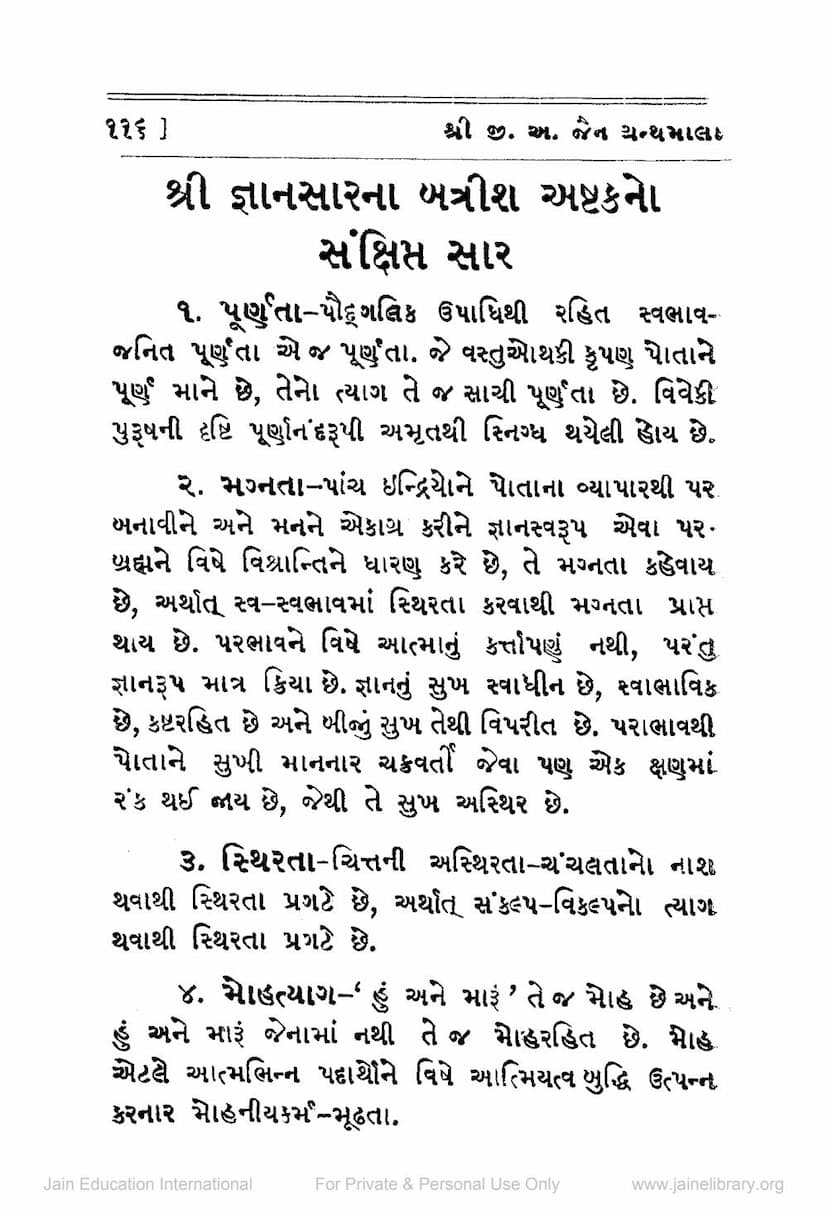
- Purnata (Perfection): True perfection is inherent and free from material attachments (pogalika upadhi). Renouncing things that lead to a sense of completeness through external possessions is true perfection. The wise are steeped in the nectar of perfect bliss.
- Magnata (Absorption/Stillness): This is achieved by turning the senses away from worldly pursuits and concentrating the mind on the supreme Brahman (knowledge-form). Stability within one's own true nature leads to this state. The soul is not the doer of external actions, but rather a being of knowledge. The bliss of knowledge is self-dependent, natural, and free from suffering, unlike worldly pleasures which are impermanent and lead to ruin, as exemplified by even a great emperor falling to destitution in an instant.
- Sthirta (Steadfastness): Steadfastness arises from the destruction of mental restlessness and fickleness, achieved by renouncing imaginations and alternations of thought.
- Mehtyag (Renunciation of Delusion): "Mine and myself" constitute delusion. Freedom from delusion means not having "mine" and "myself" attached. Delusion is the ignorance or bewilderment caused by identifying with things other than the soul, driven by the deluding karmas.
Qualities of the Enlightened and the Path:
- Gyani (The Knowledgeable): True knowledge is that which allows the soul to repeatedly merge with the supreme Brahman (Nirvana). Extensive scriptural study is not the primary goal. Knowledge tinged with attachment and aversion is ignorance. True knowledge is that which fosters self-nature and is the cause of self-realization. Other forms of knowledge that are attached to worldly things are blinding, as stated by the great souls.
- Sham (Tranquility): This is the ripening of knowledge that has transcended worldly objects and embraced its natural state. While a monk aiming for the highest state (like a Garuda) may engage in external practices, ultimate Siddhi is achieved through inner tranquility (sham).
- Indriyajay (Conquest of the Senses): Those wishing to escape the cycle of birth and death and attain liberation must strive to conquer their senses. The senses, like the ocean, are never satisfied, no matter how many rivers flow into them. Therefore, one should be content with the inner self.
- Tyag (Renunciation): This involves renouncing possessiveness (mamta) and embracing equanimity (samata). It also means renouncing the external sense of self and embracing the internal self. One should serve a true guru until their own soul's essence shines forth and guides them.
- Kriya (Action): Right action is that which follows the words of the omniscient Tirthankaras, as contained in the Jinagamas. This is called "Vachananushthan" (adherence to scripture).
- Atma-ne Viche Trit (Contentment in the Soul): Just as material substances satisfy material needs, the soul finds satisfaction in itself. Thus, reliance on external satisfaction is inappropriate for the knowledgeable. Yearning for material pleasures leads to a state worse than poison for the soul, while satisfaction derived from the taste of knowledge leads to a continuous stream of meditative nectar. The monk attains ultimate contentment by drinking the nectar of knowledge, enjoying the fruit of action, and savoring the tranquil betel leaf.
- Nirlep (Unattached): The soul is not the doer, instigator, or follower of the attributes of matter. The soul possessing this knowledge remains untainted. Even the soul engaged in action with devotion (tapas and scriptural knowledge) can be tainted, but one who possesses the knowledge of pure consciousness (bhava-gyan) and is free from action remains untainted. The eradication of gross faults comes from action, while the eradication of subtle faults comes from the power of knowledge. For partial or total vows, external action is paramount, whereas in higher stages of spiritual development (7th, 8th, 9th gunasthanas), knowledge is paramount.
- Nihspruh (Unaspiring/Detached): A monk driven by desire appears insignificant, like straw or cotton, and is prone to drowning in the ocean of existence. True detachment is great happiness, and attachment is great suffering.
- Maunva (Silence/Non-action in Matter): Not engaging with material objects is silence. Right faith (samyaktva) is silence, and silence is right faith. True faith is resting in the adoptable nature of the soul, as determined by pure faith. Silence is dwelling in the adopted nature, having distinguished the rejectable from the adoptable. Their unity is profound. The soul knows its own purity through itself. Therefore, the monk's state of knowledge unites knowledge, faith, and conduct (Ratnatrayi). The action of one who revels in self-knowledge is itself knowledge. Their silence is supreme. Just as wrong perception of a jewel prevents engagement with a pure jewel, knowledge and faith that do not lead to action in the pure self-nature or the eradication of impurities are not true knowledge or faith. As the entire action of a lamp is its light, so the actions of one whose thoughts are not different from their self-nature are knowledge-filled, and their silence is supreme.
- Vidyavan (Learned/Wise): Wisdom is the intellect directed towards truth. The soul is ever-changing. One who knows that external association (pudgalasang) is impermanent is wise. The inner soul, having bathed in the lake of equanimity and cleansed the impurities of karma, is supremely pure. The belief in "I" and "mine" is ignorance. The wise one discriminates between karma and soul, which are like milk and water, inextricably bound, and separates them based on their inert and conscious natures.
- Vivekvan (Discerning): One who knows the soul by the soul, for the soul, and through the soul is the doer. For such fortunate beings, the fever of discernment and non-discernment is not a cause for attachment. In the world, body, soul, speech, mind, consciousness, etc., are often perceived as undifferentiated due to lack of discernment. The rare discerning individual recognizes the distinct nature of the body and soul, which is hard to grasp even over many lifetimes. Most beings in the world are attached to the non-discrimination of body and soul.
- Madhyastha (Impartial/Neutral): A great monk is one whose mind is equipoised towards truth in their own doctrine and towards the futility of others' doctrines. They examine truth without partiality. A one-sided perspective cannot be neutral. All beings are subject to the effects of their own karma and experience its consequences. A neutral person remains equanimous towards them, free from attachment or aversion. External thoughts lead to attachment, while self-reflection leads to supreme happiness. The neutral person's mind, like a calf, follows the cow of reason, whereas the prejudiced person's mind is like a monkey pulling its tail.
- Nirbhayavan (Fearless): One becomes fearless by renouncing desires for happiness from objects other than the soul, such as the body, senses, etc., and by eradicating the seven types of fear related to attachment, delusion about happiness in sensual objects, and sinful activities like worldly pursuits. A great monk who has nothing to gain, nothing to lose, nothing to protect, nothing to give, and knows the knowable through knowledge, is fearless everywhere.
- Anatmasamsha (Self-Praise Avoidance): While reflecting on one's own virtues can be beneficial, self-praise leads to downfall in the ocean of existence. Therefore, the praise of one's own qualities should be abandoned. One should consider themselves to be extremely low compared to past virtuous souls. Great monks who have understood the pure states of all souls with equal vision do not experience exaltation due to impure states.
- Tattvadrishti (Vision of Truth): One whose vision is focused on form (rupa) gets deluded by form. One whose vision is formless (absolute truth) is absorbed in the formless soul. External vision is non-truth vision, and internal vision is truth vision. Only through the vision of truth is the true nature of things understood. External vision is associated with actions like smearing ashes, pulling hair, and wearing impure clothes, which are considered valuable by the observer. Truth vision, however, considers oneself significant through the dominion of knowledge.
- Sarva Samriddhivan (Possessor of All Abundance): When external vision is subdued, the great monk sees all abundance directly within the soul. The text quotes: "Seeing externally, the mind chases after the external; seeing internally, one attains imperishable wealth."
- Kavipaka Chintan (Contemplation of Karma's Fruition): Knowing that the entire world is subject to karma, the monk is neither elated by happiness nor afraid of suffering. Even the Shruta-kevalis (those who possess all scriptures) on the path of tranquility can be reborn in the cycle of existence due to the onset of inauspicious karmas. Understanding that all arising karmas will eventually cease, they maintain an equal vision and attain natural bliss. Beings whose karma has not reached its final stage of transformation, even while striving, forfeit their dharma. Monks in the final stage of karmic transformation, seeing the flaws of carelessness in others, significantly defile the dharma. Therefore, one should not allow room for carelessness. Carelessness and similar afflictions can cause even great beings like Shruta-kevalis to enter an infinite cycle of existence.
- Bhavudvega (Disgust for Worldly Existence): To cross the difficult mountain of worldly existence, the monk is as diligent in religious practice as someone holding a pot of oil while being chased by a king, or striving to achieve a difficult target. Fear's antidote is fear. When faced with afflictions (upasarga), the monk, fearing worldly existence, endures them correctly and remains fearless. A householder monk should be mindful of the fear of the world, but one who revels in their true nature has no room for worldly fear.
- Lokasannatyag (Renunciation of Worldly Notions): A monk who has attained the sixth stage of spiritual development and whose state is beyond the ordinary world does not become attached to worldly notions. Many follow worldly notions, but only a few go against them. Truly following the pure path is rare. The monk who renounces worldly notions and has destroyed envy, possessiveness, etc., lives happily. It is never justifiable for a wrong believer to abandon their true vows based on worldly acceptance. The text highlights the deep pain caused by the arrow of worldly notions striking the limb of one's true vows. What need is there for worldly conduct in a self-attested dharma? Many desire welfare in the world, but few attain it. Just as jewel merchants are few, so too are self-realizers.
- Shastra-rupi Drishti (Scriptural Vision): The wise person sees all states of being through the eyes of scripture. Those who are self-willed in scriptural knowledge do not benefit from pure and faultless practices like alms-giving. Such practices do not increase qualities like knowledge because their hearts are corrupted by falsehood and ignorance. The monk who follows the conduct prescribed in scriptures and for whom scripture is their only vision attains the supreme state.
- Parigrahatyag (Renunciation of Possessions): The power of possessions is so great that it can corrupt the minds of even monks. Do we not hear the distorted ramblings of those who wear the monastic guise, their words like open wounds, poisoned by the influence of the "graha" of possessions? Those yogis who have renounced sons and wives, are free from attachment, and are solely devoted to knowledge, are unaffected by the bonds of matter. Those who are indifferent, having renounced external and internal possessions like straw, are true monks. For one whose intellect is clouded by attachment, the entire world is a possession; for one free from attachment, the entire world is non-possession.
- Anubhav-Gyan (Experiential Knowledge): All scriptural endeavors are merely directional pointers; only experience leads one across the ocean of existence. Even hundreds of scriptural arguments do not lead to knowledge of the supra-sensory Brahman without pure experience. This is stated by the sages. Without the pure state free from afflictions like hunger, thirst, grief, delusion, desire, passions, etc., one cannot see through the three forms of vision (material, scriptural, or mental contemplation). Experiential knowledge is attained only by the absence of mental fluctuations (absence of false belief, ignorance, and delusion). Through experience, one realizes the self-aware Brahman.
- Yogavan (One Engaged in Yoga): All conduct that unites the soul with liberation is called yoga. Its variations are related to place, form, meaning, representation, and supportlessness. The first two are yogas of action, and the latter three are yogas of knowledge. Each of these has four aspects: desire, activity, stability, and achievement. Thus, there are twenty types of yoga. In turn, these have four variations based on affection, devotion, speech, and detached practice, totaling eighty types of yoga. By attaining the highest yoga (Shaileshi Yoga), one gradually achieves liberation. The text states that those who are free from the influences of place, etc., are gravely flawed if they teach scriptures based on unsound principles, as stated by the ancient acharyas.
- Niyag (Dedication/Commitment): A monk who has dedicated their soul to the nature of consciousness, renounced perversions, follows the pure conduct of a sage, and performs eightfold devotion to the supreme being, understands this to be their duty. Such enlightened beings are not tainted by sin.
- Puja (Worship): "Bhavapuja" (inner worship) is performed by worshipping the pure soul, the deity, with the ninefold celibacy, bathed in the water of compassion, adorned with the clean garment of contentment, marked with the tilak of discernment, and whose heart is purified by contemplation, mixed with the saffron-scented sandalwood paste of devotion and faith. For householders, "dravyapuja" (external worship) with distinction is appropriate, while for monks, "bhavapuja" (unqualified inner worship) is fitting.
- Dhyan (Meditation): A monk whose mind is singular, where the meditator, the object of meditation, and meditation itself become one, experiences no suffering. The inner self is the meditator, the supreme soul is the object, and focused intellect is meditation. The unification of these three is oneness. Just as a reflection appears on a gem when mental fluctuations cease, so too does the supreme soul manifest in the pure inner self. The fruits of this threefold meditation reduce the need for external austeries. Austerities lacking this threefold meditative fruit are not rare even for the non-evolved.
- Tap (Austerity): Knowledge that burns away karmas is itself austerity. Inner austerity is desirable, and external austerity enhances it. The ignorant follow the flow of the world with the mentality of "I will be with the people." The wise, however, swim against the current, engaging in austere practices like fasting for long periods, driven by religious conviction. This is why even the four types of gyanis (knowledgeable beings) undertake austerity, knowing they will achieve liberation in this very life. For those detached from the world and seeking self-knowledge, hardships like heat and cold are not unbearable, much like the pursuit of wealth. True austerity is that which is free from wrong contemplation, without greed, and where the senses are not destroyed.
- Sarvanaya Ashray (Reliance on All Perspectives): One who is absorbed in the quality of conduct possesses all perspectives (nayas). The wise who are equipoised and rely on all perspectives savor self-happiness. The impartiality of those who understand all perspectives benefits the world. The deluded who are stuck to a single perspective suffer from pride and strife. Salutations to those who have illuminated the perspective that relies on all nayas for the welfare of the world and whose minds have assimilated it!
Illustrative Example (Vaidyas/Doctors):
The text concludes with an analogy comparing different doctors to different philosophical viewpoints. The true Jain-Vitrag (non-attached) vision is like a complete and truthful doctor who knows all diseases, their causes, and cures. Other "fake" doctors represent incorrect doctrines, offering superficial relief or even worsening the disease by incorporating worldly desires and false beliefs. The true path is costly and may not initially appeal to those attached to worldly pleasures, but it ultimately leads to true health and liberation. The Vitrag vision is likened to a "trividya" (threefold doctor) that cures the disease of false belief, prevents the relapse of illness, and strengthens the perfect health of pure consciousness.
The core message emphasizes the importance of self-reflection and understanding the distinction between the body and the soul as the primary duty for spiritual progress.