
Grammatical Functions Of Upapadas
Added to library: September 1, 2025
Summary
Here is a comprehensive summary of the Jain text "Grammatical Functions Of Upapadas" by V. M. Bhatt, based on the provided pages:
The book "Grammatical Functions Of Upapadas" by V. M. Bhatt explores the semantic and syntactic roles of specific grammatical particles in Sanskrit, which are traditionally known as upapadas. These include terms like saha (with), vina (without), ṛte (except), and namaḥ (salutation to).
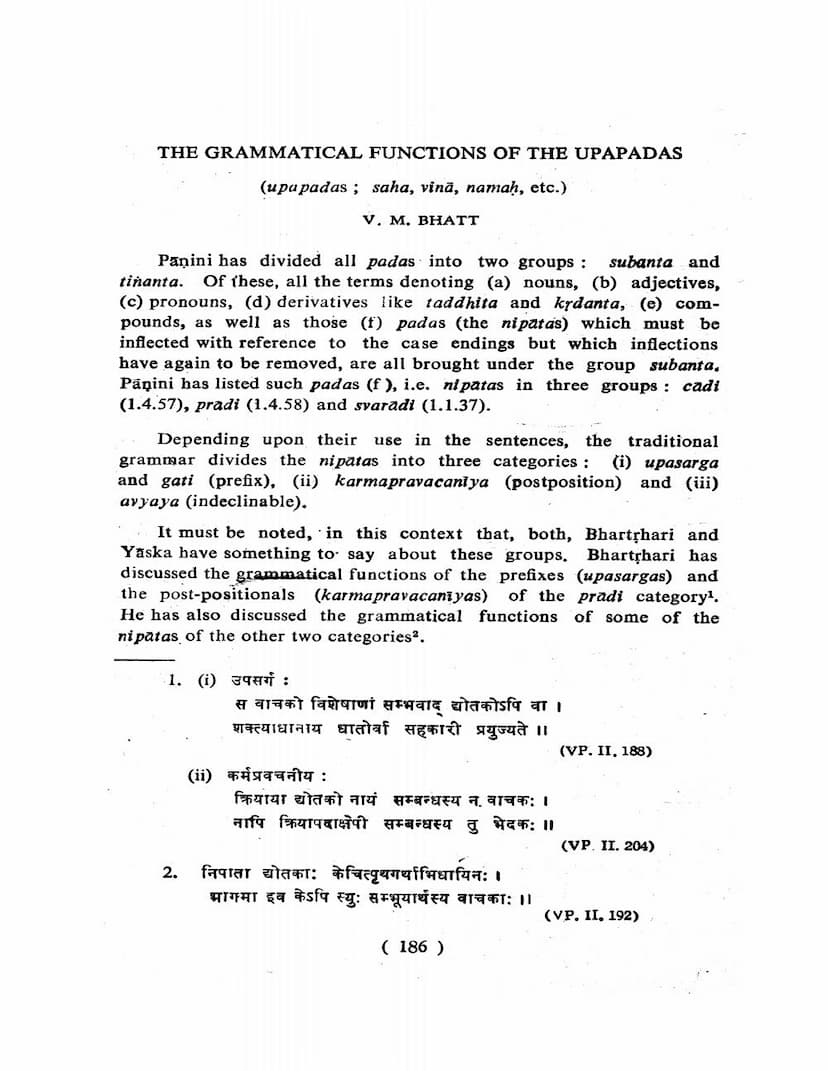
The author begins by outlining Panini's classification of Sanskrit words (pada) into subanta (noun stems) and tinanta (verb stems). Subantas encompass a broad category including nouns, adjectives, pronouns, derivatives, compounds, and certain indeclinables (nipatas) that require inflection but whose inflections are subsequently removed. Panini categorizes these nipatas into three groups: cadi, pradi, and svaradi.
Traditional grammar further divides these nipatas into three functional categories: upasarga and gati (prefixes), karmapravacaniya (postpositions), and avyaya (indeclinables). The text notes that scholars like Bhartṛhari and Yāska have discussed the functions of these categories, particularly prefixes and post-positionals.
In contrast, Yāska classifies nipatas semantically into three groups: those denoting similes (upamārthaka), conjunctions (karmopasaṁgrahārthaka), and those that are mere gap-fillers (padaparāpārthaka).
The core of the book addresses a perceived gap in existing scholarship: the grammatical functions of certain upapadas that govern case inflections, such as saha, vina, ṛte, and namaḥ. While Panini provides syntactic rules for these, the author argues that their specific grammatical functions have not been thoroughly explored.
Bhatt posits that these upapadas play a crucial role in indicating the context or situation surrounding an action, providing nuances beyond the core participants and their relationships. He illustrates this with a sentence analysis, showing how phrases like Lakṣmaṇena saha (with Lakṣmaṇa) function similarly to adjectives or possessive phrases, adding descriptive information to the main participant (Rama) without detracting from their prominence.
Key functions of specific upapadas explored:
- Saha (with): The author argues that saha primarily denotes accompaniment. Syntactically, its use, as seen in Panini's aphorism sahāyukte 'pradhāne (2.3.19), establishes a hierarchical relationship between participants in an action. The accompanying individual is presented as secondary to the main doer, thus reinforcing the focus on the primary actor rather than "defocussing" them.
- Vina (without): Vina exhibits similar behavior to saha. Its use can imply that an expected accompaniment did not occur, adding a layer of implication to the statement.
- Sati-saptami (adverbial use of the seventh case, like in udayati savitari - when the sun rises): These constructions, designated as upapadas by Patañjali, contextualize the action itself, similar to how saha and vina add context to the doer. For instance, goṣu duhyamānasu (while the cows are being milked) provides a temporal and situational context for another event.
- Namaḥ, svasti, svāhā, svadhā, alam, and vaṣaṭ: These upapadas are noted for their ability to function as verbs in the absence of a finite verb form (tiñanta pada). In sentences like "Gaṇeśāya namaḥ" (Salutations to Ganesha), namaḥ performs the action of saluting.
In conclusion, Bhatt argues for moving beyond the traditional view that limits upapada analysis to syntactic rules. He asserts that these particles have distinct semantic contributions: saha and vina enrich statements about the doer, sati-saptami constructs add context to the action itself, and particles like namaḥ can directly function as verbs. The author highlights the supportive work of scholars like Nāgeśa, who recognized the concept of "action" (kriyātva) within some upapadas.