
German Research In Nepal
Added to library: September 1, 2025
Summary
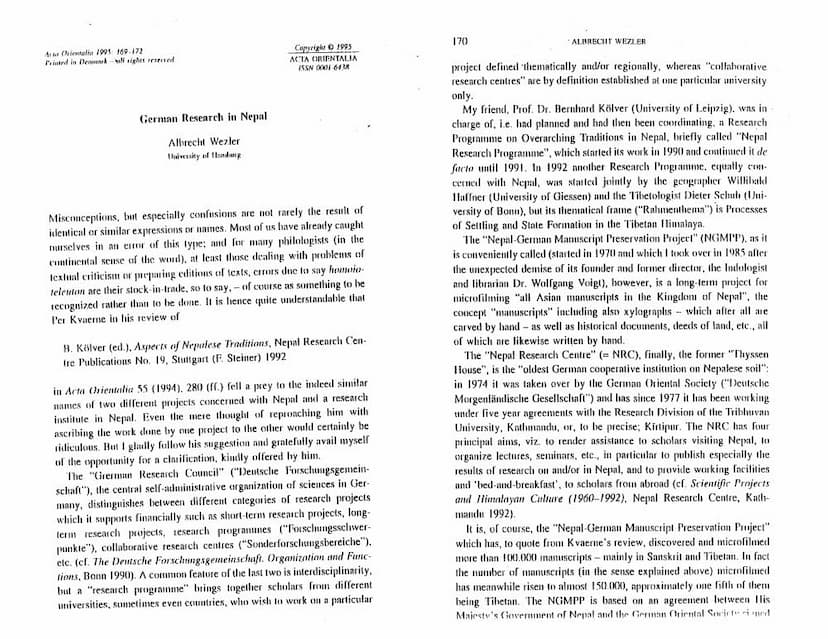
This document, "German Research in Nepal" by Albrecht Wezler, serves to clarify the distinctions between various German research initiatives and institutions in Nepal, particularly addressing a potential confusion noted by Per Kvaerne in a review.
The author begins by highlighting how similar names can lead to misunderstandings, a common pitfall for philologists engaged in textual criticism. He then proceeds to differentiate several key German projects and institutions related to Nepal:
-
German Research Council (Deutsche Forschungsgemeinschaft): This is a central German organization that financially supports various research projects, categorizing them into short-term projects, long-term projects, research programs ("Forschungsschwerpunkte"), and collaborative research centers ("Sonderforschungsbereiche"). Research programs are characterized by bringing together scholars from different universities, sometimes across countries, to work on thematic or regional projects. Collaborative research centers, on the other hand, are established at a single university.
-
Nepal Research Programme: This was a thematic and/or regional research program coordinated by Prof. Dr. Bernhard Kölver (University of Leipzig), which began in 1990 and concluded its active work in 1991.
-
Another Research Programme (starting 1992): This program, also concerning Nepal, was a joint effort by geographer Willibald Haffner (University of Giessen) and Tibetologist Dieter Schuh (University of Bonn). Its thematic focus was "Processes of Settlement and State Formation in the Tibetan Himalaya."
-
Nepal-German Manuscript Preservation Project (NGMPP): This is a long-term project that began in 1970 and was taken over by the author in 1985 after the death of its founder, Dr. Wolfgang Voigt. The project's core mission is to microfilm "Wall Asian manuscripts in the Kingdom of Nepal," a broad definition that includes xylographs and historical documents like land deeds, all of which are handwritten. The NGMPP has been extended multiple times and is based on an agreement between the Nepalese government and the German Oriental Society. It has been instrumental in discovering and microfilming a vast number of manuscripts, primarily in Sanskrit and Tibetan, with the current count exceeding 150,000, of which about one-fifth are Tibetan. The microfilming work often involves arduous expeditions to remote locations in Nepal to access manuscripts preserved in villages and monasteries.
-
Nepal Research Centre (NRC): Formerly known as "Thyssen House," the NRC is described as the "oldest German cooperative institution on Nepalese soil." It was taken over by the German Oriental Society in 1974 and has been operating under five-year agreements with Tribhuvan University in Kathmandu since 1977. The NRC's primary aims include assisting visiting scholars, organizing lectures and seminars, publishing research findings on Nepal, and providing working facilities and accommodation for foreign scholars.
The author emphasizes that the NGMPP is the project responsible for microfilming the substantial number of manuscripts mentioned by Kvaerne. He clarifies that publications based on the material provided by the NGMPP have been appearing since its early years and their number has steadily increased. The project has increasingly focused on Tibetan texts, with a significant portion being previously unrecorded.
The document also details the operational aspects of the NGMPP:
- Negative master copies and one positive copy of microfilms are stored in Nepal at the Microsilin House.
- A second positive copy, owned by the German Oriental Society, is permanently transferred to the State Library in Berlin.
- A section of the NGMPP was established at the Institute for History and Culture of India and Tibet at the University of Hamburg in 1987 to compile a computer-aided "Preliminary List of Manuscripts and Xylographs Microfilmed by the NGMPP." This list is based on index cards, with descriptive catalogs to follow after the microfilming work is complete.
- Reports on the NGMPP's activities have been published in journals like ZDMG and are also included in publications by the German Oriental Society. The author is working on a comprehensive English report but is delaying its publication until 2001 to include a longer duration of the project's work.
Finally, the author provides contact information for inquiries about individual titles and manuscripts, directing them to the State Library in Berlin or the Institute for History and Culture of India and Tibet in Hamburg, as well as to the National Archives and the Nepal Research Centre in Kathmandu.