
Gaye Ja Geet Apan Ke
Added to library: September 1, 2025
Summary
Here's a comprehensive summary of the Jain text "Gaye Ja Geet Apan Ke" (Sing Your Own Song) by Moolchand Jain, based on the provided pages:
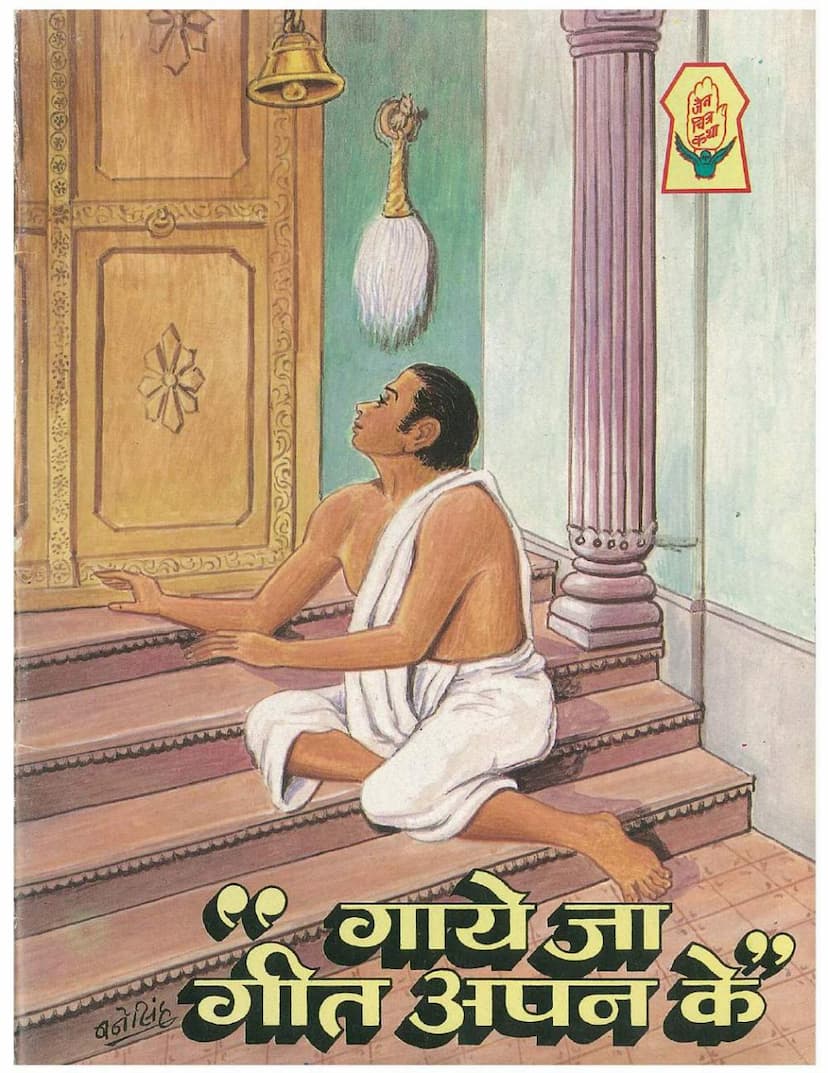
The book "Gaye Ja Geet Apan Ke" (Sing Your Own Song) is a Jain text authored by Moolchand Jain and published by Acharya Dharmshrut Granthmala. It's presented as a collection of teachings and illustrative stories designed to guide individuals toward spiritual understanding and liberation from suffering. The underlying theme emphasizes self-realization, detachment, and the inherent purity of the soul.
The book is structured as a series of short narratives and dialogues that convey Jain philosophical principles.
Key Themes and Concepts Illustrated:
-
The Illusion of Ownership and Attachment (Moh): The initial stories highlight how humans mistakenly identify themselves with external possessions like wealth, family, body, and even achievements.
- Story 1 (Pages 3-5): Seth Prakash Chand is distressed after losing his factory and son. His friend, Dhaniram the jeweler, uses the analogy of gold purity. Just as Dhaniram can distinguish pure gold from impurities by weighing, the friend advises Prakash Chand to use a sharp "inner vision" to see that his true self is separate from his possessions and experiences. He realizes that the body, family, wealth, and even actions are not the "self."
- Story 2 (Pages 17-21): Seth Dharmdas and his wife are overjoyed when they have a son, believing he will bring them happiness and security. However, their son falls ill and dies at a young age. In his grief, Dharmdas is enlightened by his dying son who explains that no one truly "owns" anyone and that suffering arises from attachment and the belief that others cause our happiness or sorrow. The son quotes "आत्मकीर्तन" (Self-Chanting) to explain that peace comes from understanding one's true, independent nature.
-
Self-Reliance and Inner Strength: The book repeatedly emphasizes that true happiness and peace come from within, not from external sources.
- Story 1 (Pages 5-6): The concept of "दृष्टि की करामात" (the wonder of vision) is introduced. By seeing things clearly, one can be freed from suffering. The advice is to look only at the "I" (the self) and realize that material things are not the self. Even the body is temporary, and the soul (the "I") is distinct from it.
- Story 1 (Page 8): The text reiterates the idea of being "स्वतंत्र" (independent), "निश्चल" (unwavering), and "निष्काम" (desireless), echoing the teachings of Munishri Varni. One should be a "ज्ञाता दृष्टा" (knower, seer) and observe events like items in a museum.
-
The Nature of the Self (Soul): The soul is portrayed as inherently pure, conscious, and blissful, unaffected by external circumstances.
- Story 1 (Page 8): The soul's nature is described as "चैतन्य स्वरूप" (conscious form) that remains unchanged even after wandering through many lives and experiencing various emotions. It is also "निष्काम" (desireless) and "चैतन्य स्वभावी" (of conscious nature).
- Story 3 (Pages 14-16): A beggar seeks happiness from a sage. The sage directs him to a fish in the river. The fish explains that the beggar is like someone living in the ocean of happiness but asking for water. The beggar is filled with "अनंत ज्ञान, अनंत दर्शन व अनंत शक्ति" (infinite knowledge, infinite vision, and infinite power), similar to a liberated soul (Siddha Bhagavan). He has lost his true knowledge by seeking happiness from external things. The solution is to "छोड़ दे भिरवारीपन, अपने अन्तर में झांक" (give up begging, look within yourself).
-
The Path to Liberation: Liberation (Moksha) is achieved through self-knowledge, detachment, and the eradication of negative emotions like attachment (raag), aversion (dwesh), and delusion (moh).
- Story 2 (Pages 10-11): A devotee seeks the "darshan" (vision) of God, expecting to receive peace and happiness. The divine voice redirects him, saying, "मेरे नहीं अपने दर्शन कर, अपने को पहिचान, अपने को निरख" (Don't see me, see yourself, recognize yourself, observe yourself). God explains that the devotee is already God. The difference lies in the presence of attachment (raag) and the effort to remove it. The path to becoming divine involves understanding one's true nature and diligently removing inner impurities.
- Story 2 (Page 12): The devotee understands that he can become like God by deeply understanding and having unwavering faith in these teachings, and by following the path indicated. He resolves to take Nirgranth (ascetic) initiation, to overcome attachment, aversion, and delusion, and become like God. The story concludes with him taking Digambar (clothed in space, i.e., ascetically) initiation and eventually becoming a Bhagavan (God).
-
The Unity of All Names (Syncretism of Deities): The book explores the idea that different deities in various religions represent the same underlying, pure soul.
- Story 5 (Pages 22-25): Followers of different religions (Buddhism, Vaishnavism, Shaivism) argue about whose deity is supreme. A Mahatma intervenes and uses the analogy of wheat and gold. He shows them that they are all looking at the same thing (wheat) but calling it by different names (wheat, gold) because they have different desires. He then explains that names like Jin (conqueror of passions), Shiv (auspicious), Ishwar (Lord), Brahma, Ram, Vishnu, Buddha, and Hari all refer to the same pure, soul-state. The ultimate goal is to reach this "निज धाम" (own abode) by shedding attachment to external objects and desires, thereby becoming God oneself.
-
Observing Events with Equanimity: The book advocates for maintaining equanimity in the face of both loss and gain, recognizing that external events are subject to natural laws.
- Story 6 (Pages 26-31): Kailash, distressed by business losses, a sick body, and the death of his son, seeks guidance from a Muni. The Muni directs him to Seth Shantilal, a wealthy businessman. Kailash observes Shantilal's calm reaction to a loss of ten lakh rupees (shipwreck) and his equal composure during a profit of fifteen lakh rupees. Shantilal explains that nothing truly happens, and events unfold due to the object's own nature and contributing causes. He clarifies that neither gain nor loss creates happiness or sorrow; it's our belief that we are the doer and our attachment to favorable or unfavorable outcomes that causes suffering. By realizing one's detachment from external causes and effects and shedding attachments (raag, dwesh, moh), one can attain true peace.
Core Message:
"Gaye Ja Geet Apan Ke" fundamentally teaches that true happiness and peace are not found in external possessions, relationships, or worldly achievements, but within one's own pure soul. By understanding the transient nature of all external things and experiences, detaching oneself from them, and focusing on the inherent, unchanging nature of the soul, one can overcome suffering and attain liberation. The book uses simple stories and analogies to make these profound Jain philosophical concepts accessible, encouraging readers to "sing their own song" of self-realization. The book also highlights the importance of moral conduct and the cultivation of virtues for personal and societal upliftment.