
Funf Gelubde Und Sechs Avashyakas
Added to library: September 1, 2025
Summary
Here's a comprehensive summary of the provided Jain text, "Funf Gelübde Und Sechs Avashyakas" by Klaus Bruhn, focusing on the core ethical principles discussed:
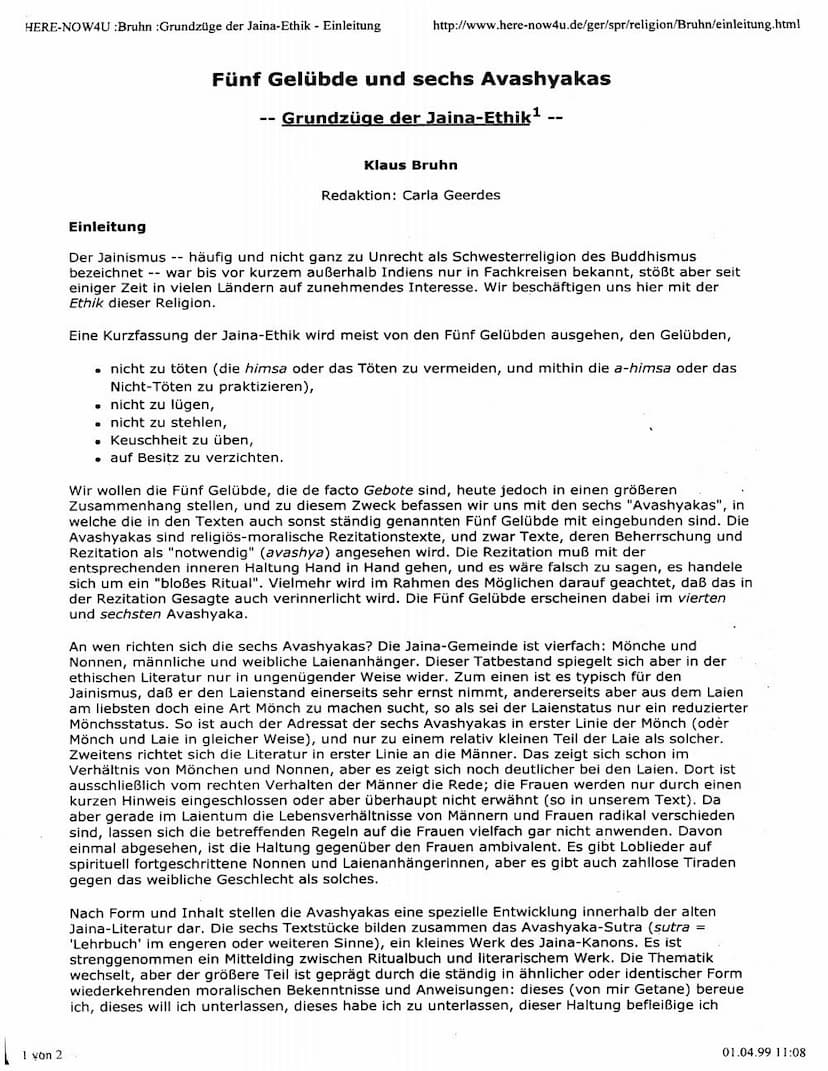
This document, "Grundzüge der Jaina-Ethik" (Fundamentals of Jain Ethics), by Klaus Bruhn, delves into the ethical framework of Jainism, with a particular focus on the Five Vows (Fünf Gelübde) and the Six Avashyakas.
Introduction to Jain Ethics:
- Jainism is presented as a sister religion to Buddhism, gaining increasing international interest.
- A concise summary of Jain ethics typically starts with the Five Vows:
- Ahimsa (Non-violence/Non-killing): To avoid harming living beings.
- Satya (Truthfulness): To avoid lying.
- Asteya (Non-stealing): To avoid taking what is not freely given.
- Brahmacharya (Chastity/Celibacy): To practice restraint in sensual pleasures.
- Aparigraha (Non-possession/Non-attachment): To renounce possessions and desires.
The Six Avashyakas:
- The author emphasizes that the Five Vows are not isolated commandments but are integrated within a larger context of the six "Avashyakas".
- Avashyakas are described as religiously and morally significant recitation texts, considered "necessary" (avashya) for followers.
- Crucially, the recitation of these texts must be accompanied by the appropriate inner attitude; they are not mere rituals but aim for internalization of the teachings.
- The Five Vows appear specifically within the fourth and sixth Avashyakas.
Target Audience and Gender Bias:
- The Jain community is fourfold (monks, nuns, male lay followers, female lay followers). However, the ethical literature, including the Avashyakas, primarily addresses monks and, to a lesser extent, male lay followers.
- While Jainism takes lay followers seriously, it often aims to make them like monks.
- The literature exhibits a significant gender bias, focusing primarily on the behavior of men. Women are often excluded or only briefly mentioned, despite significant differences in life circumstances that would require distinct ethical considerations. There's an ambivalent attitude towards women, with praise for some but also numerous criticisms of women as a group.
Nature and Development of the Avashyakas:
- The Avashyakas represent a specific development within early Jain literature.
- The six texts collectively form the Avashyaka-Sutra, a small work within the Jain canon, acting as a bridge between a ritual book and a literary work.
- The content varies but largely consists of recurring moral affirmations and instructions, such as: "I regret this (action)," "I will refrain from this," "I must refrain from this," "I will dedicate myself to this attitude," and "I venerate the Tirthankaras."
- This development continued in numerous later works of a similar nature.
Detailed Breakdown of the First Three Avashyakas:
-
Avashyaka I: Samayika (Equanimity/Meditation):
- This is a moral confession.
- It's based on an ancient Jain formula, slightly expanded.
- Key themes include confession and repentance, although Jainism isn't primarily presented as a religion of repentance.
- The text involves a commitment to equanimity and renouncing all blameworthy actions (in thought, word, and deed), both personally and by condoning them in others. It concludes with self-reproach for any transgressions.
-
Avashyaka II: Caturvimshatistava (Praise of the Twenty-Four Tirthankaras):
- This is a hymn of praise to the 24 Tirthankaras, the foundational spiritual guides of Jainism.
- Except for the last two, the Tirthankaras belong to a legendary past, with the most recent being Mahavira (contemporary of Buddha).
- The text reflects a tendency towards the "deification" of the Tirthankaras, although their role is primarily as spiritual guides rather than intervening deities. There's a slight resemblance to Hindu Bhakti (devotion).
- It lists the names of the 24 Tirthankaras and expresses the desire for their favor, health, knowledge, and supreme devotion. It concludes with a wish for the Tirthankaras to show the path to liberation.
-
Avashyaka III: Vandana (Salutation/Respect):
- This Avashyaka is described as a combination of ritual of repentance and encounter ritual.
- Traditionally, a disciple approaches their teacher to express repentance for any possible or actual faults during the day.
- The text involves formulaic speech between the student and teacher, including requests for permission to approach and expressions of respect and humility.
- It emphasizes the importance of asking for forgiveness from the teacher for daily failings.
Summary of Avashyakas IV-VI (as presented in the text):
-
Avashyaka IV: Pratikramana (Retrospection/Repentance):
- This Avashyaka involves multiple sections, each containing a confession of repentance.
- Each section catalogues various forms of monastic misconduct, including specific references to harming living beings in detail (e.g., stepping on seeds, plants, insects, etc.).
- It highlights the early Jain mentality of extreme caution regarding all forms of life, seeing sentient beings in every element. This caution evolved but the core principles remained.
- The text distinguishes between different categories of living beings based on the number of senses.
- It elaborates on various transgressions related to Asamyama (lack of self-control), worldly attachments, passions (anger, pride, deceit, greed), the Great Vows, categories of living beings, fears, pride, and rules for monks.
- The Great Vows (Mahavratas) are for monks, while the Lesser Vows (Anuvratas) are for lay followers (discussed in Avashyaka VI).
- The concept of "elemental beings" (tiny creatures forming the elements) is explained, emphasizing the strictness of Ahimsa for monks.
- The section concludes with a powerful statement of universal forgiveness and love for all beings.
-
Avashyaka V: Kayotsarga (Abandonment of the Body/Self-Mortality):
- This is described as the most difficult exercise for a Jain monk.
- It involves remaining motionless (primarily standing) for an extended period to meditate.
- The depictions of Tirthankaras in art often show this posture.
- "Meditating" in Jainism means engaging with the teachings and internalizing what is essential.
- The literary composition of Avashyaka V contains the Kayotsarga exercise but also repeats and elaborates on previous texts.
- The monk aims to destroy bad karma through this practice, focusing on stillness while allowing involuntary bodily functions.
- The exercise is a discipline of the body and mind, often performed as part of the larger ritual.
-
Avashyaka VI: Pratyakhyana (Renunciation/Vow):
- This chapter focuses on the twelvefold ethics for laypeople, beginning with the Five Lesser Vows (Anuvratas).
- It also includes rules for fasting.
- The Lesser Vows are less strict than the Great Vows for monks. Laypeople renounce "gross" or serious transgressions, unlike monks who renounce all possible violations.
- The Five Lesser Vows are detailed with their respective transgressions:
- Ahimsa (Non-killing): Laypeople renounce "gross" killing, with transgressions like binding, beating, cutting, overloading, and depriving of food and water. Ahimsa for laypeople was particularly related to dietary restrictions.
- Satya (Truthfulness): Renouncing "gross" untruthful speech, including false accusations, backbiting, revealing confidences, and forgery. It emphasizes the scrutiny of human communication and avoiding unfriendly speech.
- Asteya (Non-stealing): Renouncing "gross" appropriation of un-given things, with transgressions like accepting stolen goods, employing thieves, smuggling, using false measures, and trading in counterfeit goods.
- Brahmacharya (Chastity): Renouncing contact with other women and being content with one's wife, with transgressions involving various forms of improper relations with women and excessive lust.
- Aparigraha (Non-possession): Renouncing unlimited possessions and limiting desires, with transgressions related to excessive ownership of land, money, people, livestock, and metal objects.
- An additional ethical obligation for laypeople is the giving of alms to monks, essential for their sustenance due to the strictness of Ahimsa.
- The text mentions the Anuvrat Movement initiated by Acharya Tulsi, which aimed to bring these vows into modern society, emphasizing self-restraint.
Erlösung (Salvation/Liberation):
- Jainism is a religion of salvation.
- The entire doctrinal system is tied to the concept of transmigration of souls (reincarnation).
- The cycle of rebirth is considered painful and must be ended. The cosmic law governing this is Karma, where every action leads to a consequence, dictating future rebirths.
- Salvation (Moksha) is achieved by shedding all accumulated Karma.
- Jain salvation is described concretely as dwelling in a realm of liberated souls at the apex of the cosmos, unlike the more negative descriptions in Buddhism (Nirvana).
- Jains believe individuals are responsible for their own liberation, relying solely on their efforts. While gods exist, they do not intervene in human life or offer salvation. The Tirthankaras, though not gods, are highly revered and fill a vacuum.
- The Jain cosmos is triply divided: heavens (gods), earthly realms (various categories of beings), and lower realms (hells).
- A point of contention within Jainism is the denial of the possibility of immediate liberation for women in some traditions.
- The text notes that the exact mechanism of Karma removal and a fully coordinated presentation of ethics and monastic rules are not always clear.
- Jain ethics, while generally plausible, include elements like alms-giving, repentance, and ritual that are not always seamlessly integrated with the core philosophy of self-effort. Alms-giving is an altruistic element, while repentance and ritual's emphasis is noted as somewhat distinct from the emphasis on asceticism.
Resumee (Summary/Conclusion):
- The document questions whether Jain Ahimsa can be a message for the modern world, noting its origins in ancient Indian mentality and the difficulty in applying it universally.
- Jainism, despite its small percentage of the global population, has provided its followers with social and political security and normal life conditions through its moral discipline and merchant culture.
- The significant emphasis on lay ethics is a key feature, integrating lay followers through specific rules like the Anuvratas and striving to elevate the lay status.
- The Jain emphasis on material restrictions and a relatively puritanical lifestyle is highlighted as a relevant counterpoint to modern material aspirations and the potential for increased crime.
- The author concludes that the entire Jain ethical system, in its complexity, offers a valuable subject for study, providing a unique perspective on Indian ethics.
Postskript (Postscript):
- The vastness and depth of Jain literature (ethical, philosophical, grammatical, legendary, etc.) are emphasized, spanning from pre-Christian times to the modern era.
- Jain art, particularly depictions of the Tirthankaras (standing or seated), is also mentioned as a rich area of study.
- The document concludes by stating that Jainism, in its intricate theoretical and practical system and its contribution to Indian culture, is a self-contained world, a "religious-historical and cultural microcosm." Its reality is complex and less accommodating to our usual ways of thinking than abstract theories might suggest.