
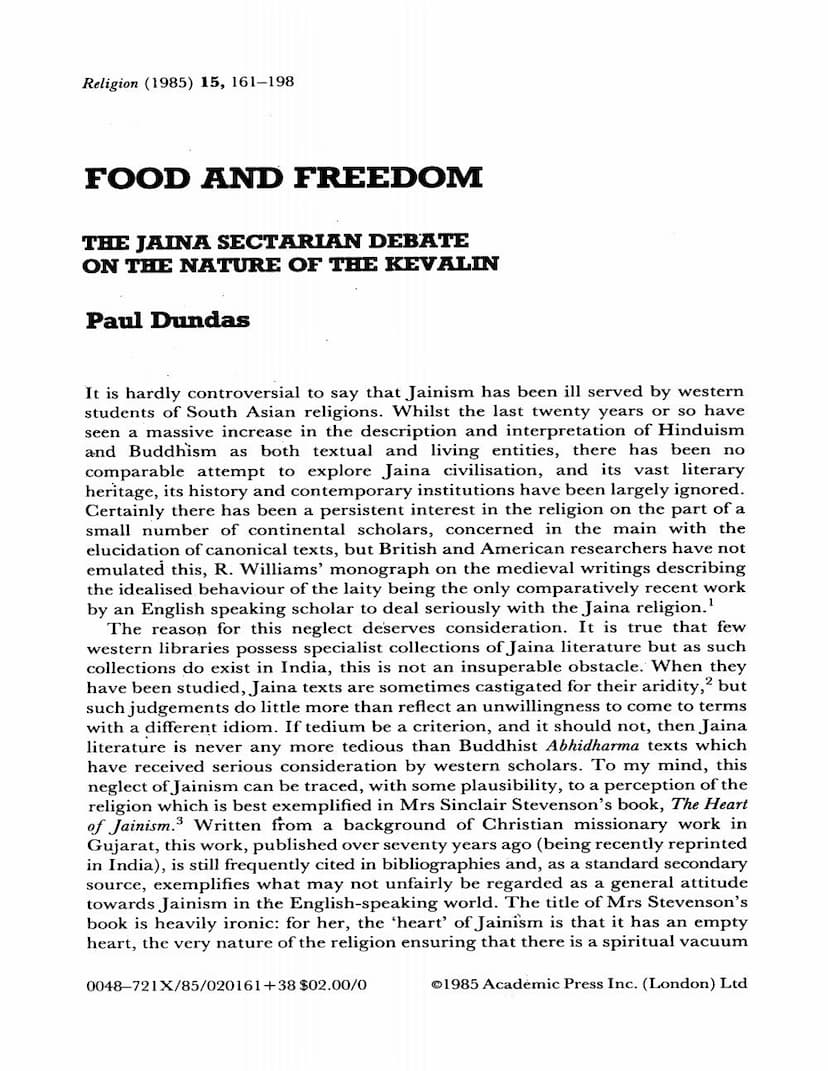
Food And Freedom
Added to library: September 1, 2025
Summary
This paper, "Food and Freedom" by Paul Dundas, delves into a significant sectarian debate within Jainism: whether the kevalin, the enlightened and perfected individual, experiences hunger and thus needs to consume food. The debate primarily involved the two major Jain divisions, the Śvetāmbaras (White-clad) and the Digambaras (Space-clad), who present starkly contrasting views on this matter.
Dundas begins by lamenting the general neglect of Jainism in Western academia, contrasting it with the extensive scholarship on Hinduism and Buddhism. He attributes this neglect partly to a perception of Jainism as austere and unappealing, a stereotype he believes is perpetuated by early Western studies. He argues that understanding Jainism's historical influence, particularly in South India, is crucial for a complete picture of ancient and medieval Indian civilization.
The core of the paper lies in exploring the historical and doctrinal reasons behind the Śvetāmbara-Digambara split, which the author suggests was rooted not just in theological interpretations but in the rejection of the canon produced at the Council of Valabhi by the Digambaras. The debate over the kevalin's food consumption is presented as a key marker of these sectarian differences.
Key Points of the Debate:
-
Śvetāmbara Position:
- They largely uphold a more "human" conception of the kevalin, who, while omniscient and liberated from harming karmas, is still considered to possess an audārika (gross, earthly) body.
- This body, according to the Śvetāmbaras, requires nourishment to sustain itself, just as any ordinary human body does.
- They point to canonical texts that describe Mahāvīra (the 24th tīrtharkara) eating, and interpret scriptural mentions of the kevalin experiencing eleven pariṣahas (afflictions) – including hunger – as evidence that the kevalin still experiences physical sensations due to vedanīya (feeling-producing) karma.
- This feeling-producing karma, they argue, has not become entirely inert, allowing for experiences like hunger, though without causing psychological distress or hindering omniscience.
- The tīrtharkaras, whom the kevalins are often identified with, are seen as exemplars whose continued existence and preaching are vital for guiding others towards liberation. Their nourishment is thus indirectly linked to soteriology.
- Śvetāmbara ritual, like offerings of edible items to tīrtharkara images, reflects this belief.
-
Digambara Position:
- The Digambaras hold a more transcendent view of the kevalin, seeing him as approaching divinity.
- They argue that the kevalin, having destroyed all ghātiyā (harming) karmas, is freed from all worldly pleasures and pains, including hunger.
- They assert that the vedanīya karma, which causes sensations like hunger, is rendered powerless without the presence of ghātiyā karmas.
- They propose that the kevalin possesses a special, subtle, luminous body (paramāudārika) that is sustained by a unique influx of matter (kṣāyikalābha), eliminating the need for food.
- They dismiss scriptural accounts of the tīrtharkara eating as corruptions of the canon or as allegorical.
- The Digambaras emphasize the kevalin's state of infinite bliss (anantasukha), arguing that hunger, being a form of discomfort, is incompatible with this state.
- Digambara practices, such as offering flowers to tīrtharkara images, align with their view of the kevalin as beyond earthly needs.
Dundas analyzes key texts and commentators from both traditions, including Kundakunda, Umāsvāti, Akalanka, Prabhācandra (Digambara), and Abhayadeva, Śīlārika, Śākațāyana, and Yaśovijaya (Śvetāmbara). He highlights how the debate crystallizes around the interpretation of specific Sanskrit and Prakrit terms and the nature of karma.
The author concludes that the debate over the kevalin's food consumption reveals fundamental differences in how each sect conceptualized spiritual perfection. For the Śvetāmbaras, the kevalin remains fundamentally human, albeit perfected, while for the Digambaras, the kevalin transcends humanity and approaches divinity. The paper also touches upon the broader impact of Hinduism on Jainism, particularly the rise of devotional practices, and the potential for misinterpreting Jaina beliefs through a Western, theistic lens. Ultimately, Dundas suggests that these differing views, while deeply ingrained in tradition, reflect two distinct visions of ultimate spiritual attainment within the Jain tradition.