
Five Vows And Six Avashyakas
Added to library: September 1, 2025
Summary
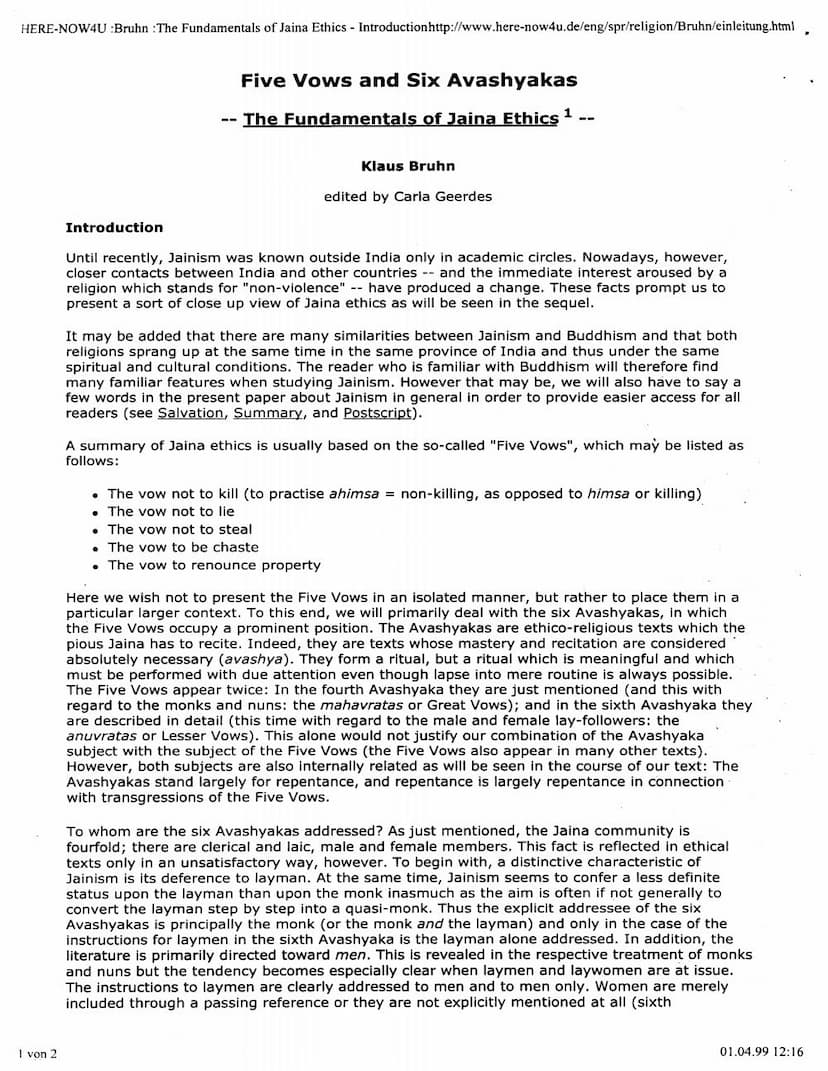
This document, "The Fundamentals of Jaina Ethics: Five Vows and Six Avashyakas" by Klaus Bruhn, provides an introduction to the core ethical principles of Jainism, focusing on the interconnectedness of the Five Vows and the Six Avashyakas.
Introduction to Jainism and its Ethics:
- Jainism, originating in India around the same time as Buddhism, is characterized by its emphasis on non-violence (ahimsa).
- Jaina ethics are primarily understood through the Five Vows.
- The text aims to place these vows within a larger context by examining the Six Avashyakas, which are essential ethico-religious recitations for pious Jains.
The Five Vows:
The Five Vows are presented as the foundation of Jaina ethics:
- Non-killing (Ahimsa): The vow to avoid causing harm to any living being.
- Truthfulness: The vow to speak the truth.
- Non-stealing: The vow not to take what is not given.
- Chastity/Celibacy: The vow to be chaste.
- Renunciation of Property/Non-possession: The vow to limit one's desires and possessions.
The Six Avashyakas:
The Six Avashyakas are ritualistic texts that are considered essential for Jains. They are presented as follows:
- Purpose: The Avashyakas largely deal with repentance and are intrinsically linked to the transgression of the Five Vows.
- Dual Presentation of Vows: The Five Vows appear in two forms within the Avashyakas:
- In Avashyaka IV (Pratikramana), they are mentioned with regard to monks (Mahavratas or Great Vows).
- In Avashyaka VI (Pratyakhyana), they are described in detail for lay followers (Anuvratas or Lesser Vows).
- Addressees: While the community is fourfold (monks, nuns, laymen, laywomen), the Avashyakas are primarily addressed to monks, with specific sections for laymen. The literature tends to be male-oriented, with less explicit mention of women's roles.
Detailed Breakdown of Avashyakas I-VI:
-
Avashyaka I: Samayika:
- A moral declaration that introduces the theme of repentance.
- It is a foundational element for the entire Avashyaka sequence.
- The core of the text is a renunciation of wrongdoing and an expression of remorse.
-
Avashyaka II: Caturvimshatistava:
- A hymn praising the twenty-four Tirthankaras (spiritual leaders who established the path to liberation).
- It reflects a tendency towards deification of the Tirthankaras, with verses expressing devotion.
- It acknowledges the Tirthankaras as spiritual guides rather than deities, as per official doctrine.
-
Avashyaka III: Vandana:
- A ritual of salutation and repentance between a junior monk (student) and a senior monk (teacher).
- It involves specific formulas for approaching and leaving the teacher's designated space.
- It highlights the importance of deportment and the use of a ritual broom (rao-harana).
-
Avashyaka IV: Pratikramana:
- Focuses on repentance for past transgressions.
- Contains extensive lists of offenses, often categorized by the number of senses of living beings affected or by various passions and faults.
- It reflects the early Jaina concern with himsa (violence) affecting all forms of life, even minute ones, and the need for rigorous precautions.
- It includes a famous verse expressing universal compassion and forgiveness: "I ask pardon of all living creatures, may all of them pardon me; I approach all beings with affection and enmity toward none."
-
Avashyaka V: Kayotsarga:
- Describes a meditative exercise of standing still (and sometimes sitting) to destroy negative karma.
- It emphasizes physical discipline and mental concentration, though a specific meditation technique is not detailed.
- The exercise is often combined with the recitation of the "salutation of the Tirthankaras."
-
Avashyaka VI: Pratyakhyana:
- Deals with renunciation and primarily outlines the twelvefold ethics for laymen, including the Five Lesser Vows.
- The vows are presented as renouncing "gross" forms of misdeeds, differentiating them from the stricter vows of monks.
- It includes the explication of vows through pentads of transgressions, serving as a catechism and demonstrating the breadth of Jaina ethics for lay followers.
- It highlights the importance of alms-giving to monks as a crucial altruistic practice.
Broader Context and Themes:
- Salvation (Erlosung): Jainism is a religion of salvation, centered on the cycle of rebirth and transmigration. The ultimate goal is liberation from this cycle through the destruction of karma, understood as a subtle form of matter attached to the soul.
- Role of Deities and Tirthankaras: While Jainism acknowledges gods, they are not active participants in human life or salvation. Tirthankaras, though not divine, are highly revered and fill a void.
- Ahimsa's Nuances: The text explores the complex and sometimes "idiosyncratic" nature of Jaina ahimsa, which extends to even the smallest forms of life, reflecting an archaic and magical, rather than purely ethical, worldview in its early stages.
- Lay Ethics: Unlike early Buddhism, Jainism places significant emphasis on the ethics of the layman, integrating them into the religious system through special rules and efforts to bridge the gap between lay and monastic life.
- Modern Relevance: The text touches upon the Anuvrat Movement initiated by Acharya Tulsi, which aimed to translate Jaina ethical principles into contemporary language and address social issues. It also discusses Jainism's potential contribution to discussions on self-restraint and puritanism in the modern world.
- Jainism's Scope: The postscript emphasizes the vastness of Jaina literature and art, covering philosophy, sciences, myths, and visual representations of Tirthankaras and deities. Jainism is presented as a complex subculture within broader Indian culture, with a rich and multifaceted reality.
In essence, Klaus Bruhn's work provides a foundational understanding of Jaina ethics by detailing the Six Avashyakas and their crucial role in embodying and reinforcing the Five Vows, offering insights into the practical and devotional aspects of this ancient Indian tradition.