
Fasting Unto Death By Children
Added to library: September 1, 2025
Summary
Here's a comprehensive summary of the provided excerpt from "Fasting Unto Death By Children" by Vijay K. Jain:
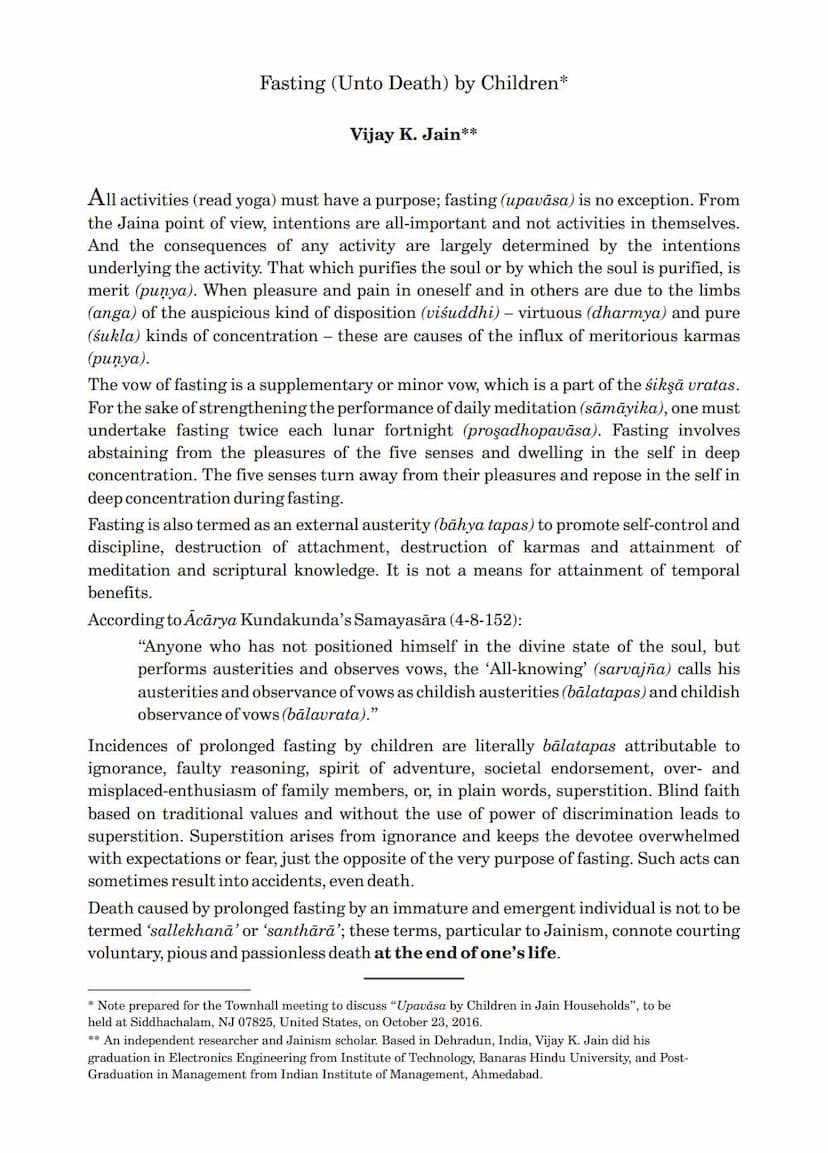
The text, an excerpt from Vijay K. Jain's work and prepared for a discussion on "Upavasa by Children in Jain Households," argues that fasting, or upavasa, in Jainism must have a clear and pure purpose. The author emphasizes that intentions are paramount, not the actions themselves, and that the consequences of an action are largely determined by these underlying intentions.
Fasting is described as an external austerity (bahya tapas) aimed at promoting self-control, discipline, detachment, karma destruction, and the attainment of meditation and scriptural knowledge. It is not intended for achieving worldly benefits. From a Jain perspective, fasting is considered a supplementary or minor vow (siksa vrata), undertaken to strengthen daily meditation (samayika), ideally twice a lunar fortnight. The core of fasting involves abstaining from the pleasures of the five senses and turning inward in deep concentration.
However, the author strongly criticizes prolonged fasting by children, labeling such acts as "childish austerities" (balatapas) or "childish observance of vows" (balavrata). This is based on Acarya Kundakunda's teaching that austerities performed without being established in the divine state of the soul are considered childish by the omniscient.
These childish fasts by children are attributed to:
- Ignorance
- Faulty reasoning
- Spirit of adventure
- Societal endorsement
- Over-enthusiasm and misplaced enthusiasm of family members
- Superstition, which arises from blind faith based on tradition without critical discrimination.
The text highlights that superstition, rooted in ignorance, leads to an individual being overwhelmed by expectations or fear, directly contradicting the true purpose of fasting. Such practices can be dangerous and may even lead to accidents or death.
Crucially, the author distinguishes these accidental deaths caused by prolonged fasting in immature individuals from the Jain concepts of 'sallekhana' or 'santhara'. These terms specifically refer to a voluntary, pious, and passionless death sought at the end of one's life as a spiritual practice.