
Etudies On Bhartrhari 4
Added to library: September 2, 2025
Summary
Here's a comprehensive summary of the provided text, focusing on Johannes Bronkhorst's analysis of the Absolute in Bhartṛhari's Vākyapadīya and its connection to Madhyamaka philosophy:
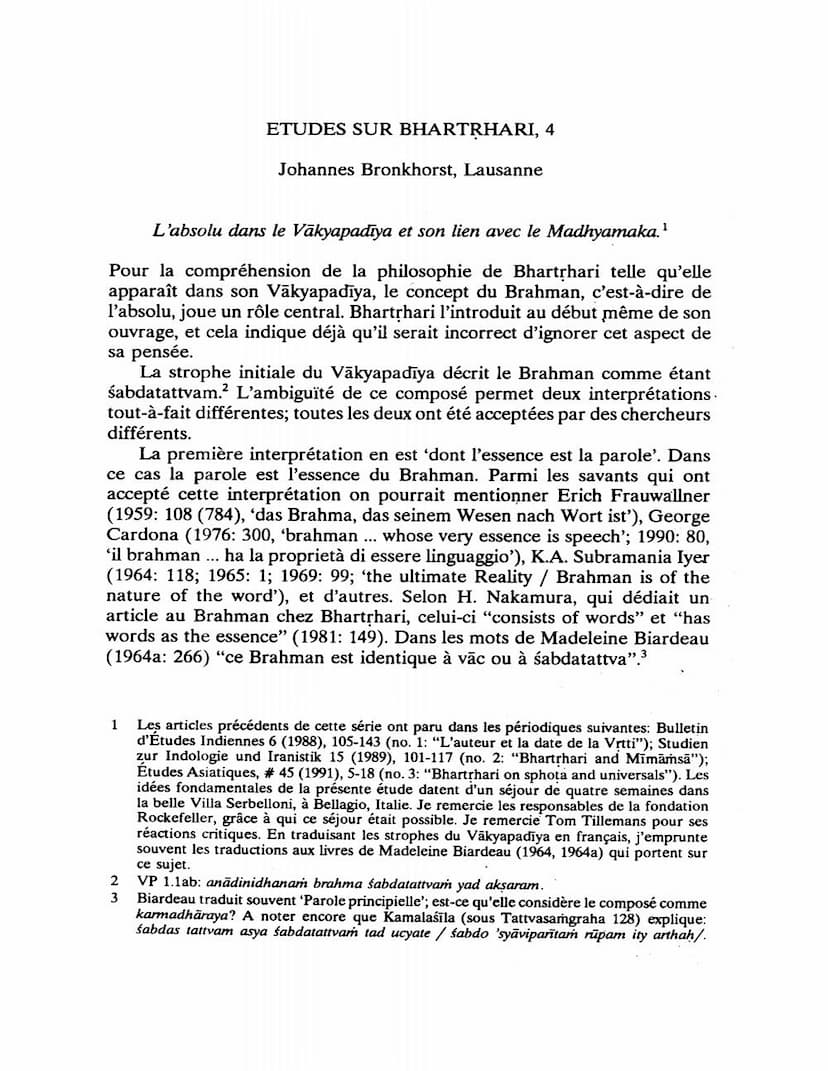
The article "L'absolu dans le Vākyapadiya et son lien avec le Madhyamaka" by Johannes Bronkhorst delves into the central concept of the Absolute (Brahman) in Bhartṛhari's philosophical work, the Vākyapadīya, and explores its potential relationship with Buddhist Madhyamaka thought.
1. Defining the Absolute (Brahman) in Bhartṛhari's Vākyapadīya:
Bronkhorst begins by highlighting that the concept of Brahman is foundational to understanding Bhartṛhari's philosophy. The opening verse of the Vākyapadīya describes Brahman as śabdatattva. This compound allows for two main interpretations:
-
Interpretation 1: "Brahman, whose essence is speech." This view, supported by scholars like Frauwallner, Cardona, and Iyer, posits that speech itself is the essence of Brahman. However, Bronkhorst finds this interpretation problematic. He argues that it conflicts with other passages in the Vākyapadīya which suggest that Brahman is the essence of all things, and that speech has "essence" as its true nature (tattvātmaka). Furthermore, speech, rooted in the phenomenal world, cannot fully grasp realities beyond it.
-
Interpretation 2: "The essence of speech." This interpretation, favored by scholars like Ruegg, Staal, and Murti, suggests that Brahman is the essential nature of speech. While acknowledging its support among some scholars, Bronkhorst states this interpretation also doesn't significantly illuminate the nature of the Absolute.
-
Consciousness as the Absolute: Bronkhorst then addresses the view that Bhartṛhari's Absolute is consciousness. He notes parallels with Upaniṣadic and Śankara's Vedanta thought. However, he finds no explicit identification of Brahman with consciousness in the Vākyapadīya. While the mind plays a role in perceiving the phenomenal world, Bhartṛhari emphasizes an "objective" aspect of external objects, distinct from consciousness. He cites verses that highlight the distinction between the phenomenal world and private imaginations, demonstrating that the world of experience, even if sometimes mistaken (like a mirage), has a shared reality.
-
The Absolute as the Totality of Everything: Bronkhorst proposes a third, less discussed interpretation: the Absolute as the totality of all that exists. He finds this concept present in some Upaniṣads and the Bhagavad Gītā. This interpretation aligns with Bhartṛhari's emphasis on the reality of wholes (touts) over their parts.
-
Wholes and Parts: Bhartṛhari asserts that wholes are real, while their parts are not. This applies to everything, from an atom to a pitcher. The existence of wholes, which appear without parts or succession, is described as "miraculous." This principle extends to language, where the sentence is considered the primary real entity, and words are derived from it through analysis (apoddhāra), not the other way around. This concept is extended to collections of sentences, like the Veda, which are seen as indivisible wholes.
-
The Totality as the Absolute: Following this logic, Bronkhorst concludes that for Bhartṛhari, the ultimate reality, the Absolute, must be the totality of everything that exists, conceived as a single entity, both temporal and spatial. The relationship between the Absolute and the phenomenal world is that of the whole to its parts. He notes the paradoxical statement that there is no difference between reality and unreality, suggesting they are two aspects of the same entity.
-
Samavāya: The Relationship of Whole and Part: Bronkhorst identifies Bhartṛhari's term for this relationship as samavāya, borrowed from the Vaiśeṣika system. He describes it as a power that transcends both difference and identity, connecting things in a way that makes it impossible to definitively say whether they are the same or different. This applies to the relationship between the Absolute and the phenomenal world.
-
Characteristics of the Absolute: Bhartṛhari describes the Absolute as being neither existent nor non-existent, neither one nor divided, neither conjoined nor separate, neither modified nor its opposite. However, another verse states the opposite: it exists and doesn't exist, it is one and divided, conjoined and separate, modified and its opposite. Bronkhorst interprets this as the Absolute's undivided nature (real, one, unmodified) and its manifestation through divisions (unreal, manifold, separate, modified). These divisions are caused by "powers" like space and time, which create spatial and temporal distinctions in the phenomenal world, while the Absolute itself is eternal and without beginning or end.
-
The Knowledge of the Absolute: The purified knowledge that grants access to the Absolute encompasses all that exists. This knowledge of the totality of objects is the knowledge of Brahman because Brahman is the totality of objects. This purified knowledge includes the past and future, as they too are part of the all-encompassing totality.
-
2. Bhartṛhari's Conception and its Relation to Madhyamaka:
Bronkhorst then turns to the crucial question of how Bhartṛhari's concept of the Absolute relates to Madhyamaka philosophy, particularly Nāgārjuna's thought.
-
Reaction to Buddhism: Bronkhorst suggests that Bhartṛhari's emphasis on the reality of wholes might be a reaction against the Buddhist doctrine of śūnyatā (emptiness), which, in its radical interpretation, denies the existence of wholes and focuses on ultimate, partless elements (dharmas).
-
Countering Madhyamaka Arguments: Bhartṛhari's philosophy can be seen as a defense against the Madhyamaka critique of all possible viewpoints. Nāgārjuna's arguments, for instance, highlight contradictions in attributing production to objects.
-
Metaphorical Existence (aupacārikī sattā): Bhartṛhari addresses these paradoxes by proposing that objects of words (padārtha) possess a "metaphorical existence" (aupacārikī sattā). This metaphorical realm allows for apparent contradictions that are resolved by understanding that words and their meanings are analytical constructs, not reflections of absolute reality. This allows for statements that might seem contradictory in absolute terms, like "production," to function within language.
-
The "Neither Identical Nor Different" Problem: Bronkhorst notes the shared ground between Bhartṛhari and Madhyamaka concerning the relationship between wholes and parts (and, analogously, between Samsara and Nirvana in Madhyamaka). Both systems grapple with a relationship where entities are neither identical nor different.
-
Critique of Previous Interpretations of Madhyamaka: Bronkhorst discusses the debate between Stcherbatsky and Schayer regarding the Madhyamaka Absolute.
- Stcherbatsky and Schayer's View: They initially proposed that the Mahāyāna Absolute is the totality of everything that exists, a monistic and undifferentiated Whole.
- Critiques of this View:
- Madhyamaka Rejection of Absolute Existence: Bronkhorst highlights critiques by de Jong and others, emphasizing that Madhyamikas, like Aryadeva and Candrakirti, deny the existence of an Absolute in itself. The ultimate reality is beyond conceptualization and not "existent" in a conventional sense.
- Buddhist Rejection of Wholes Being More Real Than Parts: De Jong's critique that Buddhist thought generally does not consider constituent elements of a whole as unreal while the whole itself is real is also emphasized. This contrasts with Bhartṛhari's view that the whole is more real than its parts.
- Critique of Western Bias: Bronkhorst dismisses the critique that Madhyamaka is purely mystical and thus inaccessible to Western rationalism, advocating for a philological approach to understanding the ideas.
-
The Madhyamaka Absolute as "Empty": While acknowledging that the Madhyamikas' absolute is often described as śūnya (empty) and relative, Bronkhorst points to passages in Nāgārjuna and Candrakirti that describe the relationship between Samsara and Nirvana as "neither identical nor different." This "neither/nor" logic, applied to the totality of phenomenal existence, might have led to the interpretation that the Absolute is the totality of the world, even though the Madhyamikas themselves rejected the idea of a real, independent Absolute.
In conclusion, Bronkhorst argues that Bhartṛhari's concept of the Absolute as the totality of all that exists, real in its entirety and manifesting through unreal divisions, is a distinct philosophical development. He suggests that this conception, while sharing some logical structures with Madhyamaka's treatment of wholes and parts, likely arose as a deliberate counterpoint to Buddhist doctrines, particularly the Madhyamaka emphasis on emptiness and the denial of a substantial, albeit total, Absolute.