
Esa Dhamme Vusunao Such Is Law Of Sage
Added to library: September 1, 2025
Summary
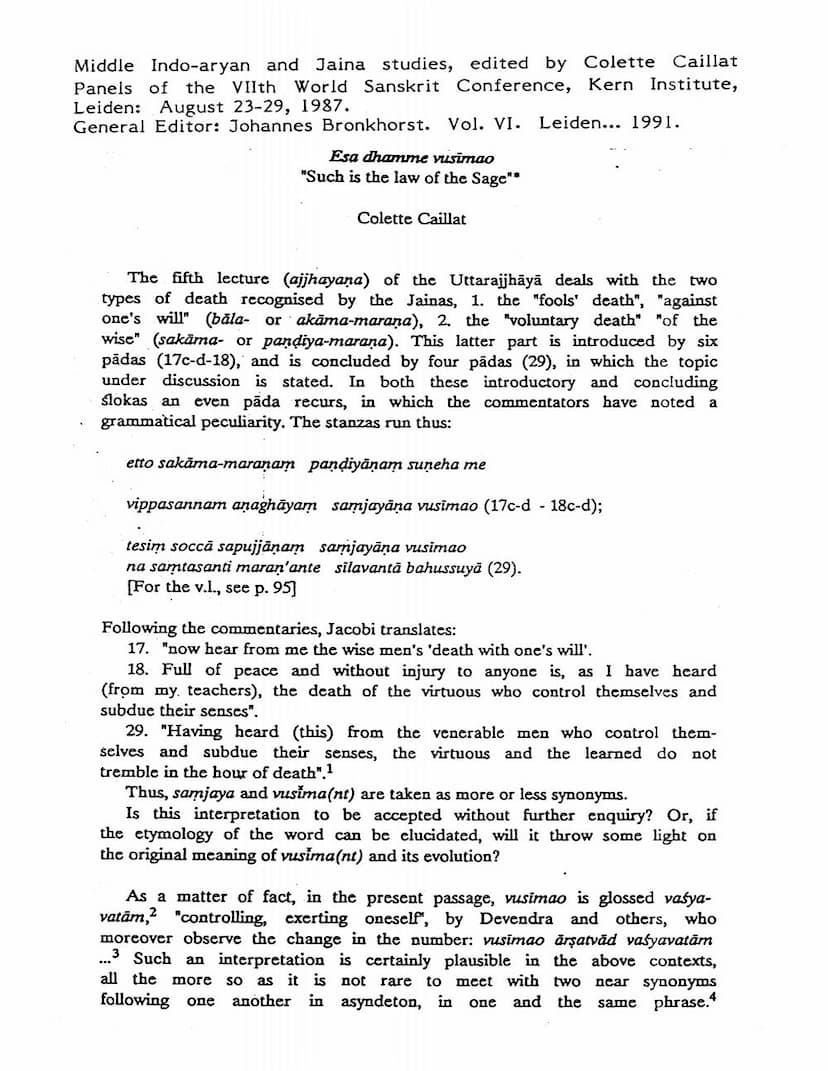
This article by Colette Caillat, titled "Esa dhamme visimao 'Such is the law of the Sage'," from the Middle Indo-Aryan and Jaina studies series, delves into the etymology and meaning of the term "vusimao" (and its variations like "vusimam") as found in Jain scriptures, particularly the Uttarajjhayaya and Suyagaḍanga.
The core of the article revolves around understanding this term, which appears in phrases like "esa dhamme vusimao" ("This is the law of the Sage"). Caillat examines how commentators and scholars have interpreted it, starting with the Uttarajjhayaya, where it is paired with "samjaya" and glossed as "vasyavatām" (controlling, exerting oneself). While this interpretation is plausible, Caillat notes grammatical peculiarities and the potential for a deeper, more original meaning.
She explores various etymological theories:
- Charpentier's suggestion of "vyavasāyavant" (resolute, energetic) is found plausible but lacking phonetic explanation.
- Pischel's derivation from VAŚaya- is deemed unlikely due to expected phonetic forms.
- A more convincing theory, proposed by PSM and ĀŚK, links "vusima(t)" to the Old Indo-Aryan (OLA) root *vṛṣimat (*vṣimant-). This connects "vusi" to the OLA word *brsi-, meaning a "roll of twisted grass" or a "pad/cushion," especially one used by ascetics. This is supported by the feminine form *brsi found in Sanskrit texts.
Caillat traces the phonetic evolution from OLA *br- to Middle Indo-Aryan (MIA) bu- and then to vu-, noting that the form "busi" is found in Jain commentaries. She argues that the word "busi" (ascetic's seat) could have been used metaphorically to represent the virtues upon which a muni stands, similar to the concept of a "pillow of righteousness."
The article then examines the use of "vusimam" and "vusimao" in the Suyagaḍanga. Here, the phrase "esa dhamme vusimao" appears as a set formula, translated by Jacobi as "this is the Law of him who is rich in control." However, Caillat suggests this interpretation is too restrictive. She proposes that "vusimao" might be equivalent to "evam kevalino mayam" ("this is the doctrine of the Kevalin," i.e., the omniscient one), implying a broader meaning of profound knowledge, faith, and conduct.
Key findings from the analysis include:
- Connection to the Three Jewels (Triratna): The term "vusimam" is understood to refer to a Jain monk (niggantha) who is perfected in the three jewels: right faith (darśana), right knowledge (jnana), and right conduct (caritra). These three are seen as interconnected, like a tightly bound mat or bunch, which is likened to the grass-seat (bhisi).
- Metaphor of the Raft: The concept of the grass-seat (bhisi) is linked to the metaphor of a raft that helps one cross the "flood" of the cycle of rebirth (samsara). The purified monk, equipped with the Triratna, acts as this raft, guiding himself and others to liberation.
- Equivalence to "Tirthakṛt": Caillat suggests that "vusimam" could have been an ancient equivalent of "tirthakṛt" (ford-maker, prophet, sage), one who helps others cross the ocean of existence.
- Semantic Evolution and Obscurity: The original meaning of "vusima(t)" likely became obscure over time, leading to misinterpretations and textual variations (e.g., "vasumanto" replacing "vusimanto" in some manuscripts). Commentators struggled to define its exact meaning, sometimes offering multiple possibilities, including control of the senses, spiritual wealth, or dwelling in the Triratna.
- Buddhist Parallel: The article draws a parallel with Buddhist texts, specifically the Dhaniya-sutta, where "bhisi" (raft) is used metaphorically for the spiritual path that leads to crossing the flood of suffering.
In essence, Caillat argues that "vusimao" signifies a perfected Jain ascetic, deeply rooted in knowledge, faith, and conduct, capable of navigating the spiritual path and guiding others towards liberation. The term's etymology, linked to the ascetic's grass-seat, reinforces its connection to the material and spiritual preparations for the ultimate goal, particularly the voluntary death ("sakama-marana") of the wise.