
Epithets Of Lord Mahavira In Early Jaina Canons
Added to library: September 1, 2025
Summary
Here's a comprehensive summary of the provided Jain text, "Epithets of Lord Mahavira in Early Jaina Canons" by Dalsukh Malvania:
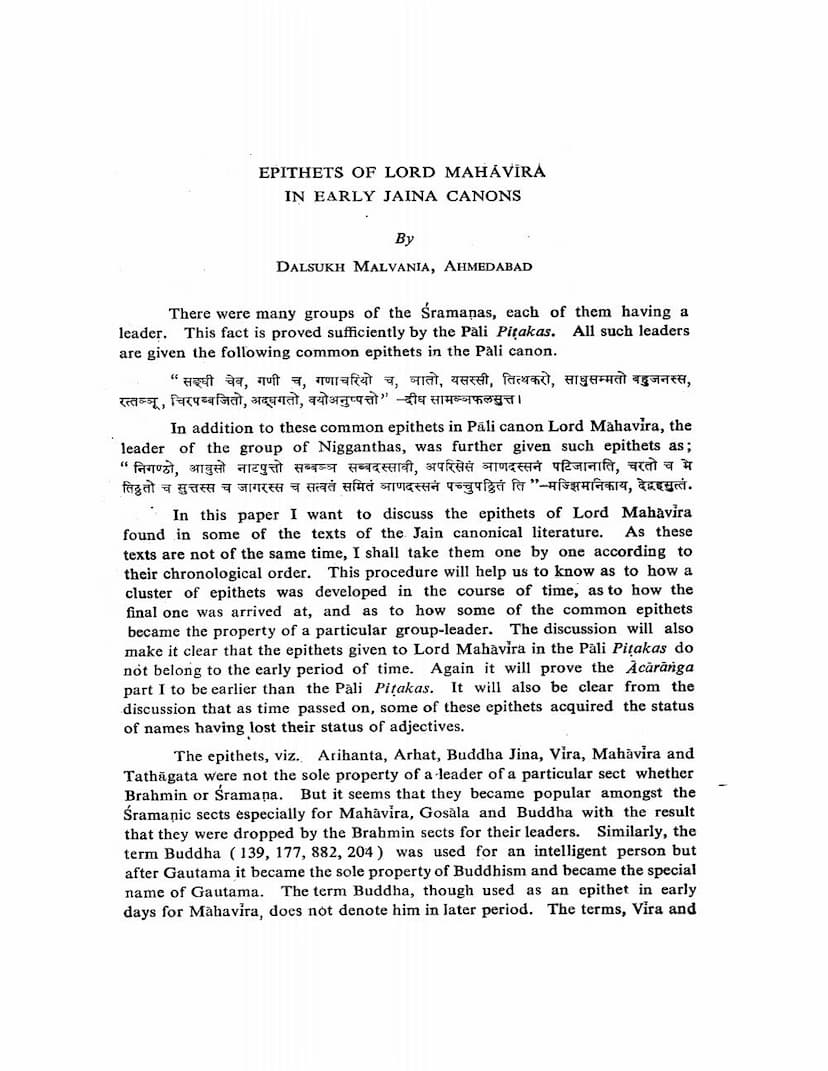
The paper by Dalsukh Malvania meticulously traces the evolution and usage of epithets attributed to Lord Mahavira within the early Jaina canonical literature. It begins by noting that Śramaṇic leaders, in general, shared common epithets, as evidenced in the Pali Pitakas. These included terms like "Sanghi," "Gaṇī," "Gaṇāchario," "Yassasī," "Tittakaro," and "Sādhusammatto bahujanaassa."
However, Lord Mahavira, as the leader of the Niggaṇthas, was also distinguished by specific epithets in the Pali canon, such as "Niṭṭhamtho," "Āvuso Nāyaputto," "Sabbañña," "Sabbadassāvi," and descriptions of his unhindered knowledge.
Malvania's core argument is that by examining these epithets chronologically across various Jaina texts, one can understand how a cluster of epithets developed, how some common ones became specific to Mahavira, and how certain epithets eventually transformed into proper names. This approach also aims to establish the relative chronology of texts, suggesting that the Acaranga Part I predates the Pali Pitakas.
Key Observations and Arguments:
-
Epithet to Name Transformation: The paper highlights how terms like "Vira" and "Mahavira," initially descriptive of heroic or great ascetics, gradually became the primary names for Lord Vardhamana, overshadowing his original name. Similarly, "Jina" and "Arhat" were initially common to all Śramaṇic leaders, but their followers became distinctly known as "Jaina" (though initially this term was also applied to Buddha's followers). "Tathāgata" also narrowed its scope to refer solely to the Buddha.
-
Acaranga Part I:
- Mahavira identifies himself as "Bhikkhu."
- "Nayaputta" and "Nāyasuya" are used, eventually becoming names.
- "Muni" is used, though also for ordinary ascetics.
- "Māhaṇa" (Brāhmaṇa) is used as a term of respect, indicating a cross-sectarian use of titles.
- "Nāṇī" and "Mehavi" highlight his character and knowledge.
- "Mahavira" is frequently used, showing a clear trend towards it becoming his name.
- "Samana Bhagavām" and its variations are prevalent, indicating his venerable status, but "Bhagavam" was not exclusively for a sect leader and could be used for ordinary ascetics and even women.
- Notably, the epithet "Tirthankara" is absent in this section, supporting the argument that Acaranga Part I is earlier than texts like the Dighanikāya that use this term for Mahavira.
- Terms like "Savvañña" (omniscience) are absent, with other terms potentially implying it, suggesting "Savvañña" emerged later.
-
Sutrakṛtānga Part I:
- Further development is observed, with "Vira" and "Mahavira" solidifying as names.
- Mahavira is explicitly called "Niggantha" for the first time, linking to the Pali term "Niggantha Nataputta."
- "Mahamuni" appears.
- Gotra ("Kasave") and regional ("Vesālic") epithets are introduced.
- The traditions of "Jina," "Arahā," and "Bhagavā" continue.
- The term "Jinasāsana" (Jaina religion) is mentioned, indicating an established order.
- While "Buddha" and "Tathāgata" are present, their later exclusive application to the Buddha is noted.
- Epithets related to knowledge and vision, such as "Anantacakkhū" and "Tilogadamsi," appear, hinting at the concept of omniscience, though the specific technical term "Savvanna" is still absent.
-
Acaranga Part II:
- Depicts Mahavira as a householder and mentions his birth name, Kumara Vardhamana.
- The tradition of the epithet "Mahavira" being divinely bestowed emerges.
- Epithets derived from parental names ("Videhadinne") and established titles ("Jina," "Vira") are present.
- Mythology enters with gods performing the "Titthayārābhisea" and requesting him to establish the "tittham" (religious order).
- Crucially, Mahavira is called "Titthayara" for the first time here.
- He is also referred to as "Savvaṇṇo" and "Kevali" (omniscient), aligning with Pali Pitaka usage.
-
Sutrakṛtānga Part II:
- Considered later than Acaranga Part II due to mentions of "Gāṇipiṭaka" and a more developed understanding of the canonical structure.
- "Dhammatittham" and "Titthayara" are found.
- Mentions of "Acarya aha" point to its later date.
- "Bhagavam" is used even for Mahavira's disciples.
- The "Three Jewels" (Jñana, Darśana, Caritra) are mentioned for the first time.
- Followers of Parsva are identified as "Nigganthas" and "pāsāvacijjā."
-
Other Angas and Non-Angas:
- Later texts generally use "Samane Bhagavaṁ Mahavire."
- A detailed "Varnaka" (description) from the Bhagavati Sutra is presented, featuring a vast array of epithets highlighting his cosmic significance and leadership, many of which have parallels in descriptions of the Buddha. These include "Ādīgare," "Tittagare," "Sahasebuddhe," "Puttime," "Purisasevū," "Lokuttame," "Loknāth," "Logapadīpav," "Logapajjoyokare," "Abhayadae," "Chakkhudae," "Magagadae," "Saraṇadae," "DhammaDesar," "DhammaSaraha," "DhammaVarChāurāntChakabadi," and "Aṇaṇtataṇaṇare," alongside "Savvaṇū," "Sabbadarisi."
- The importance of "Purusa" in various contexts, drawing parallels with Vishnu's epithets, is noted.
In essence, Malvania's paper provides a scholarly deconstruction of how Lord Mahavira's identity and reverence were built through an evolving set of titles and epithets within the foundational texts of Jainism, highlighting the dynamic nature of religious language and hagiography. The paper strongly argues for the antiquity of Acaranga Part I by its relative lack of certain epithets that appear in later Jaina and Buddhist texts.