
Encore Pratityasamutpadahrdaya Karika Of Nagarjuna
Added to library: September 1, 2025
Summary
Here's a comprehensive summary of the provided Jain text, "Encore: The Pratityasamutpadahrdaya Karika Of Nagarjuna" by V. V. Gokhale, based on the provided pages:
Overall Purpose:
This text is an exposition and presentation of Nagarjuna's "Pratityasamutpadahrdaya Karika," a concise five-stanza summary of the Buddhist concept of dependent origination (Pratītyasamutpāda). The work by V. V. Gokhale aims to provide the Sanskrit text of these karikas, along with a fragment of its commentary, shedding light on its historical discovery and scholarly significance.
Introduction (Pages 1-3):
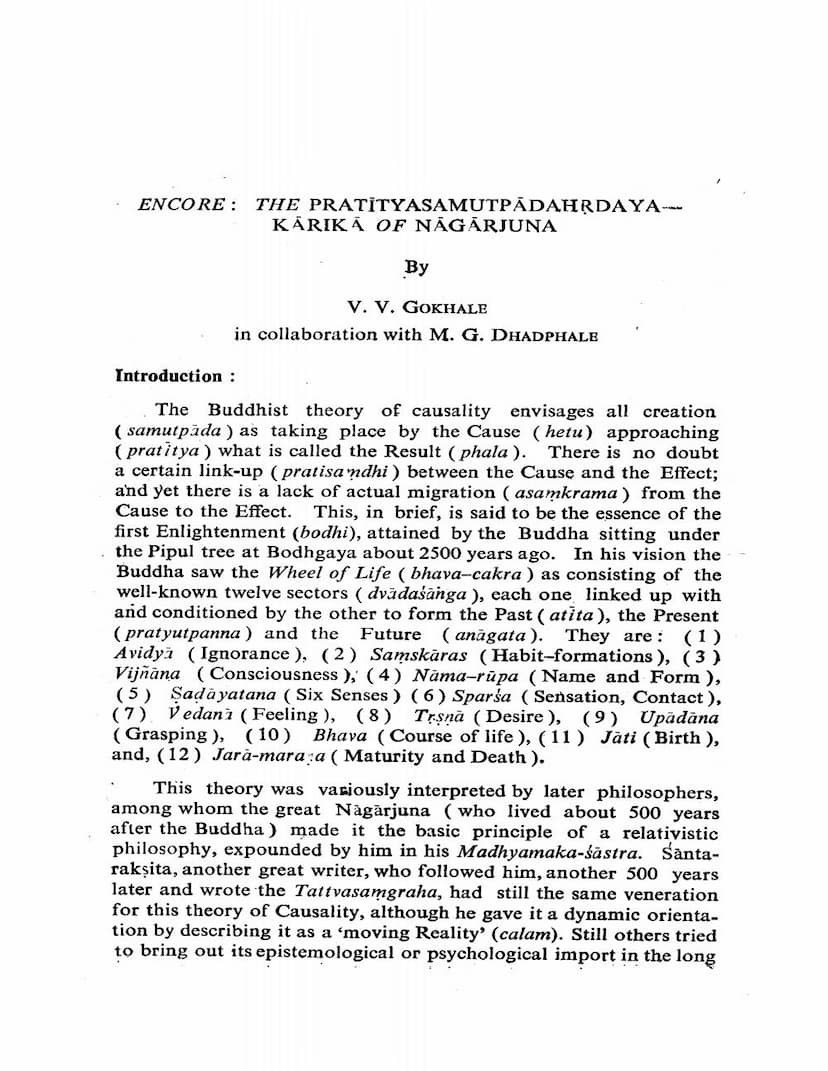
- Pratītyasamutpāda (Dependent Origination): The introduction begins by explaining the core Buddhist theory of causality, where all phenomena (samutpāda) arise due to a cause (hetu) approaching a result (phala). This theory, central to the Buddha's first enlightenment, views existence as a chain of twelve linked factors (dvādaśāṅga), which cycle through past, present, and future. These factors are listed: Avidya (Ignorance), Saṃskāras (Habit-formations), Vijñāna (Consciousness), Nāma-rūpa (Name and Form), Ṣaḍāyatana (Six Sense Bases), Sparśa (Contact), Vedanā (Feeling), Tṛṣṇā (Desire), Upādāna (Grasping), Bhava (Becoming), Jāti (Birth), and Jarā-maraṇa (Old Age and Death).
- Nagarjuna's Interpretation: The text highlights Nagarjuna's significant contribution by making this theory the foundation of his Madhyamaka philosophy. While later scholars like Śāntarakṣita also revered the theory, Nagarjuna's version is particularly noteworthy for its brevity and profundity, encapsulated in the five "Pratītyasamutpāda-hrdaya" (Heart of Dependent Origination) karikas.
- Scholarly Journey of the Text: The author details the arduous journey of rediscovering the Sanskrit text of Nagarjuna's karikas and their commentary.
- Initially, only a few stanzas were known to exist in Sanskrit, with a more comprehensive text ("Pratītyasamutpāda-śastra" attributed to Ullangha) discovered in Chinese versions.
- A fortunate discovery in a manuscript at the Kundeling monastery in Lhasa, Tibet, yielded the full Sanskrit text of the five karikas and a commentary fragment on the first two stanzas. This discovery was published in 1955.
- More recently, photographs of Sanskrit manuscripts in the "Gilgit" script (dating to around 600 AD) from the National Archives of India revealed the Pratītyasamutpāda-hrdaya text again, this time accompanied by a more extensive, though still incomplete, commentary fragment. These photographs are central to the current publication.
The Sanskrit Text and Commentary (Pages 4-7):
- Presentation of the Karikas: The text then presents the five Sanskrit stanzas (karikas) attributed to Nagarjuna, along with notes on the adopted orthography and the nature of additions/uncertain readings from the manuscript.
- Commentary Explanations: The commentary fragment provides a detailed explanation of each karika, elucidating the Buddhist concepts:
- Karika 1 & 2: These stanzas group the twelve links of dependent origination into three categories: kleshas (afflictions/defilements), karma (actions), and duḥkha (suffering). The commentary explains how the twelve links are interconnected and fall into these three broad categories (e.g., Avidya, Trsna, Upādāna are kleshas; Samskaras and Bhava are karma; Vijñana, Nama-rupa, etc., are duḥkha). It emphasizes that these are "viseṣa" (distinctions) of the "aṅga" (limbs) of the causal chain, not self-generated but dependent on other factors.
- Karika 3: This stanza describes the cyclical nature of existence, where from these categories, others arise, leading to the continuous "bhava-chakra" (wheel of becoming). The commentary clarifies the progression and the meaning of "tu" (but) as a marker of regulation within this cycle.
- Karika 4: This crucial stanza addresses the nature of self and reality. It states that the entire world, including cause and effect, is empty of an inherent self or "satva" (being). Phenomena arise from emptiness, and emptiness arises from phenomena. The commentary interprets this to mean that nothing has an independent, substantial existence; all is interdependent and ultimately empty of a permanent self.
- Karika 5: This stanza uses several analogies (lamp, seal, mirror, sun-gem, seed) to illustrate the concept of "pratisandhi" (reconnection/transmission) and "asamkrama" (non-migration) between causes and effects, particularly in the context of rebirth. It argues against the notions of a migrating soul or a static existence. The commentary explains these analogies in detail, showing how one phenomenon arises from another without a substantial transference, and how attachment arises from the perception of self and "mine."
- Nagarjuna's Core Teachings in the Commentary:
- The commentary reiterates that there is no independent self or soul (ātman) in existence.
- The process of arising and ceasing is not a migration of substance but a dependent origination from emptiness.
- The ultimate freedom (moksha) comes from understanding this emptiness and interdependence, which leads to the cessation of suffering by breaking the cycle of grasping and craving.
- The text concludes with two more verses (numbered 6 and 7, which appear to be reiterations or expansions of the core ideas presented in the karikas), emphasizing the importance of seeing reality as it is (bhūta) to achieve liberation.
Key Jain and Buddhist Concepts Highlighted:
While the text is about a Buddhist philosopher (Nagarjuna) and his interpretation of a Buddhist doctrine, it is presented within the context of a Jain publication. This might suggest an interest in comparative philosophy or the relevance of Nagarjuna's insights within a broader Indian philosophical landscape, which includes Jainism. The summary, however, focuses on the content of Nagarjuna's teachings as presented by Gokhale. The core concepts are:
- Pratītyasamutpāda: The central theme, explaining the interconnectedness and conditioned nature of all phenomena.
- Śūnyatā (Emptiness): The absence of inherent, independent existence in all things, a cornerstone of Nagarjuna's Madhyamaka philosophy.
- Anātman (Non-Self): The negation of a permanent, unchanging self or soul.
- Karma and Rebirth: The cycle of actions and their consequences leading to rebirth, explained through the lens of dependent origination.
- Nirvāṇa/Moksha: Liberation from the cycle of suffering, achieved through wisdom and the understanding of emptiness.
In essence, Gokhale's work provides a scholarly presentation and explication of Nagarjuna's profound and concise statement on dependent origination, emphasizing its philosophical depth and the historical challenges in its textual recovery.