
Emendation Of Some Verses In Bhrtharis Trikandi
Added to library: September 1, 2025
Summary
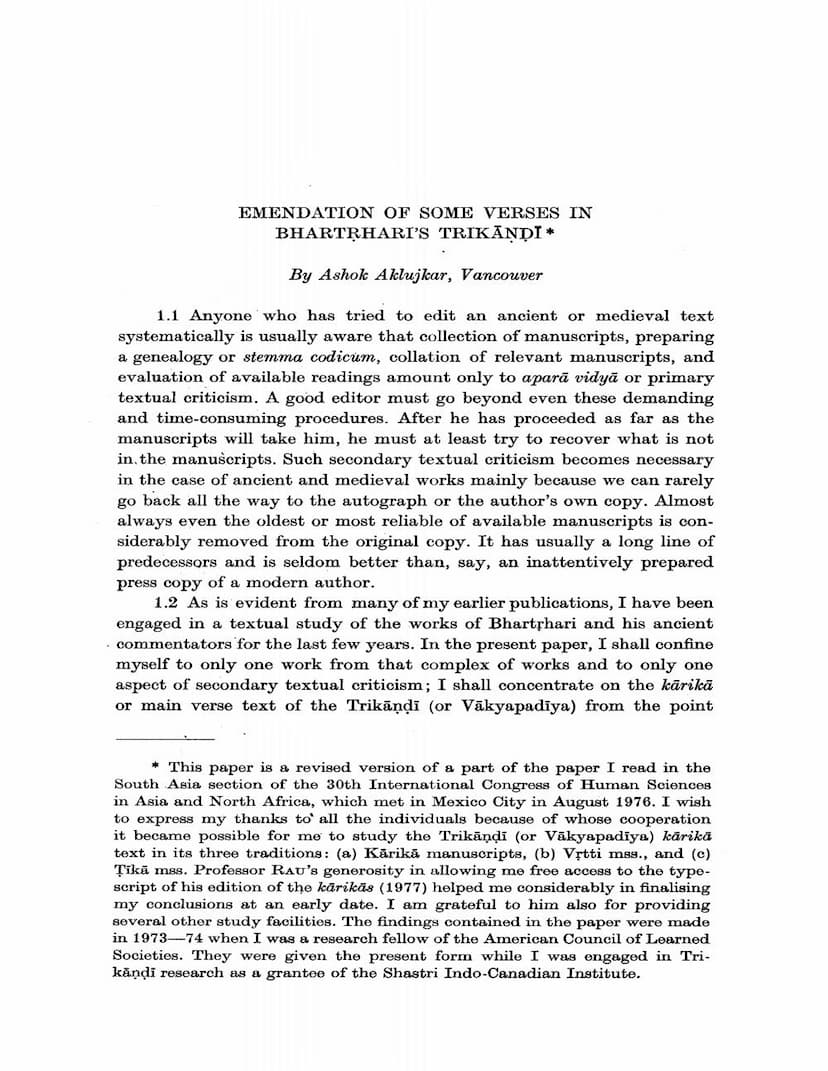
This document, "Emendation of Some Verses in Bhartṛhari's Trikāṇḍi" by Ashok Aklujkar, is a scholarly article focusing on textual criticism and proposing emendations to verses in the ancient Sanskrit text Trikāṇḍi (also known as Vākyapadīya) by Bhartṛhari. The author, Ashok Aklujkar, is a scholar who has dedicated years to studying Bhartṛhari and his commentators.
The article begins by explaining the necessity of "secondary textual criticism," which goes beyond simply collecting manuscripts and comparing readings. This secondary criticism aims to recover what might be lost or corrupted in the surviving manuscripts, as ancient texts are rarely preserved in their original autograph form. Aklujkar emphasizes that his study focuses on the main verse text (kārikā) of the Trikāṇḍi and specifically on emendations that are not already present in printed texts or manuscripts. He also excludes emendations based solely on different punctuation or splitting of words, which he considers corrections of previous editions rather than deeper textual issues.
The core of the article presents several specific proposed emendations to verses from the Trikāṇḍi, along with the author's reasoning:
-
Verse 2.79: This verse deals with eligibility for performing a ritual in Mimāṃsā philosophy. Aklujkar identifies a syntactically problematic quarter ('b') and suggests changing a reading from "artho" or "arthe" to "arthini" and "bhidyate" to "vidyate." This emendation, supported by textual evidence from other verses and manuscripts, aims to make the verse contextually meaningful, stating that a person seeking to perform a rite possesses the necessary capability.
-
Verse 2.91: This verse is discussed in the context of Bhartṛhari's theory of the indivisible nature of sentence-meaning. The author highlights the difficulty in deriving Bhartṛhari's intended argument from the verse's current wording, which seems to contradict his thesis. Aklujkar proposes a significant emendation, changing words like "asamvidam" to "asamvidan" and "sarvatra" to "sarvam na." This revised reading aims to convey the idea that a dull-witted person, mistaking a part for the whole, fails to comprehend the entire sentence-meaning, thus supporting Bhartṛhari's point. He also cites Bhoja's citation of the verse, which shows similar contextual difficulties.
-
Verse 2.136: Aklujkar notes redundancy in the expression "bhidyate prthak" (is divided separately) and suggests changing "bhidyate" to "vidyate." This minimal change, supported by manuscript evidence, aims to create a more concise and meaningful statement about how perception of the same object can vary.
-
Verse 2.230: This verse discusses the non-uniqueness of grammatical description. The author finds the example "pacantiti" problematic, as it appears to contradict the point that a single suffix can convey information conveyed by two. He suggests that the original reading was likely "pacāttiti," which would provide a more appropriate example by illustrating both the absence of one suffix and the presence of another.
-
Verse 2.409: This verse addresses expressions used differently without form change. The current wording, particularly the last quarter "eka-jāti-samanvayāt" (because of the presence of an identical universe), is seen as contradictory to the verse's stated view that different uses imply different entities. Aklujkar proposes inserting a visarga after "eka-jāti," creating two words. This emendation would allow the verse to state the view of those who advocate non-identity and then explain how these advocates account for the common perception of homophonous expressions as one entity.
-
Verse 3.14.297: The reading "yadā" (when) is found problematic as it necessitates an implied addition to make the verse syntactically complete, which is unusual for the Vrtti commentary and the overall structure of this section of the Trikāṇḍi. Aklujkar suggests "yad vā" (or, to come to another alternative) as a more likely original reading. This change would remove the syntactic incompleteness and signal the transition to a new topic, the anya-padārtha-prādhānya-pakṣa.
-
Verse 3.14.605: The author analyzes the verse in the context of comparing an army formation to an eagle and images of the Kasyapa family to the Kasyapas. He finds the current wording awkward and the commentary's interpretation strained. He proposes replacing "saha" with "sadrk" (similar) and "kāśya pasyeti" with "kāśyapas ceti." This emendation aims to clarify the comparison and provide a more grammatically sound and contextually appropriate meaning.
In summary, Ashok Aklujkar's article is a detailed scholarly endeavor to refine and clarify the text of Bhartṛhari's Trikāṇḍi through meticulous textual analysis and proposed emendations, aiming to bring the verses closer to their original intended meaning and philosophical arguments.