
Ego In Western And Indian Psychology
Added to library: September 1, 2025
Summary
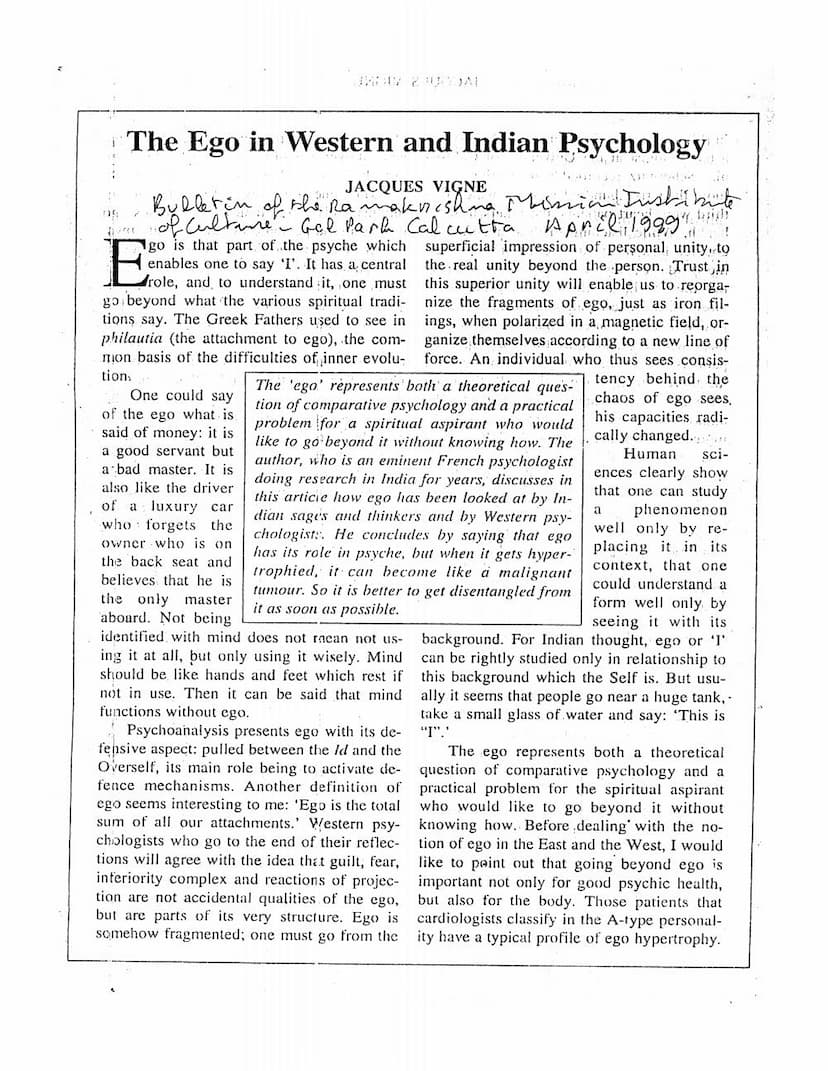
This article, "The Ego in Western and Indian Psychology" by Jacques Vigne, explores the concept of the ego from both Western psychological and traditional Indian spiritual perspectives. Vigne argues that while the ego is a necessary component of the psyche, enabling us to perceive ourselves as unified individuals, it can become a destructive force when hypertrophied or unbalanced.
Key takeaways from the article include:
-
The Ego's Dual Nature: The ego is presented as both a theoretical question for comparative psychology and a practical challenge for spiritual aspirants. It provides a superficial sense of personal unity but also points to a deeper, real unity beyond the individual.
-
Western Perspectives on the Ego:
- Psychoanalysis: Views the ego as a defensive mechanism, pulled between the Id and the Overself, activating defenses.
- Attachments: Vigne suggests that the ego is the "total sum of all our attachments."
- Fragmentation and Guilt: Western psychology acknowledges that guilt, fear, inferiority complexes, and projection are structural parts of the ego, suggesting its fragmented nature.
- Physical Health: Research like Larry Scherwitz's is cited, indicating a correlation between excessive self-reference (using "I," "my," "mine") and heart disease, suggesting an overly ego-centric personality is detrimental to physical well-being.
- Narcissus Myth: The myth of Narcissus is interpreted as an allegory for the spiritual journey, from identification with the physical body to introspection and the dissolution of the ego. The transformation into a flower symbolizes compassion and the ego's potential for selfless expression.
- Overself vs. Self: Vigne distinguishes between the "Overself" in psychoanalysis (often rooted in parental taboos) and the true "Self," cautioning against confusing the ego's drivers (like Id) with the true Self.
- Personalism: The Western concept of the "person" and its "hard kernel" of self-affirmation, particularly in response to totalitarian regimes, is discussed, contrasting with Eastern notions of transcending the individual.
- Subpersonalities: The article touches upon the modern psychological concept of subpersonalities or ego states, acknowledging their presence in most individuals, not just those with severe mental health issues.
-
Indian Perspectives on the Ego:
- Ego in Context of the Self: Indian thought emphasizes understanding the ego in relation to the Self, viewing the ego as a reflection against the backdrop of the ultimate reality.
- Ego Transformation: The Indian approach involves transforming the tamasic ego (laziness) to rajasic (driven but attached) and then to sattvic ego (purity, clarity). Only then can one hope for its absence.
- Sattvic Ego and Renunciation: The act of embracing monastic life or renouncing worldly possessions in Indian culture is presented as a manifestation of the sattvic ego, which is a stepping stone towards transcending the ego entirely.
- Impersonal Expression: Sages in India often speak impersonally about themselves (e.g., "here" instead of "I," or referring to their body) to signify detachment from the ego.
- Ripe vs. Unripe Ego: Sri Ramakrishna's distinction between the "ripe ego" (realizing "nothing is mine") and the "unripe ego" (attachment to worldly possessions) is highlighted.
- Aham vs. Ahamkara: The distinction between aham (the pure, impersonal "I") and ahamkara (the ego built from desires and worries) is introduced.
- Dispersion (Vikshepa): The tendency of the ego to disperse consciousness through distraction is identified as a common defense mechanism, linked to the Sanskrit words for memory and worry.
- Absence of Ego: This concept is not exclusive to India, appearing in Taoist texts. The Sanskrit word Atma can refer to both the limited self and the universal Self, reflecting the evolving nature of inner reality.
- Giving up the Doer: A crucial step in Indian spirituality is relinquishing the idea of being the sole "doer" (karta), recognizing that all strength comes from a higher source, like fire animating vegetables.
- Idolatries: The article identifies four ultimate idolatries: the body, the ego, the spiritual master as a person, and the Divine as a metaphysical person. Transcending identification with the body is seen as leading to the dissolution of the others.
- Impermanence and Ego Dissolution: Focusing on impermanence weakens the ego, leading to an absence of fear and a sense of being "at home" within oneself.
- Interconnectedness: The article contrasts the Western view of individuals as separate islands with the Indian understanding of a common base that links everyone, leading to true compassion.
Conclusion:
Vigne concludes that while the ego plays a vital role in psychic functioning, its hypertrophy can be like a malignant tumor. Meditating helps build immunity against this growth. Ultimately, the ego itself is considered incurable, and disentangling from it as soon as possible is advised, leading to a state of stability, inner unity, and compassion, akin to being "in oneself by oneself." The ideal pursuit is the genuine absence of ego, which brings liberation.