
Earliest Extant Vaisesika Theory Of Gunas
Added to library: September 1, 2025
Summary
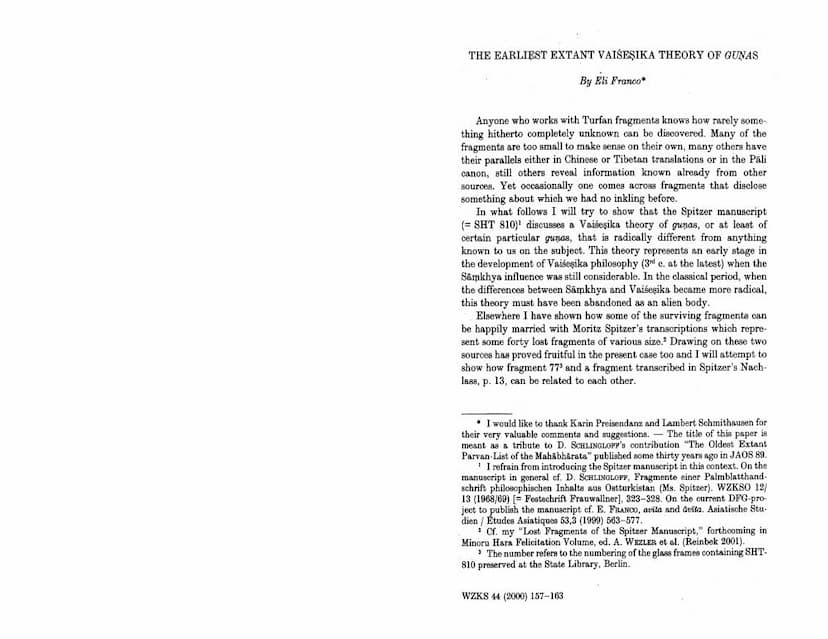
Here is a comprehensive summary of the provided text, "The Earliest Extant Vaisesika Theory of Gunas" by Eli Franco:
This article by Eli Franco discusses a fragment from the Spitzer manuscript (SHT 810), a collection of Buddhist and other Indian philosophical texts found in Turfan. Franco argues that this manuscript reveals a radically different theory of gunas (qualities) within the Vaisesika school, representing an early stage of its development (at least dating to the 3rd century AD). This early theory, he contends, was later abandoned as it was incompatible with classical Vaisesika doctrines and showed considerable influence from the Samkhya school.
The core of Franco's argument revolves around the interpretation of fragments 77a and 77b from the Spitzer manuscript. These fragments, along with transcriptions from Spitzer's Nachlass, are analyzed to present a dialogue, likely between a Vaisesika philosopher and a Buddhist opponent.
Key Findings and Arguments:
-
Novel Vaisesika Theory of Gunas: The most significant discovery is the Vaisesika philosopher's claim that qualities (gunas) do not cease to exist when they disappear. Instead, they are absorbed (pralina) into the atman (soul) and continue to inhere in it in an atomic form or state. This absorption is described as a "contraction into the state of an atom" (anusamavasthasamhṛta), not annihilation (avinasta).
-
Samkhya Influence: This doctrine bears a strong resemblance to the satkāryavāda (theory of pre-existing effect) of the Samkhya school. However, Franco highlights crucial differences:
- Samavaya Relationship: The Vaisesika text explicitly mentions the samavāya (inherence) relationship (ātmasamaveta, ātmani samaveta, asamavāya), a concept central to Vaisesika and not accepted by Samkhya.
- Location of Mental States: Unlike Samkhya, which assigns mental states like pleasure and pain to matter, the Vaisesika in this text considers them qualities inherent in the atman (sukhaduḥkham ātmani samavetam).
-
Opposition to Classical Vaisesika: This early theory directly contradicts classical Vaisesika doctrines. Classical Vaisesika does not accept samavāya for qualities of qualities and views qualities themselves as non-spatial entities. The idea of qualities existing in an atomic state, as suggested by this fragment, is incompatible with this later view.
-
Buddhist Objections: The Buddhist opponent raises several objections:
- Questioning how the atman can be a cause.
- Asking for the difference between absorbed and non-absorbed qualities inhering in the atman.
- Accusing the Vaisesika of the fallacy of dṛṣṭāntavirodha (contradiction by example), possibly using the example of speech that ceases to be perceived when one becomes silent.
-
Vaisesika Rebuttals and Explanations: The Vaisesika philosopher responds by explaining:
- Absorbed qualities are not perceived because they are "absorbed" in the atman, drawing an analogy to speech that is not perceived when withdrawn.
- Absorption doesn't mean complete destruction but a state of being "as if perished" (vinasta iva).
- The contact with the manas (mind) is the distinguishing factor, suggesting absorbed qualities are not in contact with the manas.
-
Early Reference to Omnipresent Atman: The text also provides an early reference to the atman being omnipresent (sarvagata). This is significant because it suggests a shift in the Vaisesika understanding of the atman's size, potentially as early as the 2nd century AD, predating other known early references to this doctrine. This also raises questions about how atomic qualities could be absorbed into an atomic atman.
-
Unusual Terminology: The term acāmakaraṇa applied to the atman is noted as unusual and its meaning is unclear, with a conjecture suggesting it might be acaranakam (not a cause).
In conclusion, Franco's article presents compelling evidence for a significant, but lost, stage in the development of Vaisesika philosophy. This early theory, deeply influenced by Samkhya, proposed a novel concept of absorbed qualities inhering in the atman in an atomic state, a notion that was later abandoned and replaced by the more established classical Vaisesika views. The discovery sheds light on the intellectual exchanges and evolving doctrines within ancient Indian philosophy.