
Doctrines Of Jainism And Their Contribution To World Peace
Added to library: September 1, 2025
Summary
Here is a comprehensive summary of the Jain text "Doctrines Of Jainism And Their Contribution To World Peace" by Shantilal V. Sheth, based on the provided pages:
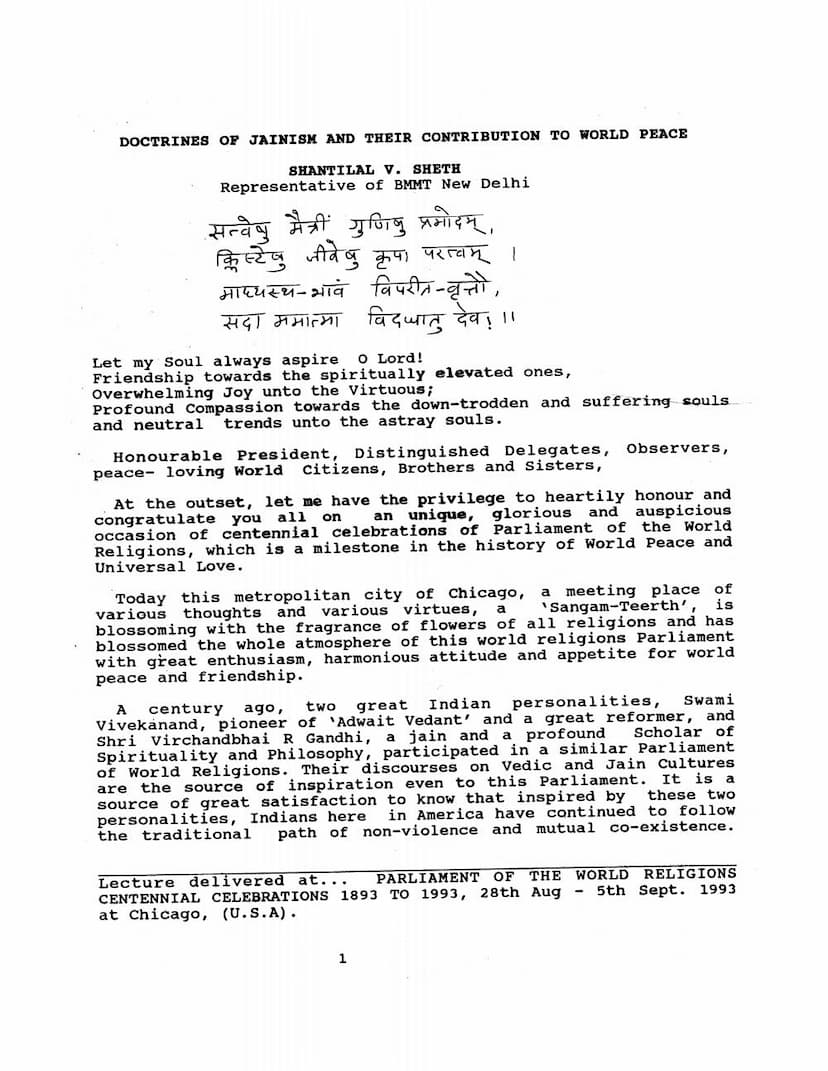
The book, delivered as a lecture at the Parliament of the World Religions Centennial Celebrations in Chicago (1993), presents Jainism as an ancient religion with profound doctrines that offer solutions to modern world problems and contribute significantly to world peace and universal love.
Introduction and Context:
- The author, Shantilal V. Sheth, begins by honoring the Parliament of the World Religions, a historical event fostering world peace and love.
- He draws inspiration from the participation of Swami Vivekananda and Virchandbhai R. Gandhi (a Jain scholar) in a similar parliament a century prior, highlighting their contributions to promoting non-violence and coexistence.
- Sheth emphasizes the continued influence of these principles through institutions like the Institute of Jainology and the upcoming University for Ahimsa.
Jainism's Core Principles and Relevance to World Problems:
- Jainism, as propounded by Lord Mahavir, is presented as a religion of spiritual peace, brotherhood, and universal love, not confined to any sect.
- The core tenets are Ahimsa (Non-violence), Anekant (Omni-perception), and Aparigraha (Non-possession).
- Sheth argues that these doctrines offer the true solutions to humanity's current state of fear, frustration, and conflict, which are not addressed by mere scientific or technological advancements.
- He criticizes the focus on development plans and arms, stating that they have not provided lasting peace and prosperity.
The Jaina Religion and its Foundations:
- The term "Jain" derives from "Jina," meaning "conqueror," referring to spiritual conquest over attachments and enmities. A Jain is one who conquers themselves, their greed, wrath, and pride.
- Lord Mahavir declared non-violence, self-restraint, and penance as the most auspicious tenets of religion. He advocated for examining religion through reason rather than blind faith.
- Jainism is described as an ethical religion with a unique metaphysical and epistemological framework.
Antiquity and Cultural Context:
- Jainism is presented as one of the world's oldest religions, predating Lord Mahavir, who was the 24th Tirthankara (omniscient teacher). The first Tirthankara was Lord Rishabadeva.
- Jain culture is identified as part of the Sramanic trend in Indian culture, distinct from the Brahmanic tradition.
- Archaeological evidence from Mohanjodaro, Harappa, and Mathura supports Jainism's antiquity.
Key Doctrines and their Contribution to Peace:
-
Ahimsa (Non-violence):
- This is the most important ethical doctrine, intrinsically linked to all other Jain vows and precepts.
- It extends to all living beings, moving and non-moving, based on the understanding that all creatures cherish life and abhor pain.
- The core message is: "All beings are fond of life like pleasure, hate pain, shun destruction, like life and love to live. To all life is dear."
- Ahimsa is practiced through forgiveness, friendliness, tolerance, self-control, and the elimination of egoism, possessiveness, selfishness, and sensual desires.
- It is seen as a means to convert foes into friends and foster mutual understanding and reconciliation, essential for peace in all spheres of life.
- The author quotes Mahatma Gandhi, stating that Jainism has explained Ahimsa most deeply and systematically.
-
Anekantvad (Omni-perception/Multi-facetedness):
- This doctrine emphasizes the relativity of truth and the existence of multiple viewpoints.
- It promotes reconciliation, mutual understanding, and brotherhood by encouraging the examination of opposing viewpoints.
- Jainism rejects "Ekantavada" (one-sidedness), which is a root cause of misunderstanding and conflict.
- By embracing all philosophical thoughts, Jainism offers a synthesis of opposing ideas, making it known as Syadvada or Nyayavada.
- This approach, when applied to life's problems, leads to reconciliation, termination of quarrels, and the achievement of peace and brotherhood. It's described as "mental non-violence."
-
Aparigraha (Non-possession):
- This doctrine addresses social inequality, the root cause of much suffering and poverty.
- It calls for controlling desires, limiting indulgence, and dispersing wealth.
- Accumulating more than one's requirements is seen as theft from society.
- This philosophy purifies society by valuing renunciation over possession, self-realization over infatuation, and charity and penance over materialism.
-
Samata (Equanimity):
- This is an essence of Jainism, meaning to remain peaceful, patient, and even-minded in all circumstances.
- Achieving true equanimity signifies ultimate inclusion, bravery, and fortitude.
- Lord Mahavir demonstrated equanimity throughout his life.
- The path to equanimity involves Equipoise (seeing all creatures as oneself), Friendship/Goodwill, and Service.
Practical Applications for World Peace:
- Equipoise: Treating all creatures like oneself fosters social awareness and self-liberation, recognizing that all beings seek happiness and fear pain.
- Love and Friendship: Cultivating friendship with everyone and love for the world at large is presented as a powerful force that can win over enemies.
- Service: Serving the old, diseased, and helpless is considered more valuable than religious worship. Selfless service elevates the soul and promotes sweet social relations.
Jain Doctrines and Modern Challenges:
- Science and Technology: While science provides knowledge about the material world, it lacks wisdom about life's meaning (beauty, happiness, love). Without self-control and Ahimsa, science and technology can widen the gap between rich and poor and lead to disaster. The synthesis of science, technology, and spirituality (Ahimsa) is crucial for human welfare (Sarvodaya); without it, there is destruction (Sarvanash).
- Environment: Jainism recognizes all forms of life, including elements, and views their destruction as violence. The principles of Ahimsa and Aparigraha promote conservation, non-killing, and reduction of wants, which are vital for environmental preservation.
- Social and Ethical Values: The decline of moral principles in politics, business, and personal life creates new forms of violence. Jain principles encourage self-control, non-harming for self-gain, and the cultivation of values like cooperation, love, and sacrifice to strengthen the social fabric.
Conclusion:
- The doctrines of Jainism provide a practical code of conduct for individuals and groups, fostering a stable society and preserving human freedom.
- Jain ethical and spiritual values are scientifically valid and timeless.
- The book concludes with a prayer for the adoption of Jain doctrines for world peace, emphasizing the path of Anekant, compassion, and universal fraternity as the "Viswadharma" (world religion).
In essence, Shantilal V. Sheth's lecture argues that the foundational principles of Jainism – Ahimsa, Anekant, and Aparigraha – offer a timeless and effective framework for addressing global challenges, fostering understanding, and achieving lasting world peace and universal well-being.