
Discipline Par Le Debat
Added to library: September 1, 2025
Summary
Here's a comprehensive summary of the provided text "Discipline Par Le Debat" by Johannes Bronkhorst, based on the provided pages:
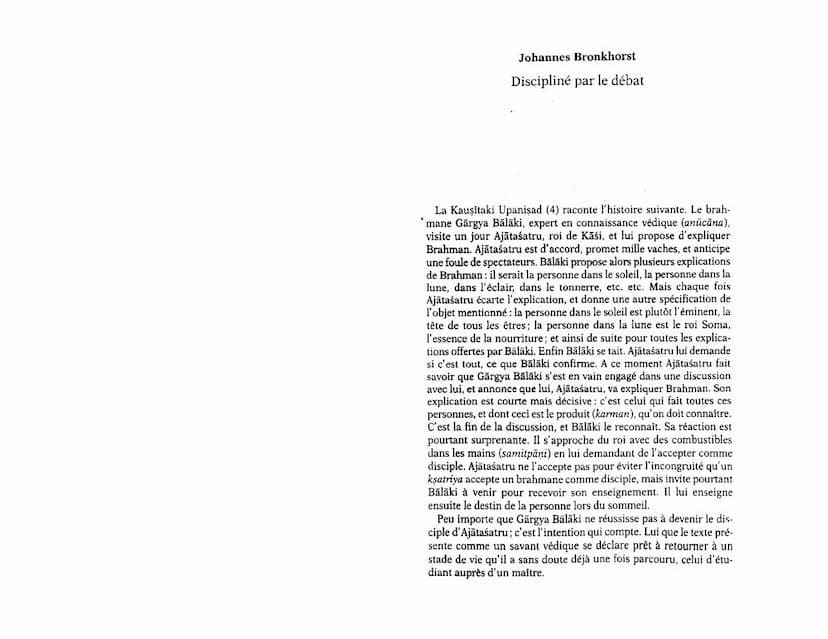
The text explores the concept of gaining knowledge and spiritual advancement through debate and intellectual challenges within ancient Indian Vedic literature. It highlights a recurring theme where respected scholars, particularly Brahmins, find themselves compelled to become disciples of others, often those from a lower social standing (Kshatriyas), due to their intellectual limitations revealed in debates.
Key Themes and Arguments:
- The Nature of Knowledge and Debate: The core argument is that in the Vedic context, knowledge is not a binary of "correct" or "incorrect." Instead, it's seen as hierarchical, with different levels of understanding. Debates serve as a mechanism to reveal these differences, with the victor possessing "more" or "superior" knowledge.
- Humiliation and Discipleship: A significant recurring motif is the apparent humiliation of learned Brahmins who, after being bested in a debate, voluntarily seek discipleship under their intellectual superiors. This is exemplified by the stories of Gārgya Bālāki and Ajātaśatru, and Uddālaka Āruṇi and his son Śvetaketu with various Kshatriya interlocutors like Citra Gārgyāyani and Pravāhaṇa Jaivali.
- The "Shattered Head" Phenomenon: The text discusses the serious consequences of being unable to answer a question or making a false claim to knowledge, which could result in the literal "shattering of the head." This illustrates the high stakes and the profound importance placed on intellectual prowess.
- Kshatriya Superiority in Certain Knowledge: The text notes that certain profound knowledge, particularly concerning concepts like the cycle of rebirth (karma) and liberation (moksha), was often held by Kshatriyas, and Brahmins were sometimes compelled to learn from them. This challenged the traditional Brahminical monopoly on knowledge.
- Inclusivism and Reverse Inclusivism: The author suggests that the Vedic tradition's tendency to incorporate foreign ideas is a form of "inclusivism." However, in the context of debates, it's not the older ideas that are subordinated to new ones, but rather the new ideas that are placed at the top of the hierarchy, forcing the older knowledge to integrate with them. This is termed "reverse inclusivism."
- Adaptation of Non-Vedic Ideas: When non-Vedic ideas, such as the doctrine of karma and rebirth, entered the Vedic tradition, they were not rejected but rather adapted and "Brahmanized" or "Vedicized" to fit within the existing framework. This adaptation was often a condition for their acceptance.
- The Value of Knowledge: The value of knowledge is not just about correctness but also about its depth and scope. The accumulation of knowledge grants status and the right to teach. Even "incorrect" or incomplete knowledge held by a participant in a debate is not entirely disregarded; it forms a basis for further understanding.
Specific Examples and Narratives:
- Gārgya Bālāki and Ajātaśatru: Bālāki, a Vedic scholar, attempts to explain Brahman to King Ajātaśatru but is repeatedly corrected. He ultimately submits to becoming Ajātaśatru's disciple.
- Uddālaka Āruṇi and Śvetaketu: These characters appear in multiple stories where they encounter intellectual challenges, often from Kshatriyas. In some instances, Uddālaka himself must seek knowledge, sometimes becoming a disciple, highlighting the fluid hierarchy of knowledge.
- The "Shattered Head" Examples: The text cites instances of questions that are too far-reaching or unanswerable, leading to the threat of a shattered head, as a consequence of intellectual failure. Gargi's question to Yajnavalkya is a prime example.
- Prajapati's Teaching to Indra and Virocana: This story illustrates that knowledge is revealed in stages, and each stage is considered valid, even if subsequent teachings offer deeper understanding. Indra's persistent dissatisfaction leads him through multiple periods of discipleship.
- Aśvapati Kaikeya's Teachings: Brahmins, including Uddālaka, seek knowledge from Aśvapati. While he accepts them as disciples, the narrative emphasizes that this knowledge is superior and a crucial "addition" to their existing understanding.
- The Integration of Karma and Rebirth: The text argues that the doctrine of karma and rebirth, likely originating from non-Vedic sources, was integrated into Vedic thought by being presented as a higher form of knowledge that enriched, rather than contradicted, existing Vedic speculations.
Conclusion:
"Discipline Par Le Debat" argues that Vedic intellectual traditions valued debate not merely as a means of refutation but as a structured process for the advancement and hierarchical ordering of knowledge. This process often led to Brahmins humbling themselves and becoming disciples, even to those outside their caste, when their knowledge proved insufficient in the crucible of intellectual exchange. The work emphasizes the dynamic nature of knowledge acquisition and the significant role of debate in shaping the intellectual landscape of ancient India.