
Did Buddha Believe In Karma And Rebirth
Added to library: September 1, 2025
Loading image...
Summary
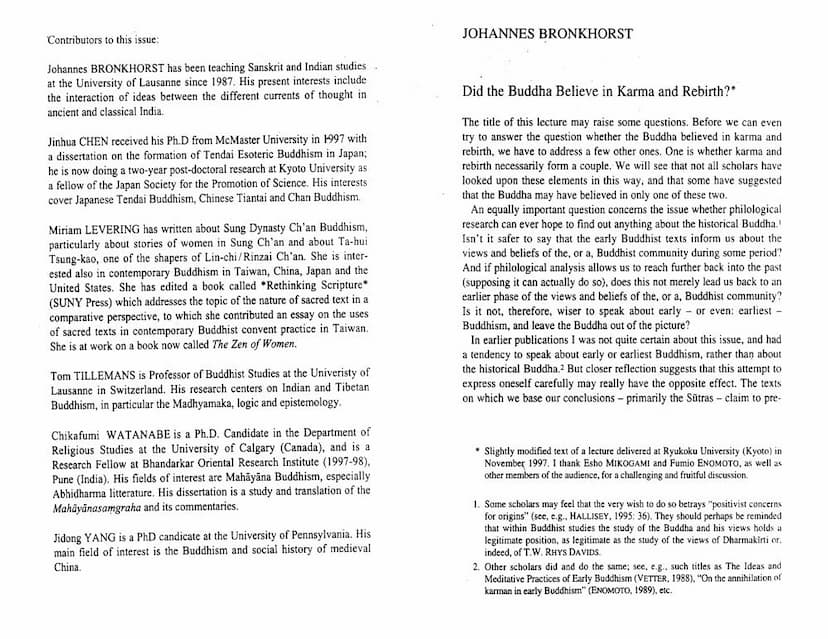
This text, "Did Buddha Believe In Karma And Rebirth" by Johannes Bronkhorst, explores the historical question of whether the Buddha adhered to the doctrines of karma and rebirth. Bronkhorst engages with the complexities of determining the Buddha's original teachings from early Buddhist texts, acknowledging the challenges of distinguishing the Buddha's views from those of his followers and later developments within Buddhism.
Key Arguments and Themes:
- Methodological Challenges: Bronkhorst begins by highlighting the difficulty of definitively attributing beliefs to the "historical Buddha" versus "early Buddhism." He argues that while texts claim to represent the Buddha's teachings, they may also reflect the evolving beliefs of the early Buddhist community. However, he asserts that relying on early texts is necessary for any attempt to understand the Buddha's views, and that these texts likely provide more information about the Buddha himself than about his earliest followers.
- Karma and Rebirth as a Pair: The text questions whether karma and rebirth are necessarily linked concepts, as some scholars suggest the Buddha might have believed in one without the other.
- Critique of Certain Scholarly Approaches:
- Tilmann Vetter's Theory: Bronkhorst critiques Vetter's idea that the Buddha initially focused on "the deathless" (nirvana) in the here and now, and only later became acquainted with the doctrine of rebirth. Bronkhorst finds Vetter's reasoning, based on variations in early sermons (like the Four Noble Truths), to be unconvincing, suggesting these textual differences are more likely due to post-Buddha transmission and preservation.
- Focus on Vedic Parallels: Bronkhorst also criticizes the tendency of some scholars (like Vetter and Enomoto) to equate early Buddhist views on karma and rebirth with the most archaic Vedic or Jaina texts. He argues that while parallels exist, they don't necessarily prove that the Buddha's earliest teachings were identical to these older traditions. He warns against assuming that passages deviating from the mainstream canonical view represent the Buddha's original thought, suggesting instead that they might be borrowings from other traditions.
- Fumio Enomoto's "Annihilation of Karma": Bronkhorst analyzes Enomoto's claim that early Buddhism, like Jainism, aimed at the annihilation of karma. He finds Enomoto's evidence, primarily a single verse from the Udana and the use of the term "nijjarā" (a Jain technical term), to be slender and possibly misinterpreted. He notes that the concept of annihilating karma through asceticism is often criticized within Buddhist texts, suggesting it was not the Buddha's central teaching.
- Bronkhorst's Proposed Methodological Rules:
- Look for Distinctiveness: To understand the Buddha's teachings, one should seek ideas that are distinct from other contemporary currents of thought, rather than ideas that simply differ from generally accepted Buddhist canonical views.
- Parsimonious Rejection: Instead of arbitrarily rejecting most of the canon to focus on a few favored passages, one should generally assume the canon preserves the Buddha's teachings and only discard specific ideas for specifiable reasons.
- Bronkhorst's Core Argument: Bronkhorst argues that the Buddha did believe in karma and rebirth, but his understanding of karma was distinct. For the Buddha, karma was primarily about intentions and desires (mental states), rather than simply physical or mental activity as understood by many contemporaries. This psychological focus, he contends, is what truly differentiated the Buddha's path to liberation.
- Critique of "Inactivity Asceticism": He contrasts the Buddha's approach with contemporary ascetic practices (like those of the Jainas) that sought to avoid rebirth through physical and mental immobility, which he sees as stemming from a different concept of karma (physical activity). He also critiques the idea of liberation through insight into an inactive self, as this also relies on a different understanding of karma.
- Persistence of Other Concepts: Bronkhorst acknowledges that practices and ideas associated with the non-Buddhist concept of karma continued to influence Buddhism throughout its history, appearing in texts that sometimes approved and sometimes criticized them. This reinforces his point that the Buddha's distinct understanding of karma was not universally accepted by his followers.
- Conclusion: Bronkhorst concludes with an unambiguous "yes" – the Buddha believed in karma and rebirth. However, he emphasizes that the Buddha's concept of karma, being rooted in mental states like desire and intention, was fundamentally different from the prevalent notions of his time. He speculates that this innovative concept of karma and the Buddha's psychological approach to liberation might have been genuinely new ideas rather than mere inheritances from existing traditions.