
Dexus Notes De Moyen Indo Aryen
Added to library: September 1, 2025
Summary
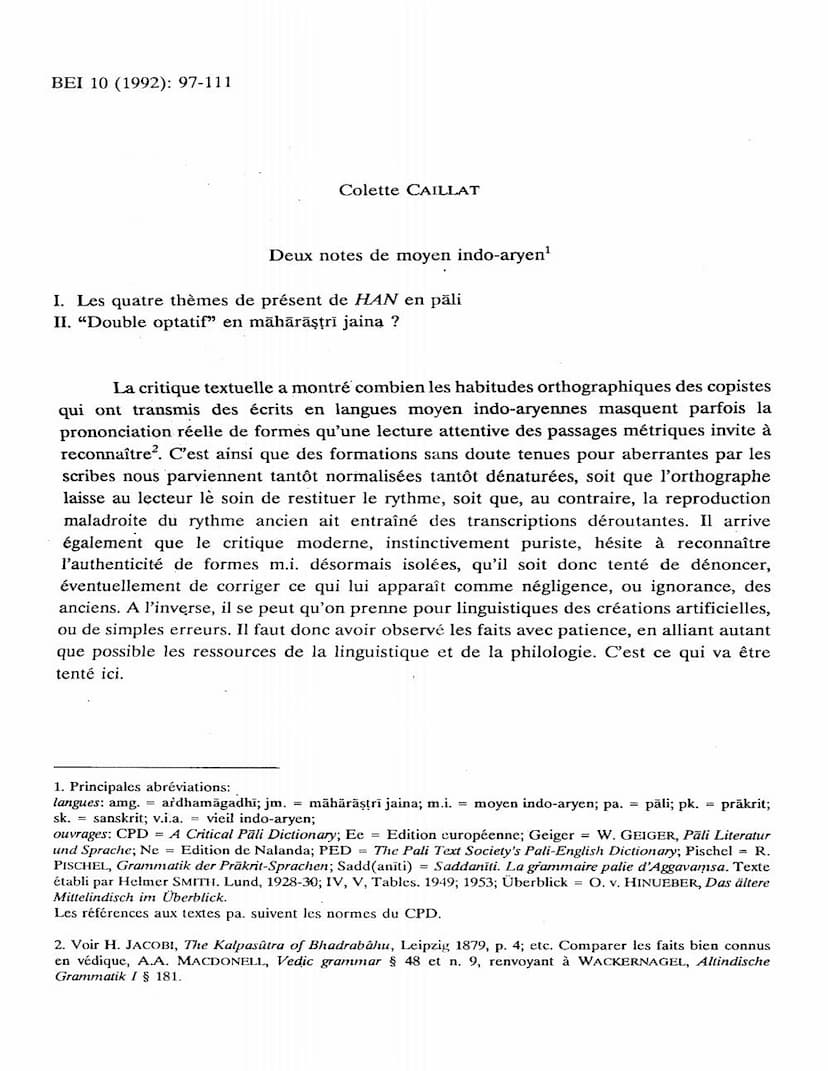
This academic article, "Deux notes de moyen indo-aryen" by Colette Caillat, published in BEI 10 (1992), explores two specific linguistic phenomena within Middle Indo-Aryan languages, focusing on Pali and Jain Mahārāṣṭrī.
The article is divided into two main sections:
Part I: The Four Present Stems of HAN in Pali
Caillat begins by addressing the challenges of textual criticism in Middle Indo-Aryan languages, where scribal habits often obscure the original pronunciation and metrical patterns. She then focuses on the root HAN ("to strike, to harm, to kill") and its various present tense stems in canonical Pāli. She highlights the diversity of these stems, which can sometimes appear aberrant to modern purists but are often supported by metrical evidence.
She identifies and discusses four main present stems derived from HAN in Pāli:
- (-)han(-ti): This is the most common 3rd person singular present form, frequently found in metrical passages of texts like the Suttanipāta and Dhammapada. Examples are provided to illustrate its usage, often in formulaic phrases.
- (-)hana(-ti): This stem, appearing in the 3rd person plural, is seen as a development from the older, reduced-grade stem. Examples from the Suttanipāta illustrate this form. Caillat notes that the phonetic particularities of Indo-Aryan influenced the development of this root, leading to the generalization of the hana- theme.
- (-)hanā(-ti): This stem with a long final vowel in the 3rd person singular is considered indisputably present in the Pāli tradition, often supported by meter or easily reconstructible. It also has parallels in Ardhamāgadhī. Caillat discusses instances from the Jātaka stories and the Vinaya, exploring potential hesitations in transcription and hypothesizing about the origin of these forms, linking them to a series of Middle Indo-Aryan presents with a thematic vowel extended to -ā-. She also draws parallels with the root BHAN ("to speak") which also exhibits a similar vowel alternation.
- haññati: This fourth type of present stem, resembling the Pāli maññati (Sanskrit manyate), is presented. Caillat notes its presence in both verse and prose, and discusses its potential use in both intransitive and transitive contexts. She examines the Saddanīti, a Pāli grammar, which classifies pațihaññati under the div-ādi class and notes its intransitive nature. However, Caillat presents examples from the Jātaka where haññati appears to be used transitively, interpreting certain passages where editors might have assumed a passive voice as active ones with indefinite subjects. She also touches upon the imperative form āhaññarum, suggesting it's a doublet of the common active imperative āhaññantu.
Caillat concludes this section by stating that the forms of the hañña- stem are of assured authenticity and likely older than some comparable forms found in the Saddanīti. She also briefly touches on the optative haññe, noting its various spellings and its active, potentially archaic nature. She connects this analysis to her earlier work on the Asokan edicts, supporting the interpretation of na hamñeyasu and na hamnesu as active optatives wishing for people to "cease killing."
Part II: The "Double Optative" in Jain Mahārāṣṭrī?
In the second part, Caillat turns her attention to the Jain Mahārāṣṭrī language, specifically examining optative forms in the Mahānisīhasutta. She notes that this text, considered relatively late, exhibits numerous linguistic and stylistic peculiarities, including what she terms "artifices."
She focuses on the optative forms labbhe and janne, observed by scholars like W. Schubring, F.-R. Hamm, and J. Deleu. Deleu's explanation that the intervocalic consonant was doubled "metri causa" is considered only partially convincing, given potential metrical deficiencies in the text.
Caillat proposes that these forms might not be entirely artificial. For labbhe, she points to the existence of a relatively fixed form labha in Pāli and Prakrit, meaning "one can obtain" or "one has the right to," which might have influenced the creation of labbhe. She also notes the presence of a future form labbhihi in the Dasaveyāliya, suggesting a possible underlying active present stem labbha-.
Similarly, for janne, she notes that the Saddanīti classifies the present stems of the root JAN ("to generate, to produce") within the divādi class, indicating a transitive meaning akin to "to make" or "to cause." This parallels the observed optative janne.
Caillat concludes that these optative forms in the Mahānisīha might reveal the latent potential of Indo-Aryan languages, which traditional grammar tends to overlook. They could be based on obscure survivals or analogies, demonstrating a dynamic interplay between phonetic and morphological variations.
Summary of the Summary (provided by the article itself):
The article's own summary highlights the continuation of previous research on the root HAN in Pāli, detailing its four present stems. It then discusses the Jain Mahārāṣṭrī optatives labbhe and janne from the Mahānisīhasutta, questioning whether they are artificial or based on underlying linguistic realities. It suggests that labbhe might be influenced by the invariant labha, and janne by the transitive present stem of the root JAN. The article posits that these forms could represent the realization of Indo-Aryan potential not always captured by traditional grammar.
In essence, Caillat's article is a detailed philological and linguistic analysis that delves into the nuances of verb morphology in ancient Indian languages, using textual evidence and comparative analysis to illuminate the complexities and evolution of grammatical forms.