
Context Of Indian Philosophy
Added to library: September 1, 2025
Summary
Here's a comprehensive summary of Johannes Bronkhorst's "The Context of Indian Philosophy," based on the provided text:
The Importance of Context in Understanding Indian Philosophy
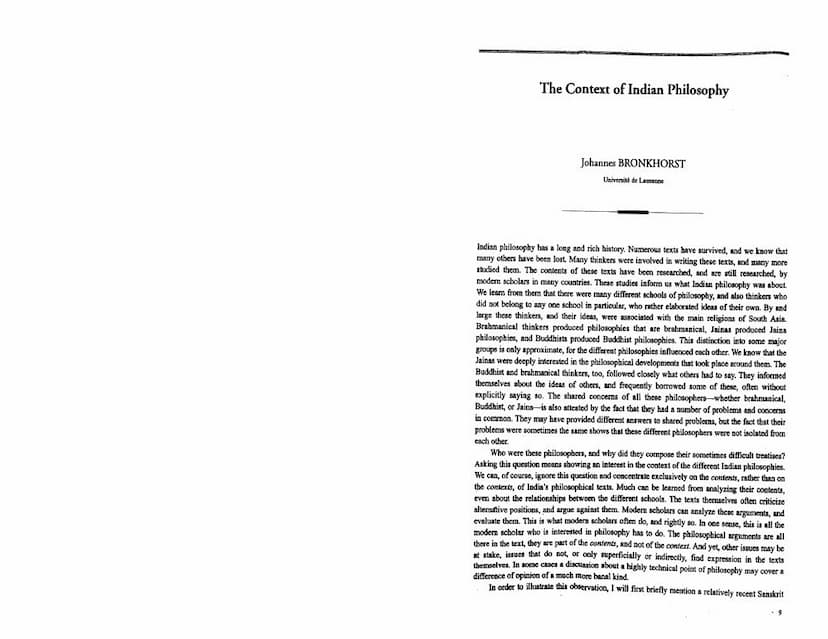
Johannes Bronkhorst argues that to truly understand Indian philosophy, one must move beyond simply analyzing the content of its texts. While textual analysis is valuable, it's insufficient on its own. A crucial, and often overlooked, element is the context in which these philosophical ideas were developed and disseminated.
Key Arguments and Examples:
-
Interconnectedness of Indian Philosophical Traditions: Indian philosophy is characterized by the interaction and mutual influence between major traditions like Brahmanical, Buddhist, and Jain. Philosophers within these schools were aware of, and often engaged with, the ideas of others, even if their answers differed. This shared intellectual landscape is a fundamental aspect of its context.
-
Beyond Purely Philosophical Debates: While philosophical arguments are part of the textual content, the reasons behind them often lie in contextual factors that are not explicitly stated in the texts. These can range from personal disagreements to broader social and religious affiliations.
-
The Case of Bhattoji Diksita (The Grammarian): Bronkhorst uses Bhattoji Diksita, a 16th-century Sanskrit grammarian, as a prime example. Bhattoji's commentary on his own grammatical treatise, while seemingly a purely academic discussion of interpretations of Panini's grammar, subtly critiqued his teacher's views. This critique, not explicitly stated, was understood by contemporaries and led to heated responses from the teacher's disciples. The underlying motivation for Bhattoji's seemingly inappropriate critique was likely a difference in religious affiliation (Advaita Vedanta vs. Madhva's Vedanta), a fact only accessible through contextual information outside of Bhattoji's works. This illustrates how personal or sectarian differences can drive philosophical discourse.
-
The Social Dimension of Philosophical Debates (Universals and Caste): The debate about the existence of universals (e.g., "cow-ness") took on a significant social dimension with thinkers like the Brahmanical Kumarila Bhatta and the Buddhist Dharmakirti. Kumarila applied the concept of universals to social classes, arguing for an inherent "Brahmin-ness" that distinguished Brahmins. Dharmakirti and his followers, as Buddhists, rejected this claim of inherent superiority. This highlights how philosophical positions can be rooted in and support social structures and identities. The opposition between Brahmins and Buddhists on this issue had deep historical roots, predating these specific thinkers.
-
The Role of Social Norms and Public Debates: Bronkhorst posits that a social custom – the tradition of public debates between philosophers of different persuasions – was instrumental in shaping Indian philosophy, particularly in fostering the development of coherent systems of thought.
- High Stakes: These debates often had significant consequences, including the loss of reputation, privileges, and even, in some accounts, life. This created a strong incentive for philosophers to prepare rigorously, develop logically sound arguments, and meticulously critique their opponents' positions.
- Systematization: The need to defend one's views effectively in public debates compelled philosophers to create coherent, internally consistent systems of thought, rather than mere collections of wisdom.
- Examples of Debates: Bronkhorst cites accounts from Chinese pilgrims like Xuanzang (Genjo) and texts like "The Life of Vasubandhu," which depict intense public debates with high stakes. These stories illustrate how winning or losing could have tangible benefits or severe repercussions, such as receiving royal patronage or facing public humiliation and defeat.
-
The Origins of Systematization and Debate: Bronkhorst suggests that the practice of systematization and the tradition of public debate may have originated in the Greek courts of northwestern India during the last centuries BCE. The interaction between Greeks and Buddhists in this region, who were interested in intellectual discourse, might have played a role in the early development of systematic Buddhist thought (Sarvāstivāda) and the engagement in critical debate.
-
The Evolving Nature of Context: While some contextual factors, like the Brahmanical claim to superiority and the tradition of debate, are long-standing, they were not static. Bronkhorst notes that the intensity and nature of debates varied, and the quality of criticism depended on proper engagement with opponents' arguments. The Theravada Buddhist text Kathavatthu is presented as an example of criticism lacking deep understanding of the opposing Sarvāstivāda positions, suggesting a less developed debate tradition in that specific context.
-
The Disconnect Between Theory and Practice (Buddhist Monks): Bronkhorst also touches upon a potential disconnect between philosophical ideals and lived reality. Citing Gregory Schopen's work on Buddhist monks in northwestern India, he suggests that despite the philosophical emphasis on liberation through study, monastic corporations sometimes marginalized or ridiculed monks engaged in serious contemplative practices. This raises questions about whether some philosophical ideals were merely paid lip service.
Conclusion:
Bronkhorst concludes by emphasizing that Indian philosophy is not a collection of timeless truths but a product of its specific historical, social, and intellectual environment. Understanding this context is not an optional indulgence but a necessary prerequisite for optimal understanding. Ignoring context risks misinterpretations and misses crucial insights into the motivations, development, and enduring questions that shaped Indian philosophical thought. It is through understanding the "why" and "how" of philosophical engagement, shaped by its surroundings, that we can truly grasp the richness and complexity of Indian philosophical traditions.