
Concept Of Vibhajjavada And Impact
Added to library: September 1, 2025
Summary
Here's a comprehensive summary of the provided text, focusing on the concept of Vibhajjavāda and its impact on philosophical and religious tolerance in Buddhism and Jainism:
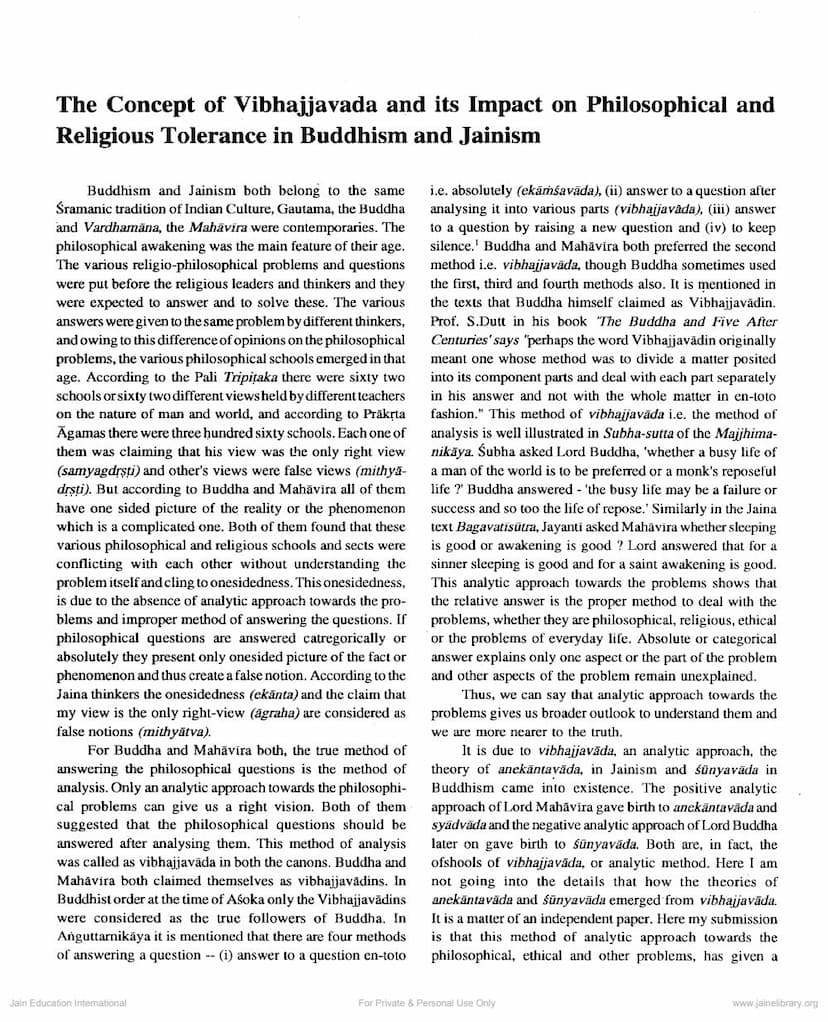
The text, "The Concept of Vibhajjavada and its Impact on Philosophical and Religious Tolerance in Buddhism and Jainism" by Sagarmal Jain, explores a shared philosophical approach between Buddhism and Jainism, stemming from their common Sramanic tradition. Both Gautama Buddha and Mahāvīra, contemporaries, emerged during an era of significant philosophical inquiry, where numerous schools offered diverse answers to fundamental questions about existence.
The Problem of One-Sidedness (Ekānta): The author highlights that during this period, various philosophical schools, numbering sixty-two in Buddhism and three hundred sixty in Jainism, each claimed their view as the only correct one (samyagdrsti) and others as false (mithyadrsti). Both Buddha and Mahāvīra recognized that these conflicting viewpoints presented only a "one-sided picture of reality" due to an absence of analytical approach and improper methods of answering questions. Categorical or absolute answers, they believed, create false notions and lead to disharmony. Jain thinkers, in particular, considered one-sidedness (ekānta) and rigid adherence to one's own view (āgraha) as false notions (mithyātva).
Vibhajjavāda: The Method of Analysis: The core of the argument is that Vibhajjavāda, meaning the method of analysis, was the preferred approach for both Buddha and Mahāvīra in answering philosophical questions. They both identified themselves as Vibhajjavādins. This method involves breaking down a problem into its constituent parts and addressing each part separately, rather than providing an absolute, all-encompassing answer.
Examples of Vibhajjavāda:
- Buddhism: The text cites the Anguttaranikāya which outlines four methods of answering:
- Answer in toto (ekāmśavāda)
- Answer after analysis (vibhaijavāda)
- Answer by raising a new question
- To keep silence Buddha is noted to have preferred Vibhajjavāda, though he also employed the other methods. An example from the Majjhimanikāya shows Buddha responding to a question about preferring a worldly life or a monk's life by stating that both could lead to success or failure, thus analyzing the situation rather than giving a simple "yes" or "no."
- Jainism: The Bhagavatīsūtra provides an illustration where Mahāvīra answers whether sleeping or awakening is better by stating that it depends on the individual: for a sinner, sleeping is good; for a saint, awakening is good.
Impact on Philosophical and Religious Tolerance: The author asserts that this analytic approach of Vibhajjavāda is the foundation for the development of Anekāntavāda in Jainism and Śūnyavāda in Buddhism.
- Anekāntavāda: Jainism's theory of Anekāntavāda (non-absolutism) emphasizes respecting the views, ideologies, and faiths of others. It posits that all viewpoints (nayavāda) are true in their own context but false when they negate other viewpoints. True understanding comes from synthesizing multiple perspectives, akin to a sighted person grasping an entire elephant versus a blind person touching only a part.
- Śūnyavāda: Buddhism's Śūnyavāda (emptiness or voidness), emerging from a "negative analytic approach," is also seen as a product of Vibhajjavāda.
Both Buddha and Mahāvīra actively condemned one-sided thinking as the primary cause of philosophical and religious quarrels and intolerance. They believed that true scholars see multiple aspects of reality, and those who cling to a single perspective are prone to conflict. The text quotes Buddha emphasizing the folly of not acknowledging opposing doctrines and the negative consequences of disputes.
Evidence of Tolerance in Practice:
- Buddhism: The text notes that this tolerant outlook was evident in Buddhism during Ashoka's reign, as indicated by his inscriptions promoting religious tolerance and coexistence. The author expresses uncertainty about whether this outlook was maintained later in India but acknowledges its presence in Buddhism's expansion outside India.
- Jainism: Jainism's commitment to religious tolerance and harmony was sustained by later Jaina Acāryas. The text mentions the Isibhāsiyāim, a 3rd BCE text, which respectfully presents the views of various Sramanic and Brahmanic thinkers. The author concludes by quoting verses from the 8th-century Acārya Haribhadra and the 12th-century Acārya Hemacandra, both of whom advocate for accepting rational and logical arguments irrespective of their origin and bowing to all those who have overcome attachment and hatred, regardless of their specific religious affiliation (Jina, Brahma, Vishnu, Shiva).
In essence, the book argues that the shared Vibhajjavāda (analytic method) of Buddha and Mahāvīra fostered the development of Anekāntavāda and Śūnyavāda, respectively, which in turn promoted philosophical and religious tolerance by advocating for a nuanced understanding of reality and respect for diverse viewpoints. This analytical approach, by dissecting complex issues and avoiding rigid, one-sided pronouncements, laid the groundwork for interfaith harmony and mutual respect within the Sramanic tradition and beyond.