
Cattle Field And Barley Note On Mahabhasya
Added to library: September 1, 2025
Summary
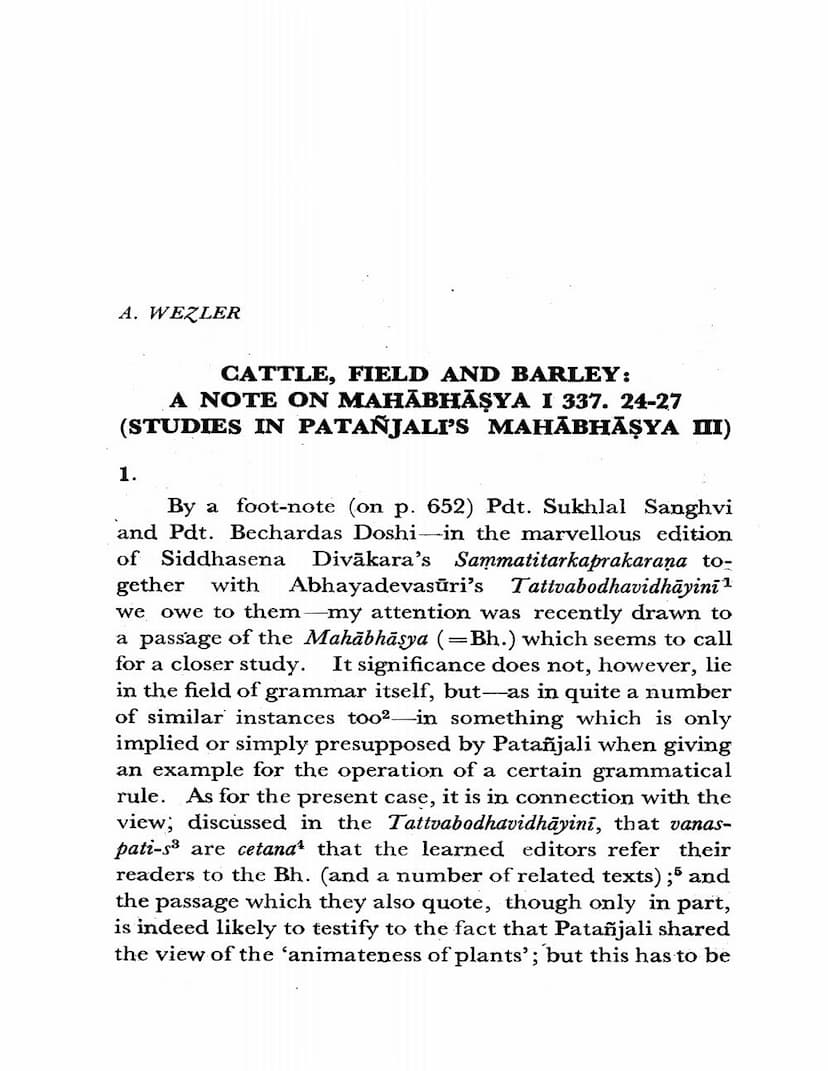
Here's a comprehensive summary of the provided text, "Cattle, Field and Barley: A Note on Mahābhāṣya I 337. 24-27" by A. Wezler, focusing on its key arguments and findings:
The article by A. Wezler delves into a specific passage in Patanjali's Mahābhāṣya (Bh.) concerning a grammatical rule (Panini's sūtra 1.4.52) and its application to the verb bhakṣayati (to eat). The author's primary goal is to clarify the underlying assumptions and potential interpretations of this passage, particularly in relation to the concept of "animateness of plants" (cetanatva).
Key Points and Arguments:
-
The Grammatical Context: The Mahābhāṣya passage discusses sūtra 1.4.52, which defines karman (object) for verbs of movement, cognition, and consumption, as well as for sound-related and intransitive verbs. Patanjali's vārttika 7 by Katyāyana and Patanjali's commentary on it introduce a restriction: the rule does not apply to bhakṣayati when it denotes the act of ahimsā (non-injury). If bhakṣayati denotes himsa (injury), the rule does apply.
-
The Core Problem: The Meaning of Himsā The crucial question for the article is what constitutes himsa in the context of bhakṣayati, especially in Patanjali's counter-example: "oxen eat barley plants" (bhakṣayanti yavān balīvardāḥ). The ambiguity arises from whether the himsa refers to the plants themselves or to their owner.
-
Two Competing Interpretations:
- Interpretation 1: Injury to the Plants: This interpretation posits that the himsa occurs because the barley plants are sentient beings (cetana) and are being harmed by being eaten. This aligns with the broader Jain and Indian philosophical idea that plants possess life.
- Interpretation 2: Injury to the Owner: This interpretation suggests that the himsa is done to the owner of the field whose property (the barley) is being consumed by someone else's cattle. This is framed within the legal context of "damage to crops" (sasyavināśa), a concern in Dharmaśāstra texts.
-
Scholarly Debate and the Author's Analysis: Wezler meticulously examines the commentaries of various Pāṇiniya scholars (Kaiyaṭa, Nageśa, Annambhaṭṭa, Śivarāmendrasarasvatī, Jinendrabuddhi, Bhattojidīkṣita, Vāsudevadīkṣita, Haradatta) on Patanjali's example.
- Kaiyaṭa and Haradatta: Present both interpretations, leaving the matter somewhat open.
- Annambhaṭṭa: Seems to favor the first interpretation (injury to plants) as Kaiyaṭa's primary view.
- Nāgeśa: Initially favors the first interpretation, citing "Bhasya's intention" (bhāṣyasvarasāt), but later, in a different work, leans towards the second interpretation.
- Śivarāmendrasarasvatī: Firmly supports the first interpretation, asserting the plants' sentience.
- Jinendrabuddhi: Attempts to reconcile both by proposing that the damage to the crop leads to harm to the owner, influenced by Jain doctrine.
- Bhaṭṭojīdīkṣita and Vāsudevadīkṣita: Clearly advocate for the first interpretation, emphasizing the plants' sentience.
-
The Author's Conclusion and Argument for Interpretation 1: Wezler argues strongly for the first interpretation (injury to the plants as sentient beings) being Patanjali's original intention. His reasoning includes:
- Lack of Mention of the Owner: If the himsa was primarily about material loss to the owner, Patanjali would likely have explicitly mentioned the owner. The absence of such mention is significant.
- Intelligibility of the Distinction: The grammatical distinction between ahimsārtha and himsārtha use of bhakṣayati becomes clearer if the latter refers to injury to living beings. Harming an owner (by damaging their property) can be achieved in many ways, not just through consumption.
- Patanjali's Focus: The core of the distinction lies in whether the object is a "dead thing" (like a prepared food pindi) or a "living being" (like young barley plants).
- Historical Context: Wezler suggests that at the time of Patanjali, the belief in the animateness of plants was more widespread, and this idea, particularly preserved in Jainism, likely informed his example. The later scholars who struggled with the interpretation might reflect a decline in this widespread belief.
- The "Damage to Crops" Aspect (Interpretation 2): While acknowledging that damage to crops is a legitimate concern in Dharmaśāstra, Wezler argues that this legal/economic dimension doesn't fully explain Patanjali's specific grammatical choice. The Dharmaśāstra texts are primarily concerned with material loss, guilt, and punishment, not with the inherent sentience of plants.
-
Ancillary Discussion (Panini 1.4.27): The article also briefly examines Patanjali's example for sūtra 1.4.27 (vāranārthānām ipsitaḥ) concerning preventing cows from eating beans (māṣebhyo gā vārayati). Here, Patanjali's explanation focuses on the herdsman's fear of legal consequences (rājabhaya) and adharma (unrighteousness) due to crop destruction, not on the beans' sentience. Wezler uses this passage to contrast Patanjali's focus in different contexts, suggesting his primary concern in the bhakṣayati passage is indeed ethical/animistic.
Overall Significance:
The article makes a significant contribution by arguing that Patanjali's grammatical examples in the Mahābhāṣya often carry deeper philosophical and ethical implications. It highlights the importance of considering the historical context of beliefs, particularly the concept of plant animateness, when interpreting ancient Indian texts. Wezler ultimately asserts that Patanjali's example of oxen eating barley plants is a deliberate illustration of himsa as injury to sentient beings, aligning with a worldview that recognized life in the vegetal kingdom, a perspective that was perhaps more prevalent in Patanjali's time than in later periods when the commentaries were written.