
Cattle Field And Barley Note On Mahabhasya
Added to library: September 1, 2025
Summary
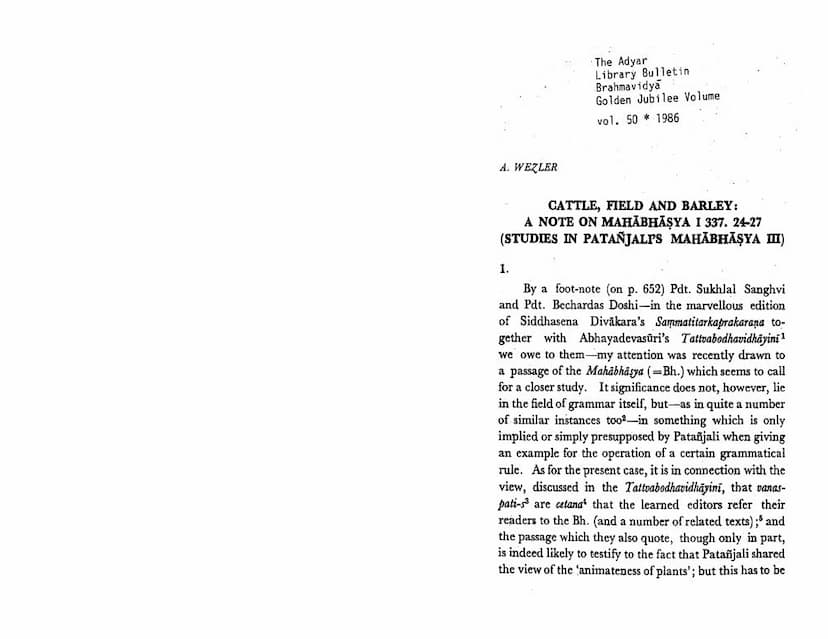
Here's a comprehensive summary of the provided Jain text, "Cattle, Field and Barley: A Note on Mahabhasya I 337. 24-27" by A. Wezler:
The article by A. Wezler delves into a specific passage in Patañjali's Mahābhāṣya (Bh.), concerning Pāṇini's grammatical rule 1.4.52. This rule deals with the classification of the agent of a verb as karman (object) in specific contexts, particularly when the verb denotes movement, cognition, or consumption, or is intransitive. The author's primary focus is to clarify the implication of Patañjali's examples used to illustrate a restriction on this rule, especially Vārttika 7 by Kātyāyana, which states bhakṣer ahimsārthasya ("of the verb bhakṣ [to eat] when it means ahimsā [non-injury]").
Key Issues and Arguments:
-
The Central Grammatical Problem: The passage in the Mahābhāṣya discusses the verb bhakṣayati. According to Pāṇini's rule 1.4.52, the agent of certain verbs (including those denoting consumption) can be treated as an object (karman) when a causative suffix (ni) is added. However, Kātyāyana's Vārttika 7 restricts this rule: it does not apply when the verb bhakṣ means ahimsā (non-injury). Patañjali provides examples to illustrate this:
- Ahimsa (non-injurious) example: Devadatta bhakṣayati pindim ("Devadatta eats a ball of food").
- Himsa (injurious) example: Devadattena bhakṣayati pindim ("[Someone] makes Devadatta eat a ball of food").
Patañjali then offers counter-examples for the ahimsā restriction:
- Bhakṣayanti yapän balivardāḥ ("The oxen eat the barley [in the field]").
- Bhakṣayanti balivardān yapän ("[Someone] makes the oxen eat the barley [plants]").
The core of the debate revolves around why the oxen eating barley is considered an act of himsa (injury) in the second example, and consequently, why Pāṇini's rule applies to the causative form.
-
The "Animateness of Plants" (Cetanatva): The author highlights that the significance of these examples lies not just in grammar but in the underlying philosophical and ethical assumptions, particularly concerning the animateness of plants. This is directly linked to the concept of himsa.
- Interpretation 1: Injury to the Plants Themselves: Some commentators, like Bhaṭṭojidikṣita and Vāsuṣevadikṣita, argue that eating barley plants in the field constitutes himsa because the plants themselves are considered sentient (cetanā) at that stage of growth (sprouting). This view aligns with the idea that harming a living being is himsa.
- Interpretation 2: Injury to the Owner: Other commentators, including Kaiyaṭa and Nāgeśa (in some instances), suggest that himsa refers to the material damage or loss caused to the owner of the field. The oxen eating someone else's barley harms the owner.
-
Debate Among Commentators: The article meticulously traces the differing opinions of various Pāṇiniya scholars:
- Kaiyaṭa: Offers both interpretations (injury to plants due to their perceived animateness, or injury to the owner) without a definitive preference.
- Annambhaṭṭa: Seems to lean towards the first interpretation (injury to plants) as Kaiyaṭa's primary view, with the second as an explanation for non-believers.
- Nāgeśa: In his Uddyota, he initially suggests both interpretations are possible but later, in his Laghusabdenduśekhara, seems to favor the second (harm to the owner), though in his Br̥haśabdenduśekhara, he presents both. His reasoning sometimes hinges on the bhāsyasvarasa (the spirit of the Mahābhāṣya).
- Śivaramendrasarasvati: Explicitly states that the injury is to the plants because they are sentient.
- Haradatta: Mirrors Kaiyaṭa's dual interpretation.
- Jinendrabuddhi: Attempts to synthesize both, arguing that if plants are sentient (as per Jainism), harming them ultimately harms their owner.
- Bhaṭṭojidikṣita & Vāsuṣevadikṣita: Strongly support the first interpretation, emphasizing the animateness of plants.
- Ramacandra: Shifts the example metaphorically, which the author dismisses as deviating from Patañjali's intent.
-
The Author's Analysis and Conclusion: Wezler argues for the first interpretation (injury to the plants) as the one most likely intended by Patañjali and Kātyāyana. His reasoning includes:
- Direct Object of Injury: The grammatical object of "eating" is the barley plants themselves. For the plants to be simultaneously the object of eating and the entity harmed, they must be considered living.
- Unintelligibility of the Second Interpretation: If the himsa were solely about material loss to the owner, the distinction between ahimsā and himsa usage of the verb would be less clear. One could harm someone by eating a ball of food if it belonged to them.
- Semantic Parallelism: Patañjali's examples often focus on the nature of the object. The contrast between a pindi (a prepared food item, considered dead) and young barley plants (considered alive) effectively illustrates the core distinction between ahimsā and himsa.
- Historical Context: The author posits that at the time of Patañjali, the belief in the animateness of plants was likely more prevalent and common, perhaps even considered "common belief" or "archaic animism." Jainism, in particular, is highlighted for preserving this idea. The reluctance of later commentators to fully embrace the animateness of plants might stem from a perceived minority status of this doctrine in their own times.
- Dharmaśāstra Comparison: The author examines Dharmaśāstra texts concerning damage to crops by cattle. While these texts focus on legal and material aspects (damage to property, fines, king's role), they primarily discuss damage and loss, not the animateness of the plants themselves. This contrast further suggests that Patañjali's focus in the Mahābhāṣya passage was on the ethical dimension of himsa related to living beings, rather than the legal/economic aspect.
-
The Role of Ahimsa Doctrine: The article connects the grammatical discussion to the broader development of the ahimsa doctrine in India. The early prevalence of the idea that plants are living beings contributed to the understanding of eating them as himsa. Wezler suggests that Patañjali likely considered eating young, growing plants as himsa precisely because they were seen as alive, distinguishing this from eating processed food.
In essence, Wezler argues that Patañjali's examples in the Mahābhāṣya implicitly rely on and reflect a worldview where plants were considered sentient beings, making their consumption an act of himsa. This interpretation is crucial for understanding the grammatical rule and its exceptions, and it offers insight into the ethical and philosophical underpinnings of early Indian thought regarding nature and life.