
Candragomins Syntactic Rules Some Misconceptions
Added to library: September 1, 2025
Summary
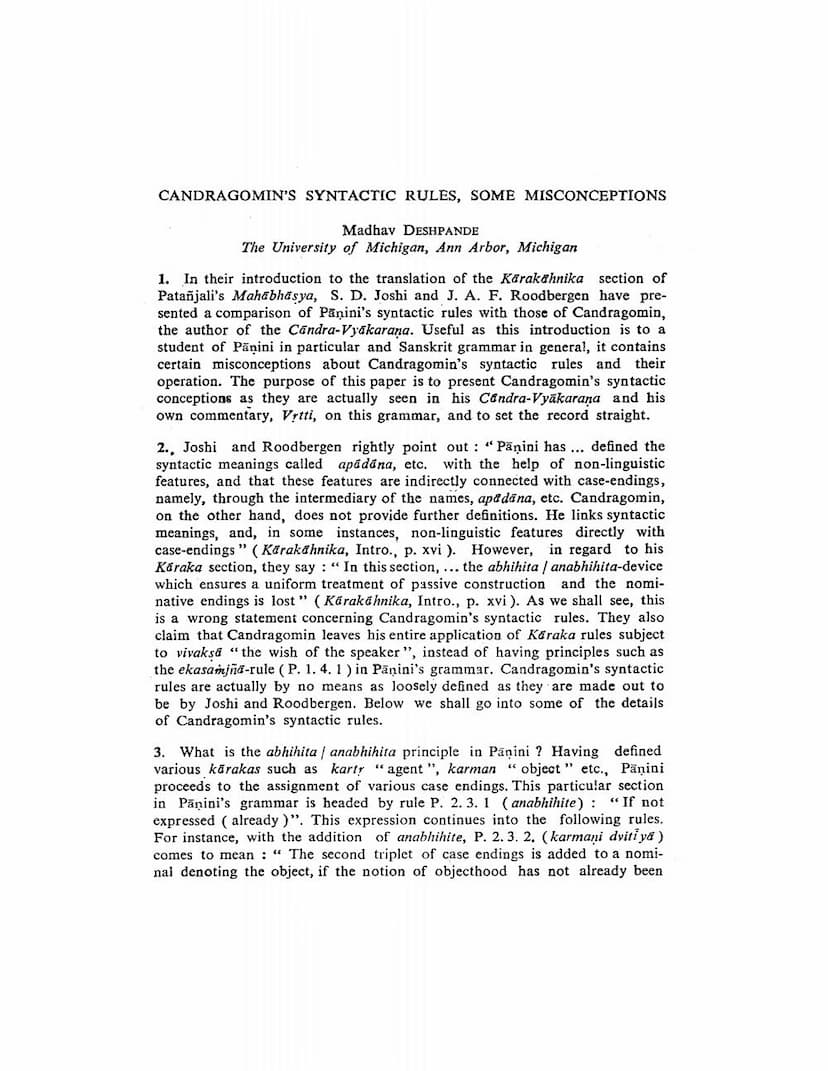
This paper, "Candragomin's Syntactic Rules: Some Misconceptions" by Madhav Deshpande, aims to correct what the author believes are inaccuracies in the interpretations of Candragomin's syntactic rules by S.D. Joshi and J.A.F. Roodbergen, particularly concerning their comparison with Pāṇini's grammar.
Deshpande argues against the following claims made by Joshi and Roodbergen:
-
Loss of the abhihita/anabhihita principle in Candragomin: Joshi and Roodbergen suggest that Candragomin's grammar loses the abhihita/anabhihita (expressed/unexpressed) device, which ensures uniform treatment of passive constructions and nominative endings, and that Candragomin relies solely on vivaksā (speaker's wish). Deshpande counters this by demonstrating that Candragomin indeed employs the abhihita/anabhihita principle. He points to Candragomin's Paribhaṣā-sūtras, which include the maxim uktārthānām aprayogaḥ ("no linguistic item is used to denote something which is already otherwise denoted"), serving the same function as Pāṇini's anabhihite rule but with a wider scope. He further illustrates this with examples from Candragomin's commentary (Vṛtti) on his rules, showing how the principle governs case-ending assignments, especially in passive constructions.
-
Candragomin's reliance on vivaksā: The critics claim Candragomin leaves his karaka rules open to vivaksā, unlike Pāṇini's more principle-based approach. Deshpande argues that this is an oversimplification. While vivaksā plays a role, Candragomin's system is not as loosely defined as presented. He highlights that Candragomin has rule-ordering and conflict-resolution mechanisms, similar to Pāṇini, albeit sometimes operating differently.
-
Misunderstanding of Candragomin's yak affix rule: Joshi and Roodbergen interpret Candragomin's rule C.1.1.80 (tin-siti yag a-lid-āsirlini) as introducing the suffix yak to denote bhāva (action) and karma (object), suggesting a "trick" to replace Pāṇini's terminology. Deshpande clarifies that this rule is an exact equivalent of Pāṇini's P.3.1.67 (sarvadha tuke yak) and that yak itself does not denote bhāva or karma. Both grammarians use yak after verb roots followed by certain affixes, with the continuation of bhāva-karmanoh from preceding rules.
-
Candragomin's handling of shared kārakas and the infinitive: Deshpande delves into Candragomin's explanation of sentences with infinitives, such as samartho bhoktum ("able to eat"). He explains how Candragomin's use of a deleted finite verb (bhavati) resolves syntactic issues related to the abhihita/anabhihita principle and vivaksā. He contrasts this with Pāṇini's approach and argues that Candragomin might have implicitly held a principle, later explicitly enunciated by Bhartṛhari, regarding the main action determining the syntax of a shared kāraka. He suggests this principle might have originated from Candragomin's teacher, Vasurata.
-
Lack of rule-ordering and conflict resolution in Candragomin: Joshi and Roodbergen suggest Candragomin's grammar lacks mechanisms like Pāṇini's ekasaṃjñā (one designation at a time) and vipatrisaṃdhe param kāryam (later rule prevails in conflict). Deshpande refutes this, demonstrating that Candragomin has a universal rule for conflict resolution (C.1.1.16) and that the order of his case-ending rules is crucial for resolving syntactic ambiguities, particularly in causative constructions. He argues that while Pāṇini handles conflicts at the designation stage, Candragomin addresses them at the case-ending rule stage, making rule-ordering more significant for his vibhaktis (case endings).
-
The role of vivaksā: Deshpande defends Candragomin's use of vivaksā, arguing it's a grammatical concept signifying necessary voluntary input for the grammar to function, not merely a stylistic choice. He contends that even Pāṇini's grammar requires vivaksā for certain operations, and their conceptions are not substantially different in this regard. He suggests that Candragomin's interpretations of certain usages might differ from Pāṇini's, leading to different semantic implications.
In conclusion, Deshpande argues that Joshi and Roodbergen's critique of Candragomin's syntactic rules is based on misconceptions. He asserts that Candragomin's grammar possesses sophisticated internal mechanisms like the abhihita/anabhihita principle, rule-ordering, and conflict resolution, which are essential for its functioning and are comparable, though not identical, to Pāṇini's system. He emphasizes the need to revise the negative evaluation of Candragomin's contributions and recognize their significant merit.