
Candra Vyakarna Some Questions
Added to library: September 1, 2025
Summary
Here's a comprehensive summary of the provided text from Johannes Bronkhorst's "The Candra-vyākaraṇa: Some Questions":
The article critically examines the Candra-vyākaraṇa, a significant Sanskrit grammatical work, by posing several key questions regarding its authorship, its relationship with other grammatical traditions, and its historical context.
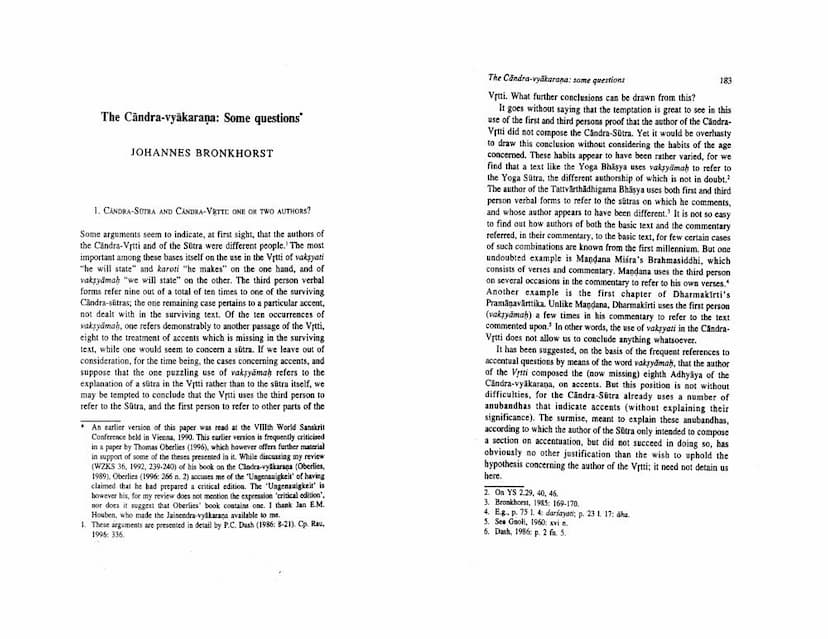
1. Authorship of the Candra-Sūtra and Candra-Vṛtti:
- Verbal Forms as Indicators: Bronkhorst first analyzes the use of first-person plural ("we will state" - vaks yamah) and third-person singular ("he will state" - vaksyati, "he makes" - karoti) in the Candra-Vṛtti. He notes that the Vṛtti generally uses the third person to refer to the Sūtra and the first person to refer to itself.
- Historical Context of Authorial Reference: However, he cautions against drawing a firm conclusion about separate authorship solely based on this, citing examples like the Yoga Bhasya and Tattvärthadhigama Bhasya where authors use similar patterns even when the authorship of the core text is not in doubt. He also points to Mandana Misra and Dharmakirti, who used both first and third person references to their own works or commentaries.
- Missing Sections and Authorial Intent: The frequent use of vaks yamah for missing accentual sections suggests the Vṛtti might have covered these. However, the Sūtra itself already includes anubandhas indicating accents. The author questions whether the Sūtra's author intended to cover accents but failed, or if this is merely an attempt to support the separate authorship hypothesis.
- Completeness and Interdependence: Bronkhorst argues that the Candra-Sūtra is incomplete without the Vṛtti. The Sūtra omits sections covered by the Vṛtti or even entire sections of Pāṇini's Aṣṭādhyāyī. The Vṛtti often fills these gaps, leading to the conclusion that the Sūtra and Vṛtti were conceived together, though not necessarily by the same author.
- Lexical Deviations: A more significant argument for potentially different authorship comes from the Vṛtti using terms like saṃjñā and naman where the Sūtra has naman and ākhyā respectively. This difference is considered the strongest evidence for separate authorship, though its weight is still debated.
2. The Kāśikā's Indebtedness to the Candra-vyākaraṇa:
- Similarities and Explanations: The Candra-vyākaraṇa and the Kāśikā (a major commentary on Pāṇini) share many similar passages. Bronkhorst considers three possibilities: Kāśikā borrowing from Candra, Candra borrowing from Kāśikā, or both borrowing from a common source. He dismisses the Kāśikā borrowing from Candra due to chronological reasons.
- Improbability of Direct Borrowing: He finds it a priori improbable that the Kāśikā, within the Pāṇinian tradition, would heavily borrow from a text of a different grammatical tradition like Candra.
- Evidence of Earlier Commentaries: Bronkhorst presents evidence of earlier commentaries on Pāṇini that both the Kāśikā and potentially Bharthari (author of the Mahābhāṣya-vārttikas) might have drawn upon. These include references in the Kāśikā to earlier Vṛttikāras and Bharthari's mentions of commentators.
- Specific Examples of Shared Sources:
- Alternative Interpretations: The Vṛtti on Candra-Sūtra 4.2.8 refers to an interpretation shared by the Kāśikā on Pāṇini 5.2.5, suggesting a common earlier source, not direct borrowing between Candra and Kāśikā.
- Bharthari's Commentary: Bronkhorst analyzes examples from Bharthari's commentary on the Mahābhāṣya that are also found in the Kāśikā. He argues that Bharthari likely found these examples in an earlier Pāṇinian commentary that the Kāśikā also used. He uses examples like pārsnitra and the enumeration of taddhita suffixes (tasilādi).
- Ganas and Lists: He examines the treatment of ganas (lists of words) and similar lists. He concludes that both Bharthari and the Kāśikā likely relied on the same early Pāṇinian commentary for their respective lists, as demonstrated by their shared inclusion of gaṅgā in the śivādi gana and the specific justifications for it. The Candra-Vṛtti often agrees with the Kāśikā in these matters, suggesting it too was influenced by the same earlier tradition, rather than borrowing from the Kāśikā.
- Verse Usage: The Kāśikā contains a verse explaining specific grammatical rules. Bronkhorst argues that this verse likely predates both Candra and the Kāśikā, and that the Kāśikā added an iṣṭi (an additional rule or example) to incorporate specific examples that Candra covered in two separate sūtras.
- Error Transmission: He discusses the case of samprāj jānuno jñaḥ vs. prasambhyam jänunor jñaḥ. He suggests that the Kāśikā might follow a different early commentary than Candra, as it presents the rule in its correct form while Candra and the Jainendra-vyākaraṇa have an incorrect form.
- Rule Amendments: The discussion of Pāṇini 3.3.122 suggests that words like ādhāra and āvāya were added to the rule after Patañjali's time. Both the Kāśikā and the Candra-Vṛtti appear to have incorporated these amendments from a post-Patañjalian Pāṇinian tradition, with Candra's list aligning with this tradition.
3. Geographical Location and Date of the Candra-vyākaraṇa:
- Geographical Clues: Bronkhorst uses the Vṛtti's example concerning the future tenses (liṭ and luṭ) and the phrase "the limitless road that must be traversed on the part of it which is this side of Kausāmbi" (yo 'yam adhva niravadhiko gantavyas tasya yad avaram kausāmbyās tatraudanam bhoktāsmahel) as an "index fossil." This implies a significant distance between the author and Kausāmbi, ruling out locations too close to it.
- Dating: The Vṛtti cites Kālidāsa's Raghuvamsa and Kumārasambhava. It also mentions "Acarya Candra" in the context of the Vākyapadīya-Vṛtti, suggesting Bharthari is later than Candra, and the Vākyapadīya-Vṛtti is older than Dignāga. This places Candra within a period potentially overlapping with Kālidāsa and Bharthari, most likely in the 5th century CE. The geographical proximity of these authors also makes their chronological closeness plausible.
4. Conclusions:
- Unified Work: Bronkhorst reiterates that the Candra-Sūtra and Candra-Vṛtti should be viewed as a single work, conceived together from the outset, even if separate authorship cannot be definitively ruled out.
- Shared Sources: It is more firmly established that the Candra-vyākaraṇa and the Kāśikā shared at least one earlier source beyond the Mahābhāṣya and the Jainendra-vyākaraṇa.
- Influence and Borrowing: The analysis strongly suggests that both the Kāśikā and Candra were influenced by earlier commentaries on Pāṇini, rather than the Kāśikā borrowing directly from Candra. In some instances, the Kāśikā provides better insight into the content of these earlier commentaries than Candra.
- Further Research: The article highlights the importance of studying Bharthari's commentary on the Mahābhāṣya for understanding these historical relationships.
In essence, Bronkhorst's article argues for a deep interconnectedness between the Candra-vyākaraṇa and the Pāṇinian tradition, particularly through shared early sources, and places the work chronologically within the 5th century CE. It emphasizes that the Candra-vyākaraṇa, while distinct, is not an isolated phenomenon but a product of and contributor to a broader grammatical landscape.