
Buddhist Studies 1984 1990
Added to library: September 1, 2025
Loading image...
Summary
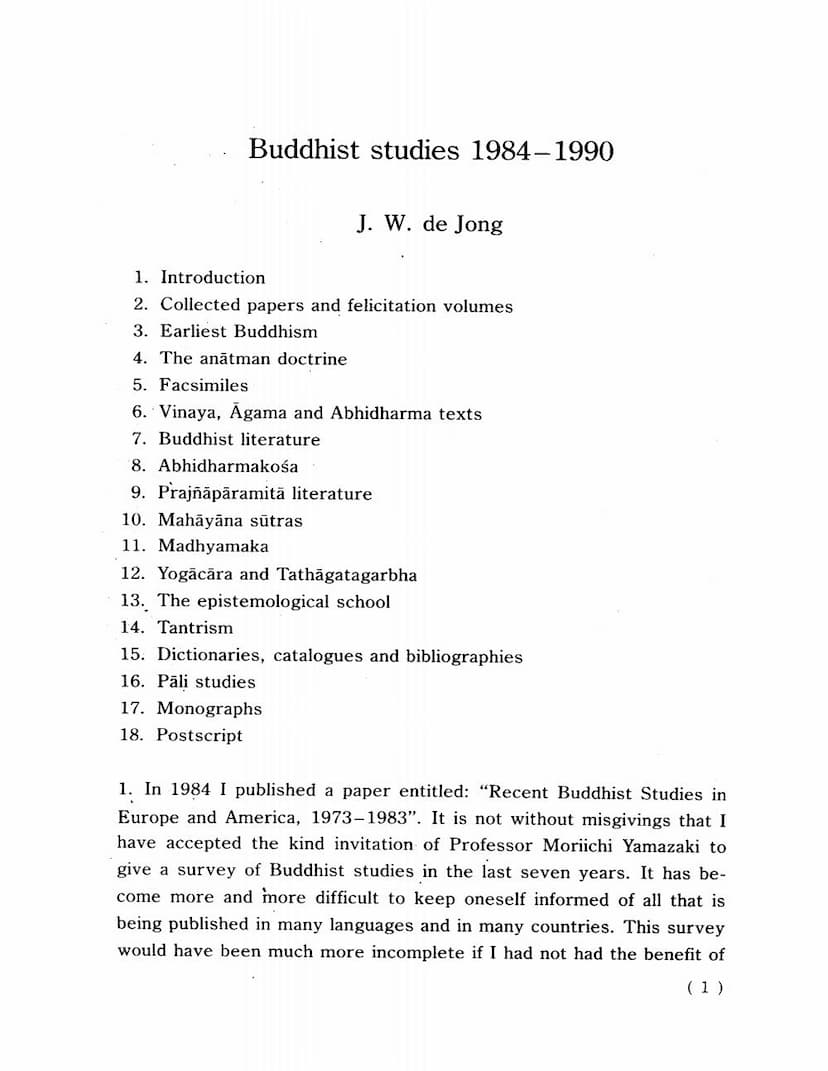
This document is a comprehensive survey of Buddhist studies published between 1984 and 1990, authored by J. W. de Jong. It is structured into eighteen sections, covering various aspects of Buddhist scholarship.
Key Highlights and Themes:
- Scope and Challenges: De Jong acknowledges the difficulty of keeping abreast of all publications due to the vastness and multilingual nature of Buddhist studies. He expresses gratitude to colleagues for their contributions and notes the limitations imposed by financial restrictions on library acquisitions. The survey primarily focuses on philological publications related to Indian Buddhism.
- Obituaries: The survey begins by commemorating the passing of several prominent Buddhist scholars during the period, including John Brough, Giuseppe Tucci, Ernst Waldschmidt, Hakuyū Hadano, Shinten Sakai, David Friedmann, Eugène Denis, Hermann Kopp, A.L. Basham, and S.N. Mukherjee.
- Collected Papers and Felicitation Volumes: A significant portion of the period saw the publication of collected works and felicitation volumes honoring scholars like Gustav Roth, Friedrich Weller, Ernst Waldschmidt, Yūichi Kajiyama, K.R. Norman, Hakuyū Hadano, Shinten Sakai, Giuseppe Tucci, Colette Caillat, Jikidō Takasaki, Masaaki Hattori, Kōtatsu Fujita, and David L. Snellgrove.
- Earliest Buddhism and the Buddha's Message: A lively discussion is noted regarding the possibility of recovering the "original message of the Buddha." A workshop on "Earliest Buddhism" revealed irreconcilable opinions. De Jong outlines three main positions: acceptance of the Nikāyas as largely reliable, skepticism about recovering the earliest doctrine due to textual transmission and transformation, and the application of higher criticism to establish textual layers and doctrinal development. Richard Gombrich's emphasis on the oral tradition and its influence is highlighted.
- The Ātman Doctrine: The ongoing debate surrounding the concept of ātman in early Buddhism is discussed, with scholars like Kamaleswar Bhattacharya and J. Pérez-Rémon arguing for Buddhist recognition of the Upaniṣadic ātman, while Steven Collins and Claus Oetke arrive at opposite conclusions, emphasizing the doctrine of anātman. Oetke's detailed analysis of the anātman doctrine is noted as particularly insightful.
- Textual Studies and Facsimiles: The importance of facsimile editions of Sanskrit manuscripts for text study is emphasized, with mentions of publications related to the Lotus Sūtra, the catalogue of Sanskrit manuscripts from Central Asia, and various Buddhist texts like the Vinaya, Agama, and Abhidharma.
- Editions of Buddhist Texts: Numerous text editions are highlighted across various categories, including Vinaya texts (e.g., Prātimokṣasūtra, Vinayavastu), Āgama texts (Dirghāgama, Samyuktāgama), and Abhidharma literature (Dharmaskandha, Lokaprajñapti).
- Buddhist Literature: Studies and editions of works by authors like Mātṛceta, Aśvaghoṣa, and Ārya-Śūra are reviewed. The Jātakamālā receives particular attention with new translations and editions. The extensive narrative literature (Avadānas) is also mentioned.
- Specific Schools and Texts:
- Abhidharma: Editions and translations of the Abhidharmakosa and its commentary are discussed, along with works on Yogācāra and Tathāgatagarbha teachings.
- Prajñāpāramitā Literature: Editions and studies of the Pañcavimśatisāhasrikā Prajñāpāramitā and the Vajracchedikā are covered.
- Mahāyāna Sūtras: Publications concerning the Pratyutpanna-Buddha-Sammukhāvasthita-Samādhi-Sūtra, Samādhirājasūtra, and Lankāvatārasūtra are reviewed.
- Madhyamaka: The continuing scholarly interest in the Madhyamaka school is evident, with discussions of works on Nāgārjuna, Āryadeva, Buddhapālita, and Bhāviveka.
- Yogācāra and Tathāgatagarbha: Studies on ālayavijñāna, āśrayaparivṛtti, and the works of Vasubandhu are highlighted.
- Epistemological School: The intensive study of the epistemological school (Dignāga, Dharmakīrti) is noted, with reviews of new editions, translations, and critical analyses of their works.
- Tantrism: Translations and studies of tantric texts like the Candamahārosaṇatantra, Guhyasamājatantra, and Kalacakra are presented.
- Pāli Studies: The Pali Text Society's ongoing publications and important contributions to Pāli commentaries are detailed, alongside the revival of the Journal of the Pali Text Society.
- Reference Works: The survey covers the publication of dictionaries, catalogues, and bibliographies, including ongoing projects like the Sanskrit-Wörterbuch der buddhistischen Texte aus den Turfan-Funden and the Critical Pāli Dictionary.
- Monographs and Surveys: Notable monographs and overarching surveys of Buddhist traditions and scholarly approaches are discussed, such as David Snellgrove's Indo-Tibetan Buddhism and Richard Gombrich's Theravāda Buddhism.
- Postscript and Bibliographical Challenges: De Jong concludes by lamenting the incomplete nature of his survey and reiterates the difficulty for non-Japanese scholars in accessing Japanese publications. He calls for a regular bulletin of Japanese Buddhist studies and advocates for more comprehensive and coordinated bibliographical efforts to cover different regions and language groups. He also reflects on the importance of linguistic proficiency (Sanskrit, Pāli, Tibetan, Chinese, Japanese) and the challenges of critical reviews in academic journals.
In essence, the document serves as a valuable academic snapshot of the state of Buddhist studies in the late 1980s, highlighting key research areas, important publications, and ongoing scholarly debates.