
Buddhist Hybrid Sanskrit Original Language
Added to library: September 1, 2025
Summary
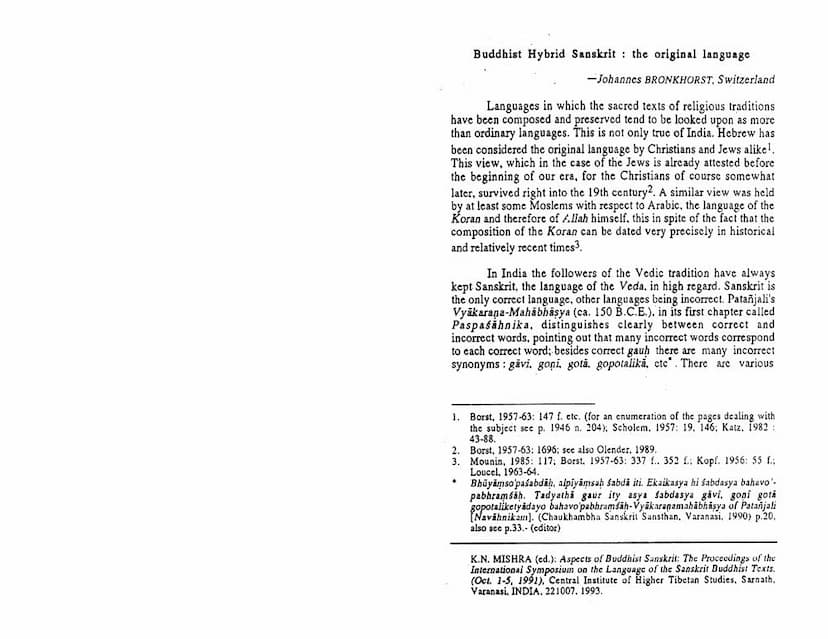
This document summarizes a paper by Johannes Bronkhorst titled "Buddhist Hybrid Sanskrit: The Original Language," which was presented at an international symposium. The paper explores the concept of "original language" within various Indian religious traditions and how this concept relates to the linguistic practices of Buddhists using Buddhist Hybrid Sanskrit.
Here's a breakdown of the key points:
-
The Concept of "Original Language": The paper begins by noting that religious traditions often ascribe a special status to the language of their sacred texts, viewing it as more than an ordinary language, sometimes as the "original language." Examples given are Hebrew for Jews and Christians, and Arabic for Muslims. In India, Vedic tradition regards Sanskrit as the correct and eternal language.
-
Sanskrit and the Vedic Tradition:
- Indian grammarians like Patañjali (around 150 BCE) distinguished between correct and incorrect words, emphasizing the importance of correct Sanskrit for producing virtue (dharma) and benefit (abhyudaya).
- Sanskrit was considered the language of the universe and eternal, as evidenced by the argument that words are not "made" like objects but are inherent.
- Later authors, like Bhartṛhari, called Sanskrit the "language of the gods" (daivi vāk), noting its corruption by incompetent speakers.
- Mimāṁsakas and others asserted the eternity of Vedic texts and their language, with Kumarila Bhatta arguing that vernacular forms are mere corruptions of the original Sanskrit word "go" (cow). Annambhatta, in contrast, believed God created various languages, including Sanskrit, at the beginning.
-
Pali (Magadhi) and Theravada Buddhism:
- Theravada Buddhism regards Pāli, which they call Magadhi, as the original language of all living beings and the natural form of expression.
- The Visuddhimagga and Sammohavinodini, a commentary on the Abhidhammapitaka, describe Magadhi as the primal language from which others, including those of different peoples, derive or transform. It is presented as the dominant language across various realms of existence.
-
Ardha-Magadhi and Jainism:
- Jains consider Ardha-Magadhi to be the language of their sacred texts and the original language of all beings.
- The Aupapatika Sutra states that Ardha-Magadhi is the speech of the gods and other beings, and that it changes into the languages of all people.
- An 11th-century Jain author, Namisadhu, writing in Sanskrit, explains that "Prakrta" is the natural, unadorned language common to all, and that Ardha-Magadhi is its basis. He claims Ardha-Magadhi is the origin of all languages, including Sanskrit, which arose from it through human modifications.
-
Buddhist Hybrid Sanskrit and its Explanation:
- The paper then turns to Buddhist Hybrid Sanskrit (BHS), the language of many Buddhist scriptures, which differs from classical Sanskrit.
- Bronkhorst notes that while Theravada Buddhists and Jains claimed their sacred languages (Pāli and Ardha-Magadhi) were the source of Sanskrit, the situation for Buddhists using BHS is complex, especially when they also used classical Sanskrit.
- The paper explores how Buddhists dealt with the use of BHS. One solution, paralleled by the Vedic Brahmins' treatment of Vedic Sanskrit (which also differed from classical Sanskrit), was to consider BHS not as a separate language but as essentially identical to classical Sanskrit.
- Evidence for this view:
- The grammar of Kumaralata, an early Buddhist Sanskrit grammarian, is cited. Fragments suggest that Kumaralata treated BHS forms (transpositions from Middle Indo-Aryan dialects into Sanskrit) as "arsa" (belonging to the rși-s), similar to how Vedic forms were treated. This suggests a view of BHS as on par with Vedic, and perhaps as essentially the same language as classical Sanskrit, just with specific "arsa" forms.
- Candrakirti, a Buddhist philosopher, in his commentary on Aryadeva's Catuhsataka, explains certain BHS-like grammatical features (e.g., "na asti" instead of "na santi") by referring to Paninian rules, specifically those concerning Vedic forms (like P.S. 7.1.39). This suggests an attempt to harmonize BHS with Sanskrit grammar, potentially by linking it to Vedic precedents. Candrakirti's adherence to Paninian grammar indicates an attempt to validate Buddhist texts within a classical Sanskrit framework.
-
Alternative Buddhist Views:
- However, Bronkhorst also considers a passage in Bharthari's Vakyapadiya (1.182cd) which contrasts the view of Sanskrit as divine and corrupted by incompetent speakers with another view. The latter view, possibly held by Buddhists ("upholders of impermanence"), suggests that the "corrupt language" (Prakrit) is actually the source of Sanskrit. This aligns with the Jain view of Ardha-Magadhi as the origin of Sanskrit.
- This latter interpretation suggests that some Buddhists might have indeed considered their sacred language (perhaps BHS) as the original language and the source of Sanskrit.
-
Conclusion:
- Bronkhorst concludes that various Indian religious currents believed their sacred texts were composed in the earliest language, the source of all others.
- Theravada Buddhists and Jains saw their languages (Pāli/Magadhi and Ardha-Magadhi) as sources of Sanskrit.
- Vedic Brahmins saw Vedic and classical Sanskrit as essentially one language, both original and eternal.
- At least some Buddhists using BHS adopted a position similar to the Brahmins, viewing BHS as fundamentally identical to classical Sanskrit and even using Vedic rules to explain its peculiarities.
- However, the passage from Bharthari suggests that some Buddhists might have also held the view that their sacred language was the source of Sanskrit, mirroring the Jain position.
The commentary from other scholars highlights some critical points:
- The title might be misleading, as the paper doesn't conclusively prove BHS is the original language but rather explores the concept and how Buddhists approached it.
- There's a debate about whether Candrakirti's use of Paninian rules implies BHS is simply a variant of Sanskrit or if it reflects a perceived similarity between BHS and Vedic Sanskrit.
- Questions are raised about the extent to which Buddhists attached sacrality to a particular language, given the Buddha's reported instruction to use their own dialect ("sakāya niruttiya").
- The paper's broad scope, covering Jainism, Vedic, and Buddhism, is noted as potentially leading to generalizations.