
Buddhism And Equality Of Four Castes
Added to library: September 1, 2025
Summary
Here's a comprehensive summary of the provided Jain text, "Buddhism and Equality of the Four Castes" by J. W. De Jong:
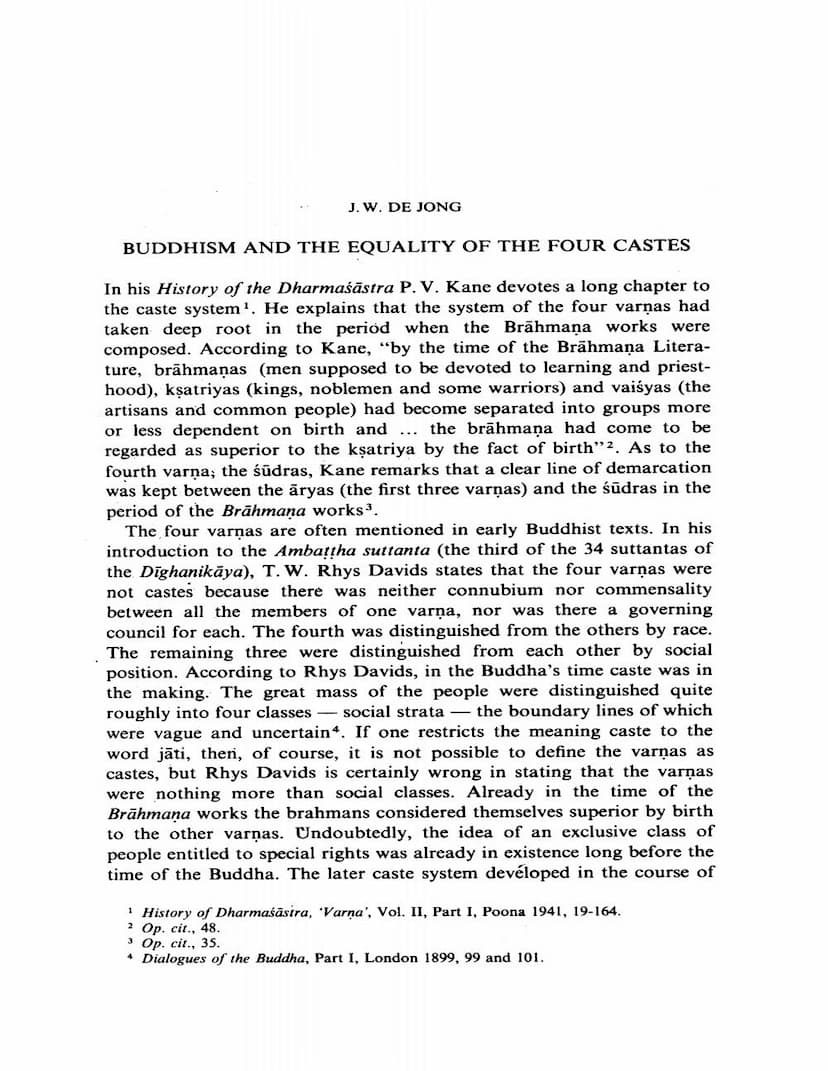
The article by J. W. De Jong explores the Buddhist perspective on the Indian caste system, specifically the concept of the four varnas (Brāhmaṇa, Kṣatriya, Vaiśya, and Śūdra). The author begins by referencing P. V. Kane's "History of the Dharmaśāstra," which details the deep roots of the four varnas in Brahmanical literature. Kane notes that by the time of these works, the first three varnas were increasingly distinguished by birth, with Brāhmaṇas claiming superiority. A clear line was also drawn between the Āryas (the first three varnas) and the Śūdras.
De Jong then examines early Buddhist texts, particularly the Pali canon, in relation to the caste system. He addresses T. W. Rhys Davids' assertion that the four varnas in Buddha's time were not true castes due to a lack of strict connubium and commensality, and that they were more like loosely defined social strata. However, De Jong challenges this, arguing that the concept of inherited superiority, particularly by the Brāhmaṇas, was already present. He highlights that while the term jāti later acquired the modern meaning of caste, early Buddhist texts used terms like kula and vanna for the varnas.
A significant portion of the article focuses on the Buddhist critique of Brāhmaṇical claims to superiority. De Jong cites passages from the Pali canon where Brāhmaṇas assert their unique purity, best status, and divine origin ("sons of Brahmā"). In contrast, the Buddha, as presented in texts like the Vāsetthasutta, deconstructs these claims. The Buddha argues that outward physical characteristics do not determine one's varna or social standing, but rather one's actions and spiritual achievements. He states that true Brāhmaṇahood is attained through virtue, self-restraint, and the understanding of suffering, not by birth. The article notes that this emphasis on action over birth is also found in later Buddhist texts and even in some passages of the Mahābhārata, suggesting a shared critique of birth-based caste.
The author then discusses later Buddhist texts that explicitly address and refute the caste system. The Vajrasūcī, attributed to Aśvaghoṣa (though authorship is debated), is highlighted. This text, along with others like the Śārdulakarṇāvadāna and Kumāralāta's Kalpanamaṇḍitikā, are shown to quote Hindu scriptures to demonstrate the spurious nature of Brāhmaṇical claims to superiority. The common theme across these texts is an absolute opposition to the caste system.
However, De Jong points out a surprising exception: a commentary by Bhāvaviveka on Nāgārjuna's Mūlamadhyamakakārikās. In this commentary, a passage from the Manusmṛti is quoted not polemically, but seemingly with approval. The quoted verse from Manusmṛti IV.80 advises against imparting knowledge or religious instruction to Śūdras. This is presented as a stark contrast to the spirit of Buddhism. De Jong speculates that this might indicate a "Buddhist brahmanisation" and a tendency among some Buddhist scholars to assimilate tenets from Brahmanical learning, although he cautions against drawing firm conclusions from a single instance.
In conclusion, De Jong's article demonstrates that early Buddhism, as reflected in the Pali canon, fundamentally challenged the Brāhmaṇical notion of inherited superiority and emphasized equality based on actions and spiritual attainment. While later Buddhist texts continued this critique, a single instance of apparent acceptance of caste restrictions suggests a complex evolution and potential assimilation of certain Brahmanical ideas within some Buddhist intellectual circles.