
Buddha And Jainas Reconsidered
Added to library: September 1, 2025
Summary
Here's a comprehensive summary of Johannes Bronkhorst's "The Buddha and the Jainas Reconsidered," based on the provided text:
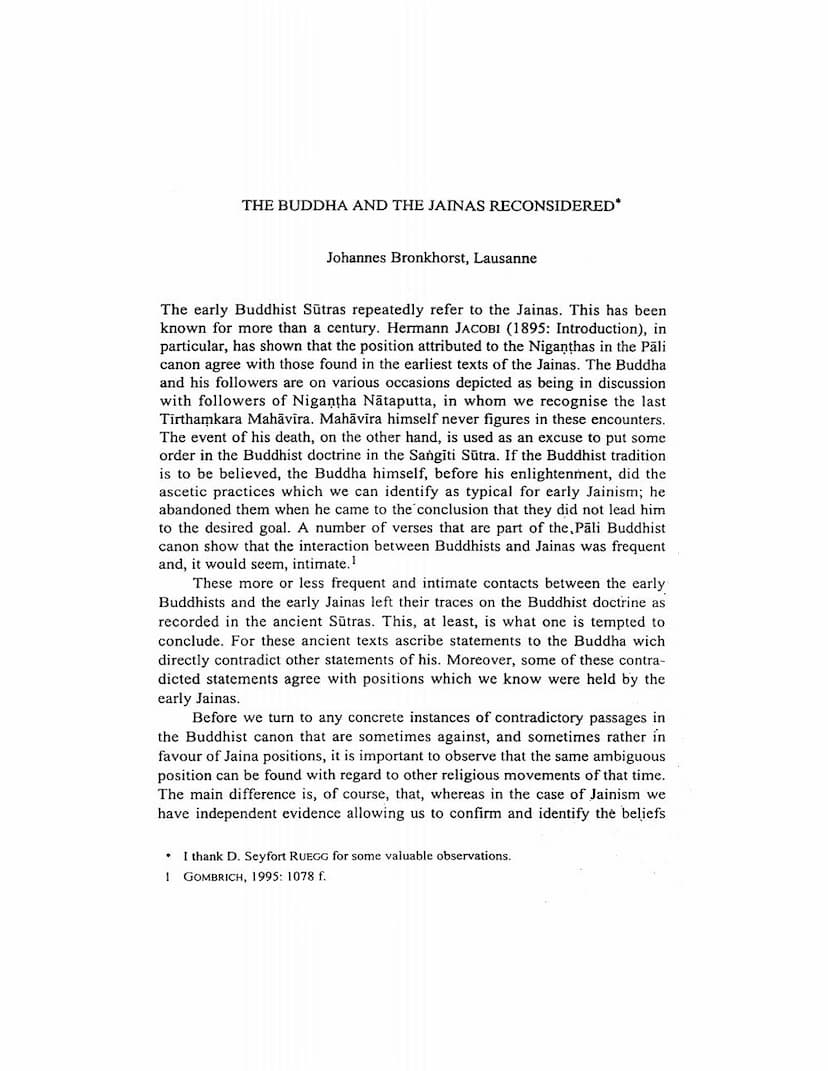
Johannes Bronkhorst's article, "The Buddha and the Jainas Reconsidered," explores the significant interactions between early Buddhism and Jainism, suggesting that these encounters profoundly influenced early Buddhist doctrine. The core of his argument is that certain doctrines and practices attributed to the Buddha in early Buddhist texts, which appear contradictory to other Buddhist teachings, can be explained by the adoption and adaptation of ideas originating from Jainism and other contemporary śramaṇa movements.
Key Arguments and Evidence:
- Frequent and Intimate Contact: Bronkhorst notes that early Buddhist Sūtras frequently mention the Jainas (Niganthas), often depicting discussions between Buddha's followers and followers of Nigantha Nātaputta (Mahāvīra). This indicates a close and ongoing relationship between the two traditions.
- Contradictory Passages in Buddhist Canon: The primary evidence presented is the existence of passages in the Pāli canon that attribute statements or practices to the Buddha which seem to contradict other Buddhist teachings. Crucially, some of these contradicted statements align with known Jaina positions.
- Three Illustrative Examples:
- Supernormal Abilities vs. Sensual Restraint: One Buddhist Sūtra depicts the Buddha boasting about his ability to remain unaffected by external events (like a thunderstorm), a claim made by some non-Buddhists. Conversely, another Sūtra ridicules such "cultivation of the senses" that leads to their non-functioning. Bronkhorst suggests the former might reflect an accepted practice or a hagiographical embellishment, possibly influenced by or reflecting similar claims in other traditions.
- Restraining Thought: The Vitakkasanthāna Sutta recommends "restraining his thought with his mind, to coerce and torment it." The same phrasing is used elsewhere in the canon to describe the Buddha's own futile ascetic practices before enlightenment, which are identified with early Jainism. This suggests that at least some Buddhists accepted or incorporated these Jaina-like methods.
- Annihilation of Actions: The Culadukkhakkhandha Sutta describes and criticizes Jainas for "annihilation of former actions by asceticism" and "non-performing of new actions." Yet, several other Sūtras attribute very similar statements, approvingly, to the Buddha himself. This is a strong indication of Jaina ideas being adopted.
- Gombrich's Counterarguments and Bronkhorst's Rebuttal: Bronkhorst engages with Richard Gombrich's response, which argues that these contradictions can be explained by the Buddha's teaching method (reinterpreting opponents' views) or textual corruption. While Bronkhorst acknowledges the literal approach of Gombrich, he argues that his own theory of outside influence is more comprehensive. Gombrich requires multiple, diverse explanations for each example, whereas Bronkhorst posits a single, unifying factor: Buddhism's vulnerability to clear answers to the problem of karma.
- Buddhism's Structural Need: Bronkhorst posits that Buddhism, while accepting the doctrine of karma and the goal of escaping rebirth, did not initially offer a clear or satisfying solution to the problem of how actions lead to rebirth. This created a "structural need" within Buddhism for effective solutions.
- Two Dominant Śramaṇa Methods: Bronkhorst identifies two prevalent methods outside Buddhism that offered solutions to the karma problem:
- Literal Inaction (Jainism): This involved suppressing all bodily and mental activity, believing that by ceasing all action, one could cease creating new karma and exhaust old karma, thus escaping rebirth.
- Insight into the Inactive Self: This involved realizing that one is not identical with the active parts of one's personality (body, mind) and that the true self is inactive and unaffected by actions.
- Buddha's Rejection and Subsequent Adaptation: Early Buddhist texts show the Buddha explicitly rejecting these methods, particularly Jaina asceticism, often with irony. However, Bronkhorst argues that the concept of the inactive self, and the idea that non-identification with active parts leads to liberation, subtly found its way back into Buddhism. He points to the first sermon in the Vinaya, which, while rejecting a permanent, blissful self, presents the realization of "not-self" as a liberating insight that achieves the same functional outcome: non-identification with one's actions. This demonstrates a "back-door" entry for doctrines that offered a clear solution to the karma problem.
- Later Buddhist Vulnerability: Bronkhorst extends his argument to later Buddhist traditions, citing the Mahāyāna tathāgatagarbha doctrine (which has striking similarities to the concept of an Ātman) and a 7th-century Tibetan controversy involving ideas of complete inactivity as a path to liberation. These examples illustrate that Buddhism remained susceptible to ideas that provided clear answers to the karma problem, even centuries after its inception.
- Conclusion: Bronkhorst concludes that early Buddhism and Jainism had a complex relationship characterized by significant influence. While the Buddha likely rejected many Jaina practices, Buddhism's inherent need for a clear resolution to the karma doctrine made it vulnerable to absorbing similar ideas. The occasional endorsement of Jaina-like practices in Buddhist texts is best explained by this susceptibility, as they offered direct and satisfactory answers to the problem of karma and rebirth, even if the Buddha's own teaching method might have facilitated their entry.
In essence, Bronkhorst argues that the historical Buddha and early Buddhism engaged with and were influenced by Jainism, leading to the incorporation of certain doctrines and practices into Buddhist thought, particularly those offering compelling solutions to the central problem of karma and rebirth.