
Buddha And Jainas Reconsidered
Added to library: September 1, 2025
Summary
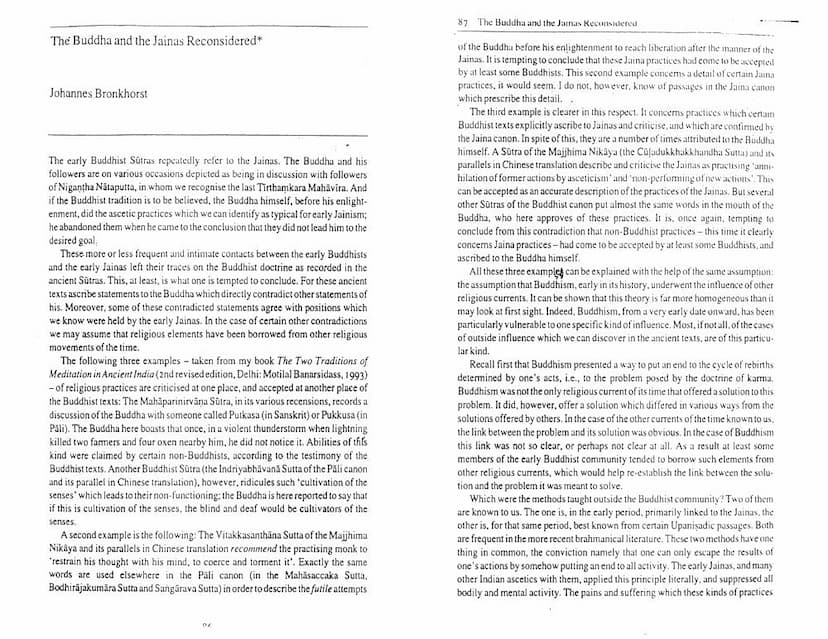
Here's a comprehensive summary of Johannes Bronkhorst's "The Buddha and the Jainas Reconsidered," based on the provided text:
Core Argument:
Johannes Bronkhorst argues that early Buddhism, while presenting its own distinct path, was significantly influenced by other religious movements of its time, most notably Jainism. This influence is evident in Buddhist scriptures where practices and doctrines that appear contradictory to core Buddhist teachings are sometimes presented, and these contradictions often align with known Jaina positions. The primary reason for this vulnerability, Bronkhorst contends, lies in Buddhism's perceived lack of a clear and direct solution to the complex problem of karma and rebirth, a problem that Jainism addressed with more apparent simplicity.
Key Points and Examples:
-
Early Buddhist-Jaina Interaction:
- Buddhist scriptures frequently mention interactions between Buddha's followers and Jaina ascetics (followers of Nigantha Nataputta, identified as Mahavira).
- The Buddha himself is depicted as having practiced asceticism similar to early Jainism before his enlightenment, only to abandon it upon realizing its ineffectiveness for his goal.
-
Contradictions in Buddhist Texts Indicating Influence:
- Bronkhorst highlights that ancient Buddhist Sutras contain statements by the Buddha that contradict other statements attributed to him.
- He suggests these contradictions arise from borrowing religious elements from other contemporary movements, particularly Jainism.
-
Three Illustrative Examples of Borrowing:
-
Example 1: Supernormal Abilities vs. Sense Restraint:
- The Mahaparinirvana Sutra describes the Buddha boasting about remaining unaffected during a violent thunderstorm that killed others – a claim of extraordinary, perhaps supernatural, ability.
- Conversely, the Indriyabhavana Sutta (and its parallel) ridicules the cultivation of the senses to the point of their non-functioning, questioning the wisdom of a blind or deaf person being considered a "cultivator of the senses." This latter critique suggests a rejection of certain ascetic practices that might lead to such a state.
-
Example 2: Restraining the Mind:
- The Vitakkasanthāna Sutta (and its parallels) advises monks to "restrain his thought with his mind, to coerce and torment it."
- Remarkably, the exact same phrasing is used elsewhere in the Pali canon (Mahāsaccaka Sutta, Bodhirajakumāra Sutta, Sangūrava Sutta) to describe the Buddha's pre-enlightenment attempts to achieve liberation in the Jaina manner. This suggests some Jaina practices, specifically the forceful control of the mind, may have been adopted by some Buddhists.
-
Example 3: Annihilation of Karma through Asceticism:
- The Culudukkhakkhandha Sutta (and its parallels) explicitly describes and criticizes Jainas for practicing "annihilation of former actions by asceticism and non-performing of new actions." Bronkhorst states this is an accurate description of Jaina practices.
- However, several other Buddhist Sutras attribute almost the same words to the Buddha, who approves of these practices. This is a clear contradiction, strongly suggesting that Jaina methods of dealing with karma through extreme asceticism were being incorporated into Buddhist teachings and attributed to the Buddha.
-
-
Buddhism's Vulnerability to Certain Ideas:
- Bronkhorst posits that Buddhism's core problem was its less obvious link between the doctrine of karma and its proposed solution for ending rebirth.
- In contrast, other contemporary movements, including Jainism and some Upanishadic traditions, offered more direct and seemingly logical answers to the karma problem, which revolved around inaction as the key to escaping the cycle of actions and their consequences.
-
Two Main Non-Buddhist Methods of Liberation:
- Method 1: Suppression of All Activity (Jaina Influence): This method, primarily linked to Jainas and other ascetics, involved literal suppression of all bodily and mental activity. Suffering and pain from these practices were seen as signs of old karma being destroyed. By ceasing all activity, including the addition of new karma, and ultimately fasting to death, liberation was achieved.
- Method 2: Realization of Non-Identification with the Active Self: This method, associated with certain Upanishadic passages, emphasized understanding that one is not identical with the active parts of the personality (body and mind). Realizing one's true, inactive self (soul) meant no longer being bound by the actions of the body and mind.
-
Buddhism's Response to These Methods:
- Early Buddhist texts acknowledge these two methods but reject them. The Buddha is depicted debating with Jainas and dismissing their practices. He also rejected the method of liberation through knowing the true nature of the self.
- Buddhism presented its own methods, which sometimes appear contradictory within its own texts. This internal inconsistency, Bronkhorst suggests, stems from the early Buddhists' own embarrassment that their solutions didn't clearly fit the problem of karma as well as those of other traditions.
-
The "Back-Door" Entry of Non-Buddhist Ideas:
- Bronkhorst argues that despite explicit rejection, elements of these foreign methods entered Buddhist doctrine.
- The First Sermon is presented as an example:
- It initially presents a conception of the self as permanent, unchanging, and blissful, which aligns with non-Buddhist views where understanding this self leads to liberation.
- However, the sermon then rejects this idea.
- Subsequently, it introduces the knowledge of "not-self" as the liberating insight. Bronkhorst explains that this "not-self" teaching, when understood as non-identification with the constituents of personality, achieves the same effect as the non-Buddhist concept of an inactive self: preventing one from being bound by actions. Thus, a doctrine seemingly rejected found its way in through a related concept.
-
Later Buddhist Echoes:
- Bronkhorst extends his argument to later periods, citing:
- The Tathagatagarbha doctrine in Mahayana Buddhism, which he notes bears striking similarities to the non-Buddhist concept of an inactive self, even prompting comment within Buddhist texts like the Lankavatara Sutra.
- An 8th-century Tibetan controversy where a position advocating complete freedom from existence by ceasing all thought and action ("No deed whatever, salutary or otherwise, is to be performed") echoes early Jaina-like ideas, even in a context without direct Jaina presence.
- Bronkhorst extends his argument to later periods, citing:
Conclusion:
Bronkhorst concludes that Buddhism was "structurally in need of a satisfactory answer to the doctrine of karma." When straightforward and compelling answers were available in neighboring religious currents like Jainism, some Buddhists were prone to adopt or adapt them. The presence of Jaina-like practices and ideas within early Buddhist texts is not necessarily evidence of original Buddhist innovation but rather a reflection of Buddhism's susceptibility to solutions that directly addressed the problem of karma and rebirth, which Jainism offered with considerable clarity and apparent effectiveness. This ongoing attraction to ideas of non-action and the inactive self continued to influence Buddhist thought for centuries.