
Buchbesprechungen Comptes Rendus Book Reviews
Added to library: September 1, 2025
Summary
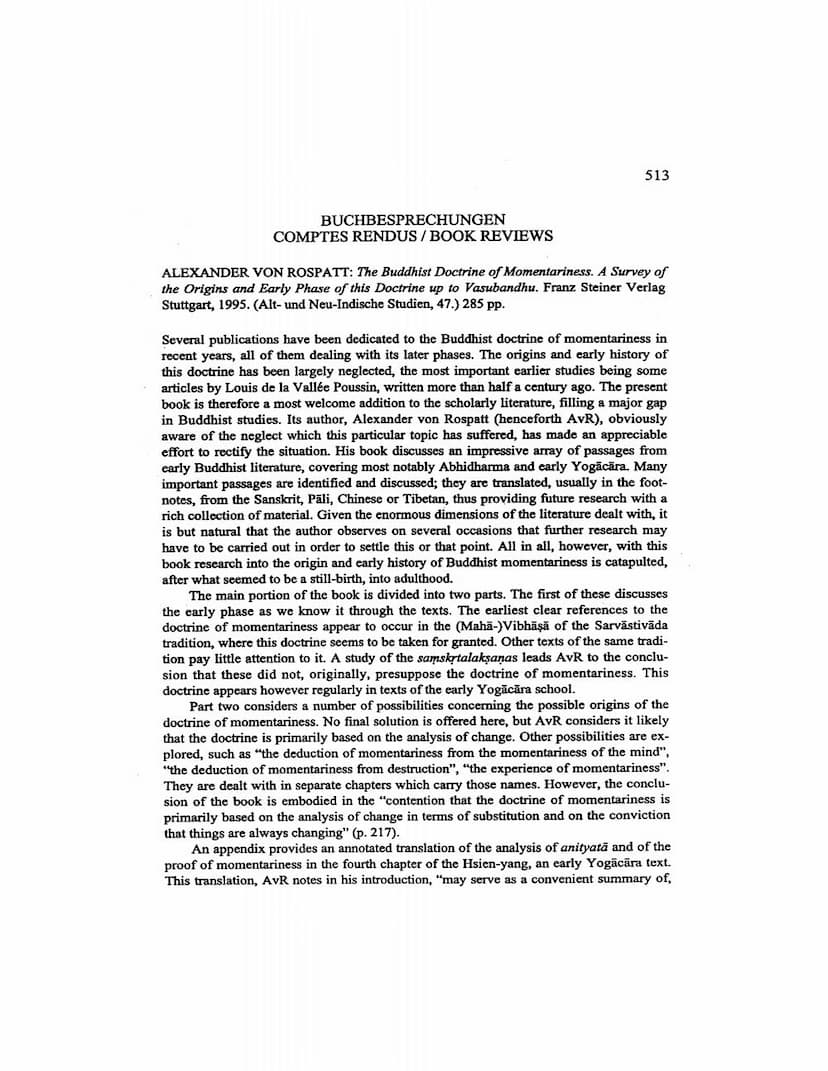
This is a comprehensive summary of the book review by Johannes Bronkhorst of Alexander von Rospatt's "The Buddhist Doctrine of Momentariness":
Book Being Reviewed: "The Buddhist Doctrine of Momentariness. A Survey of the Origins and Early Phase of this Doctrine up to Vasubandhu" by Alexander von Rospatt (AvR).
Reviewer: Johannes Bronkhorst
Overall Assessment: Bronkhorst considers Rospatt's book a "most welcome addition to the scholarly literature, filling a major gap in Buddhist studies." He praises AvR's "appreciable effort to rectify the situation" by discussing an "impressive array of passages from early Buddhist literature," translating them carefully, and providing a "rich collection of material for future research." Bronkhorst believes the book "catapulted" research into the origins and early history of Buddhist momentariness "into adulthood."
Key Contributions of AvR's Book:
- Focus on Origins: Addresses the neglected area of the origins and early phase of the doctrine of momentariness, contrasting with more recent studies that focus on later phases.
- Extensive Textual Analysis: Examines a wide range of passages from early Buddhist literature, particularly from the Abhidharma and early Yogācāra traditions.
- Detailed Translations: Provides translations of these passages from Sanskrit, Pāli, Chinese, or Tibetan, often in footnotes.
- Structured Argument: Divides the book into two parts: one discussing the early phase as known through texts, and the other exploring possible origins.
- Proposed Origin: AvR suggests the doctrine is "primarily based on the analysis of change" and the "conviction that things are always changing."
- Appendix: Includes an annotated translation of an analysis of anityata (impermanence) and a proof of momentariness from an early Yogācāra text.
Bronkhorst's Critiques and Further Considerations:
While highly praising the book, Bronkhorst raises several important points and offers alternative interpretations:
-
The Intellectual Context of "Dharma-Theory": Bronkhorst argues that AvR doesn't sufficiently consider the intellectual context in which momentariness arose. He suggests a strong connection between the doctrine of momentariness and the dharma-theory, particularly within the Sarvāstivāda tradition.
- Dharma-Theory: This theory, which led to a detailed analysis of "ultimate constituents" (dharmas), and the concept of material atoms also emerging in Sarvāstivāda, both represent a fundamental tendency to break down things into their smallest parts. Bronkhorst proposes that the preoccupation with moments (as "ultimate constituents" of time) is a parallel development to the search for ultimate constituents of reality.
- AvR's Rejection: Bronkhorst notes that AvR implicitly rejects this link, stating spatial atomism is "independent from this doctrine of momentariness" without providing arguments.
- Bronkhorst's Argument: He believes the doctrine of momentariness, like the developed dharma-theory, might be a product of (Sarvästivāda) Abhidharma.
-
Origin of Momentariness Outside Abhidharma: AvR's impression is that momentariness originated outside mainstream Abhidharma, citing the lack of reference in texts younger than the Mahā-Vibhāṣā (which does refer to it).
- Bronkhorst's Counter-Argument: Bronkhorst suggests a simpler explanation: that authors of those texts accepted momentariness as basic knowledge and didn't need to write about it because it didn't directly affect their discussions. This implies momentariness might have been "basic knowledge" within the Sarvāstivāda tradition even earlier.
- Consequences of this View: This interpretation makes tracing the origin more difficult but suggests non-mention in older texts doesn't prove its absence.
-
The Samskṛtalakṣaṇas and Momentariness: Bronkhorst critically examines AvR's argument about the samskṛtalakṣaṇas (marks of conditioned entities) and their connection to momentariness, particularly in the context of the Pañcavastuka.
- AvR's Claim: AvR argues that the samskṛtalakṣaṇas in earlier texts (like Dharmasri's Abhidharmasāra) do not show traces of momentariness, and that terms like "birth" and "age" imply existence over a span of time, suggesting momentariness is a later development.
- Bronkhorst's Rebuttal:
- Lack of Mention: The absence of mention of momentariness in those texts is not surprising if the doctrine was already assumed.
- Terminology: Terms like "birth" and "age" might have been traditional terms retained even when their original meaning evolved. He questions if these terms were first used in the context of the Pañcavastuka.
- Endurance and Change: Bronkhorst argues that "duration" and "destruction" being distinct events doesn't necessarily contradict momentariness. He also points out the Mahā-Vibhāṣā's nuanced view of the samskṛtalakṣaṇas as conceptually given and not always causally active simultaneously, which could accommodate momentariness.
- Vātsiputriyas-Sammatiyas Example: Bronkhorst scrutinizes AvR's use of the Vātsiputriyas-Sammatiyas to argue against a connection between samskṛtalakṣaṇas and momentariness. He points out that even they applied samskṛtalakṣaṇas only to momentary entities (excluding material ones), which, for Bronkhorst, reinforces a connection.
-
Parallelism with Dharma-Theory and Mahāyāna: Bronkhorst highlights other areas where he feels AvR could have explored the parallelism between momentariness and dharma-theory.
- Mahāyāna: He notes that in early Mahāyāna texts, moments lose their duration, and the denial of conditioned entities' duration becomes equivalent to the denial of their existence, equating momentariness with dharmanairātmya (emptiness of dharmas).
- Vasubandhu: Bronkhorst sees a parallelism in Vasubandhu's arguments: one proving destruction cannot be caused (implying entities are destroyed as soon as they arise) and another proving the impossibility of atoms of finite size. He questions if this is coincidence or reflects the same underlying logic.
Conclusion of the Review:
Bronkhorst concludes by agreeing with AvR that the doctrine of momentariness is "likely... primarily based on the analysis of change." However, he reiterates that this analysis occurred within a broader context of analysis into dharmas, a context he feels was insufficiently addressed in AvR's book. Despite this reservation, he believes the book is likely to remain "the most thorough and complete investigation of the origins and early history of the Buddhist doctrine of momentariness for some time to come."