
Bubun Tozentai
Added to library: September 1, 2025
Summary
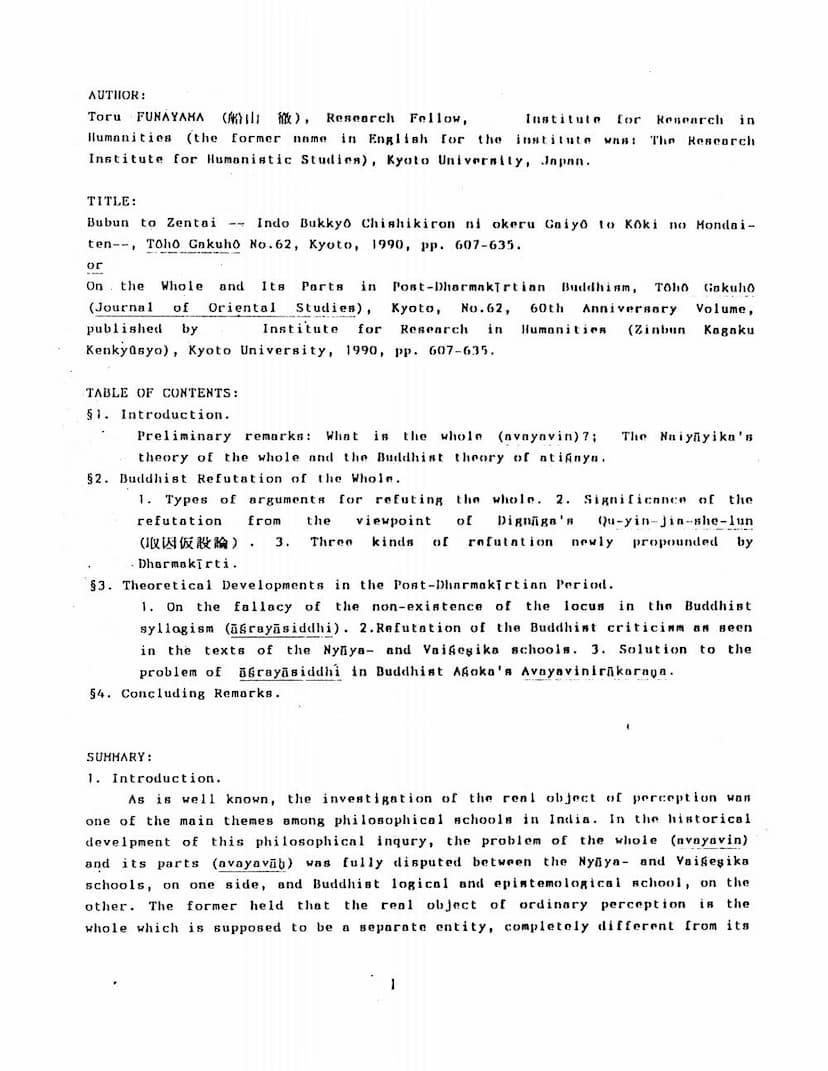
Here's a comprehensive summary of Toru Funayama's "Bubun to Zentai" (On the Whole and Its Parts in Post-Dharmakirtian Buddhism) based on the provided text:
This academic article by Toru Funayama, a Research Fellow at Kyoto University, delves into the philosophical debate in Indian Buddhism concerning the concept of the "whole" (avayavin) and its constituent "parts" (avaya vā). The central theme is the Buddhist refutation of the whole and the subsequent theoretical developments, particularly in the post-Dharmakirti period.
Key Points:
-
The Core Debate: The article highlights a fundamental disagreement between the Nyaya and Vaigegika schools on one side, and the Buddhist logical and epistemological schools on the other.
- Nyaya/Vaigegika View: These schools posited that the actual object of ordinary perception is the "whole," which is a distinct entity separate from its parts. They argued that since the parts (like atoms) are imperceptible, the perceived object must be the whole itself.
- Buddhist View: Buddhists generally denied the existence of the whole as a distinct entity. They proposed that what is perceived is an "assemblage" (pratibha) of atoms, a mental construct rather than an independently existing entity. Dharmakirti's influential arthasūnya (meaningless or lacking intrinsic essence) theory strongly supported this view.
-
Buddhist Refutation of the Whole:
- Pre-Dharmakirti Arguments: The article mentions various arguments used by Buddhists before Dharmakirti to refute the whole. These include arguments based on the non-perception of the whole, the impossibility of it having weight or color independent of its parts, and the popular argument of avṛttyanupapatti (inconsistency of relation between the whole and its parts).
- Motivations for Refutation: The article explains that the refutation of the whole was natural for:
- Madhyamikas (like Nagarjuna): Their doctrine of emptiness (śūnyatā) naturally led to the rejection of any independently existing entities, including the whole.
- Sautrantika-Yogācāra Philosophers: Their view that the object of perception is a mental manifestation of atomistic aggregates made the concept of a distinct whole superfluous.
- Dignāga's Contribution: Dignāga's Nyāyapraveśa (likely the "Qu-yin-jin-she-lun" mentioned, referring to the Chinese translation) is discussed. Dignāga interpreted the Buddha's silence on the oneness or difference of phenomena as an invitation for practitioners to free themselves from afflictions without engaging in such abstract debates. He also distinguished the Buddhist concept of an assemblage (exemplified by "body" and "wood") from the Nyaya concept of the whole, noting that the Nyaya school (specifically Vidyotakara) did not formally admit concepts like "army" as wholes.
-
Theoretical Developments in the Post-Dharmakirti Period:
- Logical Problem of Āśrayāsiddhi: This section focuses on a crucial logical problem that arose after Dharmakirti. Following Dharmakirti's refutation of the oneness of the whole, later Buddhist philosophers like Santarakṣita, Kamalagila, Dharmottara, Jitāri, and Āryadeva (referred to as Agoka) developed syllogisms to refute the whole. A key premise they used was that an object wrongly associated with contradictory properties is not one but many.
- Nyaya/Vaigegika Criticism: Naiyāyikas (like Bhāsarvajña and Vacaspatimiśra) and Vaigegikas (like Vyomagiva) severely criticized these Buddhist syllogisms. Their main critique was that if the syllogism is a direct proof (svatantra-sādhana) and not a hypothetical refutation (prasanga), it commits the fallacy of the non-existence of the locus (āśrayāsiddha or āśrayāsiddhi). This means the subject of the syllogism is proven to be non-existent, making the argument invalid.
- Sankara-svāmin's Role: Sankara-svāmin is identified as an early Naiyāyika critic who distinguished between prasanga and svatantra-sādhana. The article suggests that this criticism was likely widespread during the 10th century as a reaction to the syllogisms of Santarakṣita and Dharmottara.
- Jñānaśrīmitra and Ratnakīrti's Solution: The problem of āśrayāsiddhi in the context of refuting the whole and in a specific type of negative inference (vyatireka-type of Kṣaṇabhaṅga-anumāna) was eventually resolved by Jñānaśrīmitra and Ratnakīrti. Their solution, in essence, allowed for the use of an unreal subject/locus in negative statements, even in direct proofs.
- Āryadeva's Solution: The article also examines Āryadeva's (Agoka) Avayavinirākaraṇa, which offered a way to refute the oneness of the whole without using the whole itself as a subject. He proposed using a "gross blue object" (sthūla nīlādi-artha) as the subject of the syllogism, arguing that this gross object, which is actually perceived, is precisely what the opponents consider to be the single, real whole.
-
Concluding Remarks:
- Funayama concludes that āśrayāsiddhi was a frequently debated issue in the latter half of the 9th and 10th centuries, both in the context of refuting unreal objects and establishing negative inferences.
- These dialogues laid the groundwork for later developments in Jñānaśrī's Kṣaṇabhaṅga-theory.
- An additional finding of the survey is the identification of a Sanskrit fragment by Muni Jambu vijaya ji as a part of Dharmottara's Pramāṇaviniścaya (PVint).
In essence, the article traces the sophisticated philosophical arguments and counter-arguments concerning the existence of the whole in Indian thought, with a particular focus on how Buddhist philosophers, especially after Dharmakirti, tackled the logical challenges posed by their opponents and developed nuanced theories to support their anti-realist stance on composite objects.