
Brahmanic And Sramanic Cultures A Comparative Study
Added to library: September 1, 2025
Summary
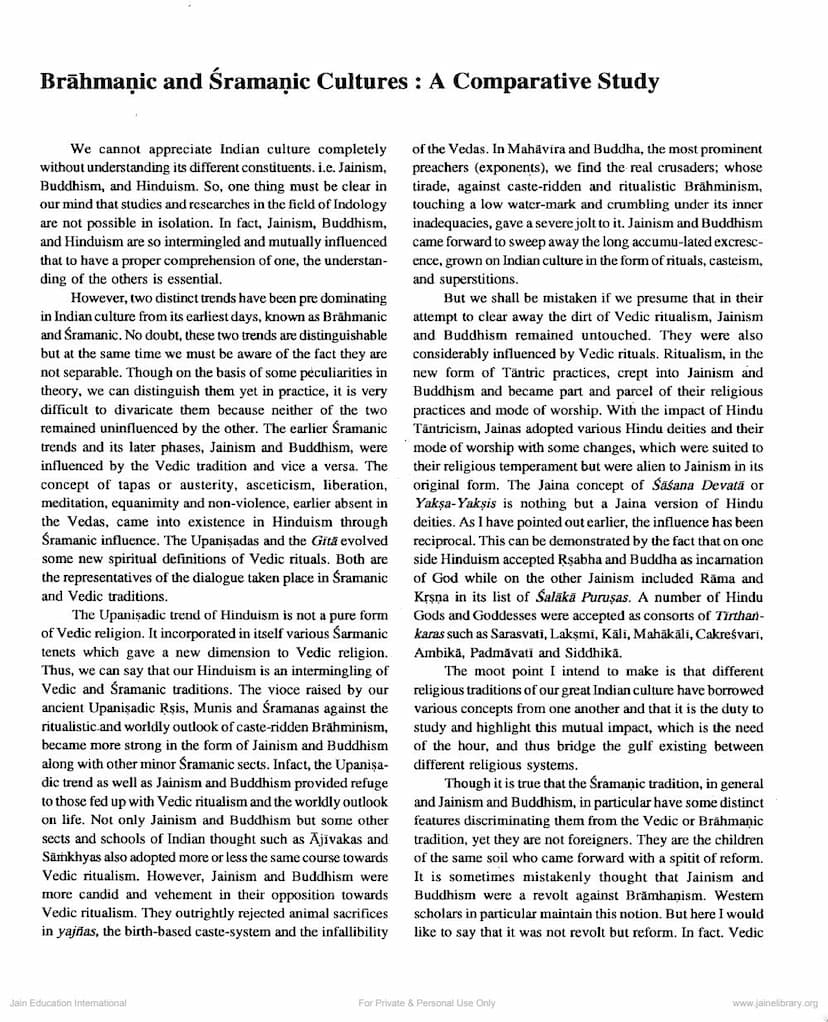
Here's a comprehensive summary of the provided text from Sagarmal Jain's "Brahmanic and Śramanic Cultures: A Comparative Study":
The text argues that understanding Indian culture requires recognizing the interconnectedness of its major religious and philosophical traditions, namely Jainism, Buddhism, and Hinduism. It emphasizes that these traditions are not isolated entities but rather deeply intermingled and mutually influenced, making it impossible to comprehend one fully without understanding the others.
The core of the discussion revolves around two dominant, yet inseparable, trends in Indian culture since its earliest days: Brahmanic and Śramanic. While distinguishable by certain theoretical peculiarities, in practice, they have been so interwoven that separating them is extremely difficult.
The author highlights that:
- Śramanic influence on Brahmanism: Early Śramanic trends, and later Jainism and Buddhism, significantly influenced the Vedic tradition. Concepts like tapas (austerity), asceticism, liberation, meditation, equanimity, and non-violence, which were initially less prominent or absent in the Vedas, entered Hinduism through Śramanic influence. The Upanishads and the Gita, for instance, evolved new spiritual interpretations of Vedic rituals, reflecting a dialogue between Śramanic and Vedic traditions. The Upanishadic trend itself is seen not as a pure Vedic form but as one that incorporated Śramanic tenets, giving Vedic religion a new dimension.
- Śramanic opposition to Vedic ritualism: The Upanishadic sages, munis, and śramanas raised voices against the ritualistic and worldly outlook of caste-ridden Brahminism. This opposition became stronger and more pronounced in Jainism and Buddhism, along with other minor Śramanic sects. These traditions, along with others like Ajivakas and Samkhyas, offered refuge to those disillusioned with Vedic ritualism and the worldly focus of life. Jainism and Buddhism were particularly vocal and vehement in their rejection of animal sacrifices in yajñas, the birth-based caste system, and the infallibility of the Vedas. Mahavira and Buddha are presented as pivotal reformers who challenged the declining and inadequate aspects of caste-ridden, ritualistic Brahminism.
- Mutual Influence and Assimilation: The text cautions against the misconception that Jainism and Buddhism remained untouched by Vedic traditions while reforming them. Instead, they were also considerably influenced by Vedic practices. Ritualism, in new forms like Tantric practices, eventually infiltrated Jainism and Buddhism. Jainism, in particular, adopted various Hindu deities and modes of worship, adapting them to their own religious temperament. The concept of Śāśana Devatās (Yakṣas and Yakṣiṇīs) is seen as a Jaina adaptation of Hindu deities. This influence is reciprocal: Hinduism incorporated Rishabha and Buddha as incarnations, while Jainism included figures like Rama and Krishna in its list of Śalākā Puruṣas. Many Hindu gods and goddesses were also adopted as consorts of Tirthankaras.
- Reform, Not Revolt: The author refutes the notion, often propagated by Western scholars, that Jainism and Buddhism were mere revolts against Brahminism. Instead, they are presented as reforms aimed at spiritual advancement. The text challenges the idea that these traditions are rivals or enemies, arguing that both Brahmanic and Śramanic traditions are integral components of the larger Indian culture, much like passion and reason are components of human personality.
- Scholarly Misconceptions and the Need for Reinterpretation: The text criticizes scholars, particularly Western ones, for creating an artificial gulf between Jainism and Buddhism on one hand, and Hinduism on the other. It urges researchers in Jainology to adopt a new approach, reinterpreting the relationship between these traditions, especially the Upanishadic trend, through the lens of ancient Jaina texts like the Acaranga, Sutrakrtanga, and Rsibhasita.
- Evidence of Unity in Jaina Texts: The author points to similarities in word, style, and essence between the Acaranga and the Upanishads as evidence of their shared origins. The Acaranga's mention of "Śramana" and "Brahmana" together indicates that for its preacher, they were not rival traditions. The Sutrakrtanga's mention of Upanishadic Rishis (like Videhanami, Bahuka, Asitadevala) and their recognition as great ascetics (maha-purusas) who attained liberation further supports this point. The Rsibhasita, considered part of the Jaina canon, also mentions various Vedic sages, calling them "Arhat Rishis," showcasing Jainism's tolerance and openness.
- The River of Indian Spirituality: The text concludes by asserting that the stream of Indian spirituality is fundamentally one, originating from a common source, even though it later branched into various rivulets like the Upanishadic, Buddhist, Jaina, and Ajivaka traditions. This assimilative and tolerant nature of Indian thought, as demonstrated by the inclusion of Vedic sages in Jaina texts, is highlighted as a valuable guide for overcoming communal separatism and strife today. A proper understanding of these traditions requires studying them in conjunction with each other, rather than in isolation.
In essence, the book emphasizes the deep-seated, reciprocal influence and shared heritage between Brahmanic and Śramanic traditions, arguing for a unified understanding of Indian culture rather than a divisive one based on perceived rivalry.