
Book Reviews
Added to library: September 1, 2025
Summary
Here's a comprehensive summary of the provided book review, focusing on the texts and their analysis:
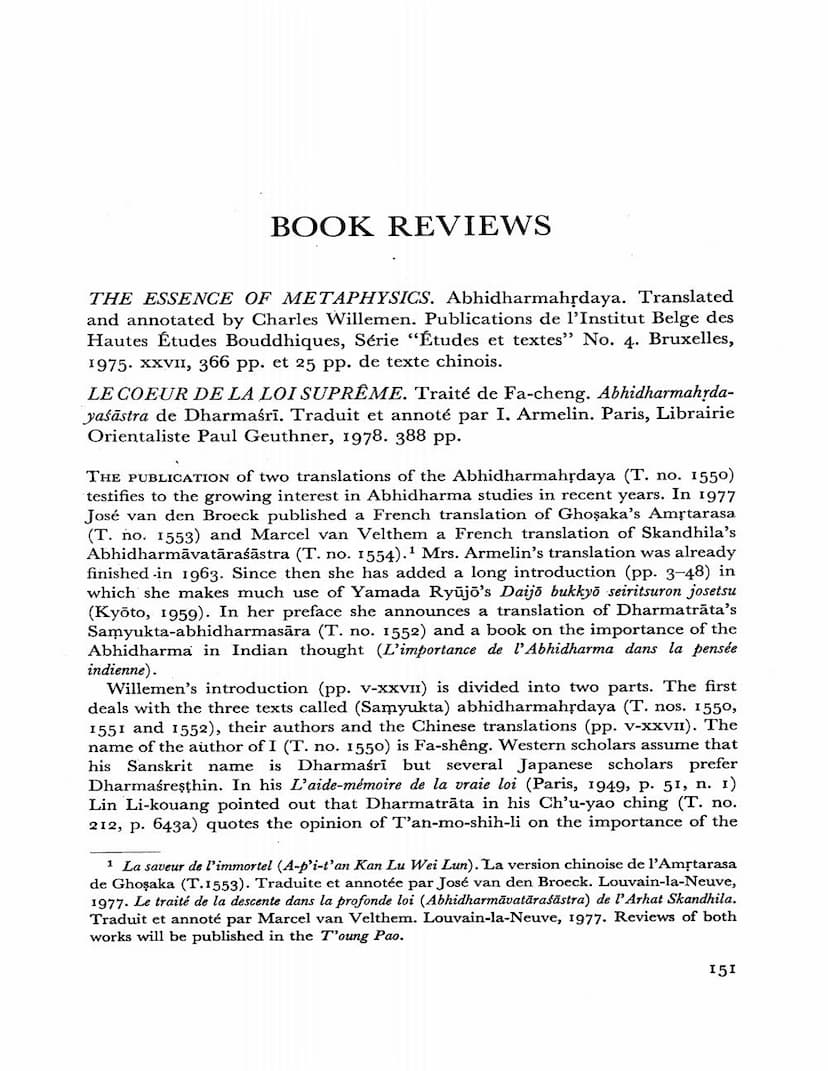
This review by J.W. De Jong discusses two French translations of the Abhidharmahrdaya (T. no. 1550): Charles Willemen's "The Essence of Metaphysics" and I. Armelin's "Le Cœur de la Loi Suprême." The review highlights the growing interest in Abhidharma studies, noting that other related translations had been published recently.
The review then delves into the introductions and content of both translations, comparing and contrasting their approaches and findings.
Key Points and Comparisons:
-
Authorship and Dating:
- Both translations address the authorship of the Abhidharmahrdaya, generally attributed to Dharmaśrī. However, the review notes scholarly debate on the precise Sanskrit name (Dharmaśrī vs. Dharmaśreșthin).
- The dating of Dharmaśrī and the Abhidharmahrdaya is complex, with discussions referencing earlier scholars like Lin Li-kouang and Erich Frauwallner. The review indicates differing opinions among scholars, including Yamada Ryūjō, regarding its relationship and chronological order with the Jñānaprasthāna and the Mahāvibhāṣā.
- Willemen suggests Dharmaśrī likely represents early bahirdeśakas (masters from Gandhara), and Upaśānta, who also translated a version, shows traces of vaibhāṣika influence. Dharmatrāta, another commentator, relied heavily on vaibhāṣika views.
-
Translation Approaches and Contents:
- Willemen's Translation: Focuses heavily on the history of Chinese translations and textual analysis. He meticulously examines Chinese versions, consulting a Tun-huang manuscript, and provides a continuous numbering of the 250 stanzas present in the Taishō text. He also includes concordances with the works of Upaśānta and Dharmatrāta. Willemen's introduction covers the three Abhidharmahrdaya texts, their authors, and Chinese translations.
- Armelin's Translation: Places more emphasis on doctrinal problems and comparative analysis. Her introduction covers topics like the Sarvāstivāda Abhidharma, the date of composition, the structure of the Hrdayaśāstra, comparisons with other treatises, the title of Dharmaśrī's work, doctrinal positions, and Dharmaśrī's relation to the Sarvāstivāda school. Armelin makes extensive use of Yamada's work but notably omits Frauwallner's significant contributions. She also compares Dharmasri's path to salvation with Brahmanical concepts, although the reviewer finds these comparisons instructive but not always definitively supported by direct evidence in Dharmasri's work.
-
Specific Textual Issues and Interpretations:
- Title Preference: Both Willemen and Armelin prefer "Abhidharmahrdaya" over "Abhidharmasāra." Armelin argues that "hrdaya" reflects Dharmaśrī's intention to reveal the heart of Buddha's doctrine, rather than extracting an "essence" (sāra). The reviewer finds this argument not entirely convincing.
- Obstacles (āvarana): The review analyzes the translation of a passage on the three obstacles. While Willemen's translation is more literal, de La Vallée Poussin's interpretation of the phrase "obstructions to the dharma" is preferred. Armelin's translation of the same passage is also discussed.
- Non-information (avijñapti): A passage on avijñapti is translated by both, with the reviewer offering his own preferred rendering that clarifies the concept of a persistent seed of an act even when thoughts change.
- First Trance (prathama dhyāna): The translation of a stanza describing the first trance is examined, with the reviewer pointing out potential inaccuracies in Armelin's translation of a key phrase and offering a more precise interpretation of Willemen's rendering.
- Vyañjana: The definition and translation of vyañjana are discussed, with a debate on its meaning as "discourse" or "syllables." The reviewer leans towards the interpretation of vyañjana as "literary composition" as found in the Kokuyaku Issaikyo translation, noting that Armelin overlooked a key Chinese character that clarifies this meaning.
-
Scholarship and Resources:
- The reviewer commends both translators for making the Abhidharmahrdaya more accessible.
- He notes that Willemen's work demonstrates a more extensive engagement with other existing Abhidharmahrdaya translations, including the Japanese version by Watanabe, Mizuno, and Oishi, which Armelin appears to have largely overlooked.
- The reviewer expresses a preference for having notes at the bottom of the page for easier study and suggests the possibility of a facing-page translation and commentary format.
- Both books are praised for their glossaries and indexes, which are valuable tools for researchers.
Overall Significance:
The review concludes by emphasizing the importance of these translations for the study of this difficult but significant text. The Abhidharmahrdaya is seen as a crucial link in the development of Abhidharma doctrines, influencing later works like Vasubandhu's Kośa. The reviewer hopes that a translation of Upaśānta's work will also become available to allow for more comprehensive comparative studies.