
Book Reviews
Added to library: September 1, 2025
Summary
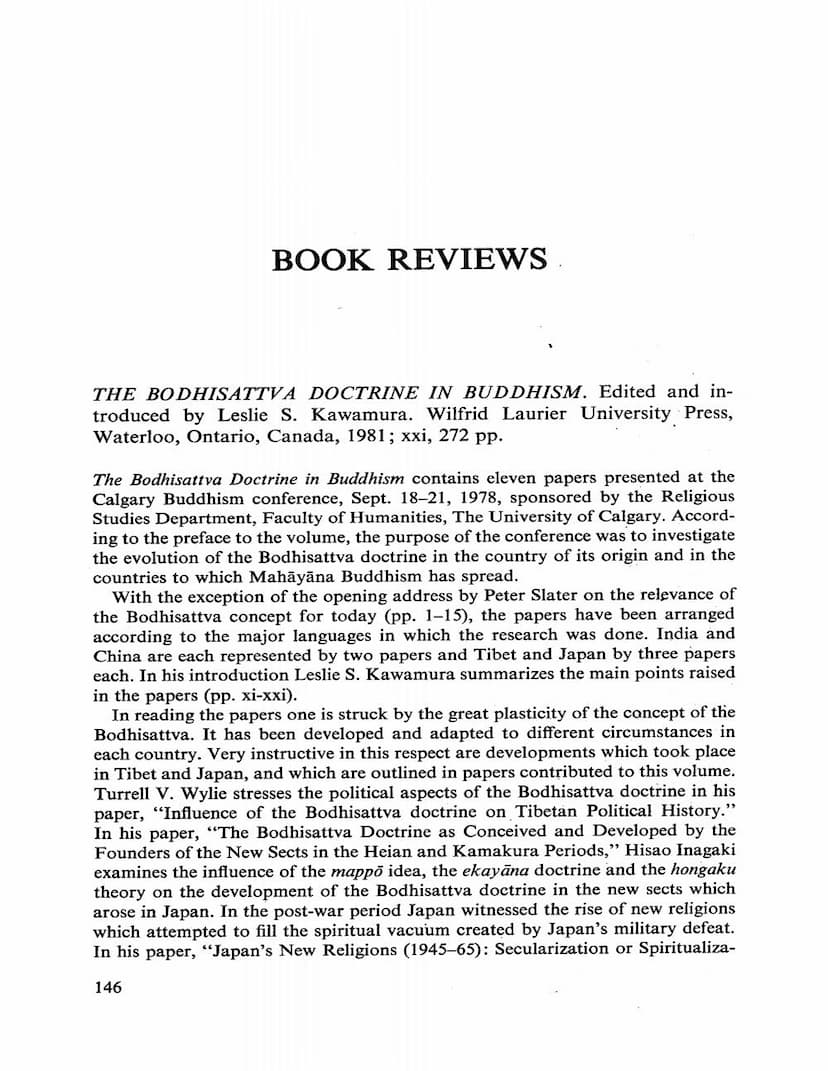
Here's a comprehensive summary of the book review of "The Bodhisattva Doctrine in Buddhism" by J. W. De Jong, drawing from the provided text:
This review by J. W. De Jong discusses "The Bodhisattva Doctrine in Buddhism," a collection of eleven papers presented at a 1978 conference in Calgary, Canada. The conference aimed to explore the evolution of the Bodhisattva concept in its place of origin (India) and in countries where Mahāyāna Buddhism spread.
De Jong notes that the papers are organized by the major languages of research, with India and China each contributing two papers, and Tibet and Japan three papers each. The volume begins with an address by Peter Slater on the concept's relevance today.
A central observation from the review is the remarkable plasticity of the Bodhisattva concept, highlighting how it was adapted to different cultural and historical contexts. The review specifically points to developments in Tibet and Japan as particularly instructive examples:
- Tibet: Turrell V. Wylie's paper, "Influence of the Bodhisattva Doctrine on Tibetan Political History," is mentioned for its focus on the political dimensions of the doctrine in Tibet.
- Japan: Hisao Inagaki examines how the mappō idea (age of declining Dharma), the ekayāna doctrine (one vehicle), and the hongaku theory (original enlightenment) influenced the development of the Bodhisattva doctrine in new Japanese sects during the Heian and Kamakura periods. Minoru Kiyota's paper, "Japan's New Religions (1945-65): Secularization or Spiritualization?", discusses the rise of new religions in post-war Japan, like Sōka Gakkai (derived from the Nichiren sect), and their success in filling a spiritual void. Leslie S. Kawamura's own paper, "The Myōkōnin, Japan's Representation of the Bodhisattva," studies the lives of devout nembutsu practitioners.
The review then delves into the papers on China:
- Yün-hua Jan's paper, "The Bodhisattva Idea in Chinese Literature: Typology and Significance," identifies three types of Bodhisattvas:
- Jātaka Bodhisattvas: Embodiments of compassion, wisdom, power, and virtue from birth stories.
- Bhūmi Bodhisattvas: Those on the ten stages of the Bodhisattva path.
- Savior Bodhisattvas: A popular type, with Kuan-yin being the most revered in China.
- Lewis R. Lancaster's paper, "The Bodhisattva Concept: A Study of the Chinese Buddhist Canon," distinguishes four types:
- Jātaka Bodhisattvas.
- "Phantasma Bodhisattvas": Beings capable of sudden appearance.
- "Meditation Bodhisattvas": Those whose names are derived from samādhi (meditative absorption) or are visualizations of meditators (e.g., Vajrapāṇi).
- "Living Bodhisattvas": Great Buddhist teachers given the title or invested with it ceremonially.
De Jong notes some discrepancies and areas for clarification in Lancaster's work, particularly regarding controversies surrounding the Bodhisattva concept in China and the historical accounts of figures like Fo T'u-têng, Samghadeva, and Dharmayaśas, suggesting further research is needed to substantiate some claims.
The review also highlights other papers:
- Gadjin M. Nagao's "The Bodhisattva Returns to This World" delves into the Mahāyāna philosophical concepts of apratisthita-nirvāṇa (unestablished nirvāṇa) and samcintyabhavopapatti (intentional self-creation), representing the "descending" aspect of the Bodhisattva path (as opposed to the "ascending" aspiration for liberation).
- Lobsang Dargyay's "The View of Bodhicitta in Tibetan Buddhism" examines Tibetan scholars' efforts to reconcile differing Indian interpretations of bodhicitta (the mind of enlightenment). De Jong points out some potential issues with citations and translations in this paper.
- H. V. Guenther's "Bodhisattva-The Ethical Phase in Evolution" translates passages from Tibetan authors explaining the term "Bodhisattva," with De Jong lamenting the absence of the original Tibetan texts for easier verification.
Finally, the review addresses A. L. Basham's paper, "The Evolution of the Concept of the Bodhisattva," offering substantial critique:
- De Jong agrees with Basham's assertion that Pāli scriptures likely contain more traces of "primitive" Buddhism than Buddhist Sanskrit texts but criticizes Basham for overlooking scriptures from other Hinayana schools, which are crucial for understanding early Buddhism and have been published in recent years (citing Ét. Lamotte's work).
- He notes that Basham relies heavily on older scholarship (Har Dayal, Marie-Thérèse de Mallmann) and doesn't adequately engage with more recent Japanese scholarship in the field.
- De Jong takes issue with Basham's interpretation of an inscription by Asoka, specifically the term sambodhi. Basham believes it refers to enlightenment, while most scholars (and the reviewer) interpret it as the Bodhi Tree, citing evidence from the Mahāvastu and other sources.
- The review expresses strong criticism of Basham's reliance on secondary sources like D. C. Sircar's Select Inscriptions without consulting original publications and points out numerous careless errors and misinterpretations in Basham's quoting and analysis of inscriptions, including those from Mathura and Nagarjunikonda. For example, Basham's interpretation of an inscription describing the Buddha as pitāmaha (grandfather) as a reflection of an imperfect understanding of the trikāya doctrine is dismissed as unfounded. De Jong also questions the dating of some inscriptions discussed by Basham.
In conclusion, De Jong praises the volume for its interesting material on the Bodhisattva doctrine and its inclusion of papers on Japanese Buddhism, which he feels is under-studied by non-Japanese scholars. He also commends the editor, Leslie S. Kawamura, for his careful editing and the excellent, detailed index. However, he regrets the absence of a paper by a reputable scholar on the development of the Bodhisattva doctrine in India, while also highlighting the critical shortcomings he found in Basham's contribution.