
Book Reviews
Added to library: September 1, 2025
Summary
Here's a summary of the provided Jain text, focusing on its content as a book review by J. W. De Jong:
This document consists of a series of book reviews authored by J. W. De Jong, published by J. W. De Jong. The reviews cover a range of academic works related to Indology and Asian studies.
Key Reviews and Their Content:
-
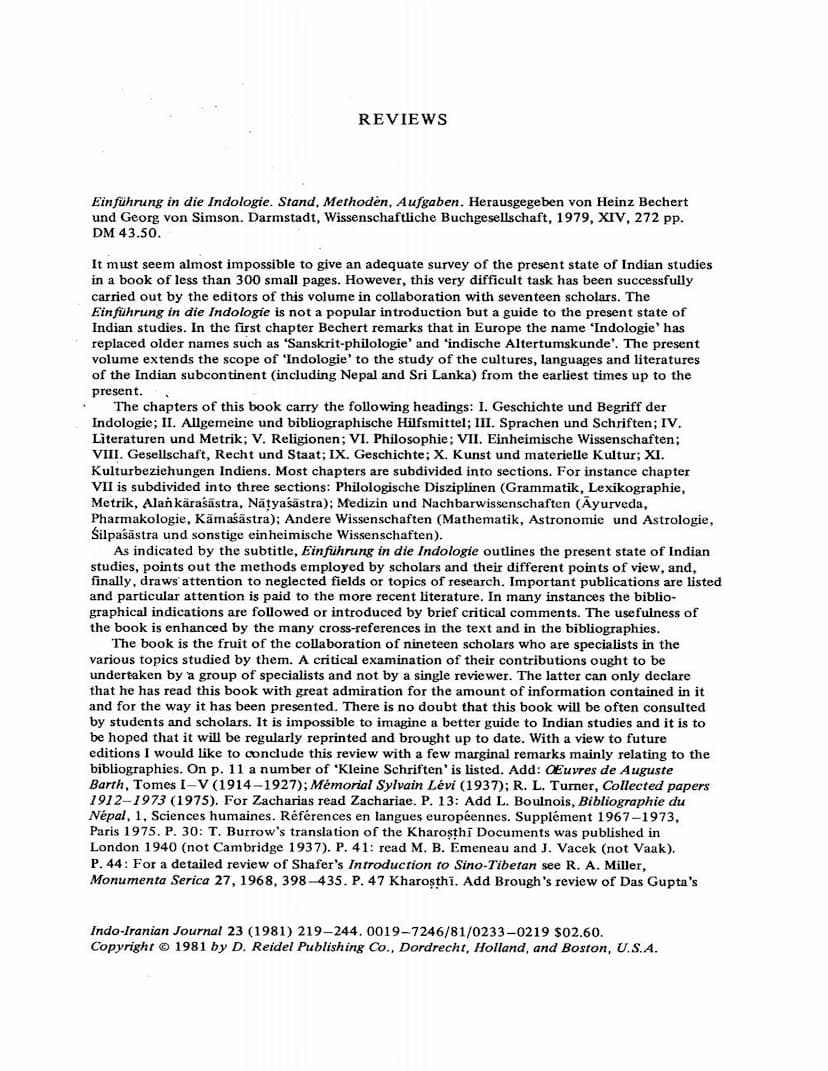
"Einführung in die Indologie. Stand, Methoden, Aufgaben." (Introduction to Indology. State, Methods, Tasks.)
- This review discusses a comprehensive volume edited by Heinz Bechert and Georg von Simson, aiming to survey the current state of Indian studies.
- De Jong praises the book for successfully outlining the scope of "Indologie," which now encompasses the study of cultures, languages, and literatures of the Indian subcontinent, from its earliest times to the present.
- He details the book's structure, listing its eleven chapters covering history, bibliographic tools, languages, literatures, religions, philosophy, indigenous sciences, society, law, state, history, art, material culture, and cultural relations of India.
- The reviewer highlights the book's focus on the methods and viewpoints of scholars, as well as identifying neglected research areas. He notes the inclusion of important publications and critical comments on recent literature.
- De Jong acknowledges the collaborative effort of nineteen specialists and expresses admiration for the book's content and presentation, anticipating it will be a frequently consulted guide for students and scholars.
- He also offers several bibliographical suggestions and corrections for future editions.
-
"Indian Lexicography" by Claus Vogel
- This review focuses on Vogel's work, a history of Indian lexicographical works, published as part of a larger series.
- De Jong notes that Vogel's book provides a substantial amount of new information beyond previous studies on the topic, particularly since Theodor Zachariae's seminal work in 1897.
- He describes Vogel's methodology: a chronological examination of "kośas" (lexicons), starting from early fragments and ending with Kṣemendra's Lokaprakāśa, with special sections on specialized and bilingual/multilingual dictionaries.
- The reviewer emphasizes Vogel's detailed descriptions of each lexicon, analysis of sources, and precise dating of works and authors. The numerous notes with bibliographical information are also highlighted.
- De Jong considers Vogel's work to be the standard for Indian lexicography for many years to come, although he notes that Zachariae's work offers more detailed information on the arrangement of kośas.
- He provides some minor corrections and additions to Vogel's text and notes, particularly concerning specific scholars and references.
-
"Cuḍālā. Eine Episode aus dem Yogavāsiṣṭha." by Peter Thomi
- This review examines Thomi's work on a specific episode from the Yogavāsiṣṭha, a large Sanskrit literary work.
- De Jong notes that the Yogavāsiṣṭha has received relatively little attention despite its popularity.
- He outlines Thomi's focus on the story of Cūḍālā, its relation to the Laghu-Yogavāsiṣṭha, and the author's textual comparison of printed editions with manuscripts.
- The reviewer discusses Thomi's hypothesis about the evolution of the Laghu-Yogavāsiṣṭha and its relationship to the larger Yogavāsiṣṭha.
- A significant portion of the review is dedicated to critiquing Thomi's translation of the Cūḍālā episode, pointing out several instances where the meaning of the Sanskrit text appears to be misinterpreted or where the translation is unclear.
- De Jong also reflects on the philosophical aspects of the Yogavāsiṣṭha, particularly its potential connection to Buddhist philosophy and the term "arthakriya."
- He concludes by stating that Thomi's work is valuable for highlighting textual problems in the episode and expresses hope for more critical editions of related texts.
-
Reviews of Buddhist, Sikh, and Tibetan Publications:
- Buddhist Research Information, Buddhist Text Information, Sikh Religious Studies Information: De Jong critiques the editorial policy and content of these bulletins, suggesting improvements for greater systematicity and comprehensiveness in bibliographical data. He points out missed references and redundancies.
- "Tibetische Handschriften und Blockdrucke, Teil 7." (Tibetan Manuscripts and Blockprints, Part 7.) This review discusses a catalog of Tibetan collections, noting its structure and contents. De Jong criticizes the catalog for lacking detail in certain areas compared to previous volumes, specifically the omission of colophons and insufficient bibliographical information for some texts. He highlights discrepancies and missing references to important secondary scholarship.
- "Wortart und Sprachstruktur im Tibetischen" (Word Class and Language Structure in Tibetan) by Heinz Zimmermann: De Jong describes Zimmermann's book as a complex analysis of Tibetan language structure, introducing a new terminology. He finds the book challenging due to its unique terminology and abbreviations but acknowledges its potential value for specialists. He notes the author's attempt to synthesize theories of Chomsky and Tesnière.
- "Einführung in die Zentralasienkunde" (Introduction to Central Asian Studies) by Annemarie von Gabain: This is a critical review. De Jong finds the book unsatisfactory as an introduction, citing a lack of systematic approach, insufficient bibliographical information, and factual errors. He notes the author's limited and sometimes erroneous knowledge of Buddhism and other related fields. He suggests the author should have focused on her area of expertise, Turkish peoples.
- "Burmese Manuscripts, Part 1." by Heinz Bechert, Daw Khin Khin Su, and Daw Tin Tin Myint: De Jong welcomes this catalog as the first detailed description of Burmese manuscripts. He finds the introduction informative regarding Burmese literature and previous studies, noting the limited translation of pre-modern Burmese works into European languages. He also corrects dating information for Bishop Bigandet's work and emphasizes the importance of this catalog for understanding Burmese literature.
- "Der Weg des Übens im ostasiatischen Mahāyāna." (The Path of Practice in East Asian Mahāyāna.) by Robert Klaus Heinemann: This review examines Heinemann's work on the relationship between practice and goals in East Asian Mahāyāna Buddhism, particularly in the context of Dōgen. De Jong discusses the book's analysis of early Buddhist texts and schools and their influence on Japanese Buddhism. He notes the complexity of tracing Indian origins and the importance of Chinese developments.
- "China in Central Asia. The early Stage: 125 B.C. - A.D. 23." by A. F. P. Hulsewé and M. A. N. Loewe: De Jong praises this annotated translation of historical Chinese texts related to Central Asia. He highlights the translators' critical scrutiny of sources, their detailed introduction explaining the historical background and textual relationships, and the copious notes and bibliography that make the work accessible to a broader academic audience. He commends the collaborative effort and its exemplary nature for future translations of Chinese historical sources.
In essence, the document showcases J. W. De Jong as a meticulous reviewer who provides in-depth analyses of academic works, offering both praise for well-executed scholarship and constructive criticism for perceived shortcomings, often with detailed bibliographical and textual corrections. The reviews cover a broad spectrum of Indological and Central Asian studies, demonstrating the reviewer's extensive knowledge in these fields.