
Book Reviews
Added to library: September 1, 2025
Summary
This document contains a collection of book reviews published in the Indo-Iranian Journal in 1985. The reviews cover a range of topics related to Indian and Buddhist studies, as well as some Tibetan literature. Here's a summary of each review:
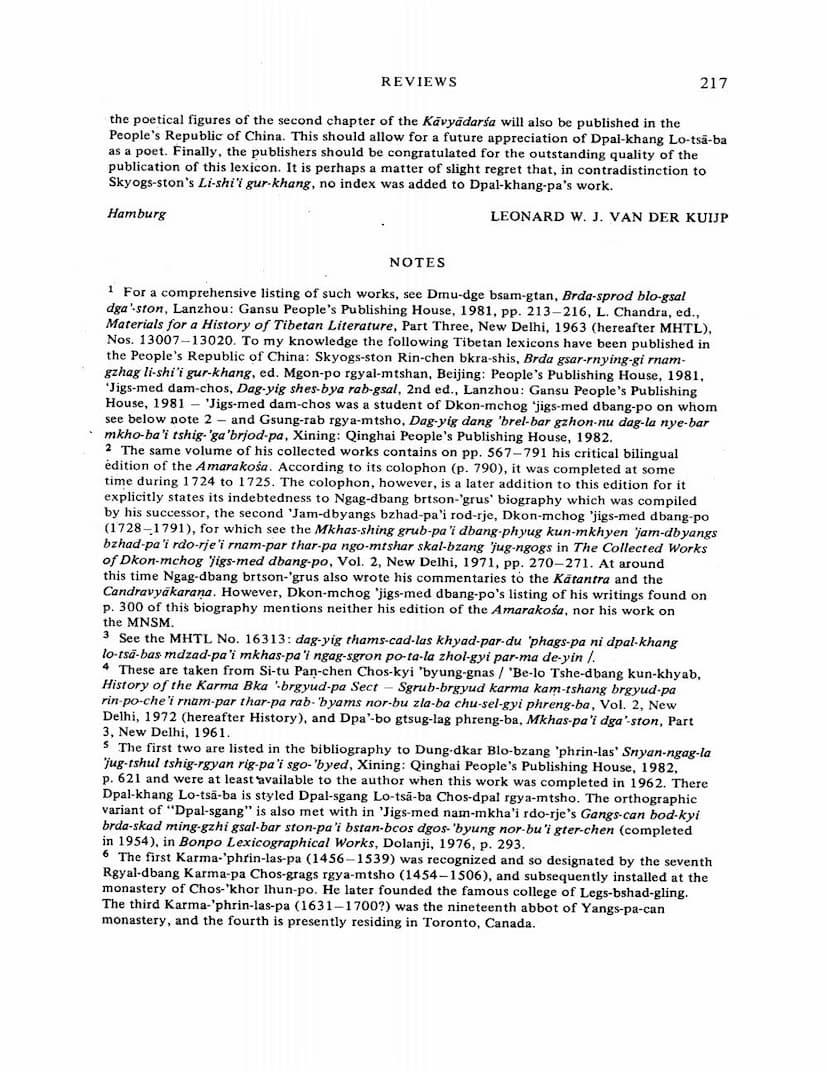
1. Dpal-khang Lo-tsa-ba's Lexicon (No author mentioned for the review)
- This review discusses a lexicon by Dpal-khang Lo-tsa-ba.
- The reviewer praises the publisher for the high quality of the publication.
- A slight regret is noted due to the absence of an index, unlike another work by Skyogs-ston.
- It is mentioned that the poetical figures from the second chapter of the Kāvyādarśa will also be published in China, allowing for future appreciation of Dpal-khang Lo-tsa-ba as a poet.
- Several notes provide extensive bibliographical information on Tibetan lexicons and related works.
2. Karl H. Potter (ed.), Indian Metaphysics and Epistemology: The Tradition of Nyāya-Vaiseṣika up to Gangesa (1977) and Advaita Vedānta up to Śamkara and His Pupils (1981)
- This review by J. W. De Jong discusses two volumes from "The Encyclopedia of Indian Philosophies."
- The second volume (1977) covers the Nyāya-Vaiśeṣika school up to Gangesa (c. 1350), and the third volume (1981) focuses on Advaita Vedānta philosophers like Gaudapada, Samkara, and his pupils.
- The reviewer notes that the use of "up to" in the titles is ambiguous regarding the inclusion of certain figures.
- Both volumes feature long introductions by Karl Potter, followed by summaries of works. Many summaries are by Potter, with contributions from other scholars.
- Potter's preface suggests that Indian philosophy needs to be appreciated by philosophers without extensive Sanskrit training and that existing translations sometimes fail to highlight what is philosophically interesting.
- De Jong raises critical points about Potter's presuppositions, such as the existence of "perennial philosophical problems" and the possibility of extricating Indian thought from its tradition. He warns of a danger that Indian thought might be analyzed primarily for its parallels with Western doctrines, potentially overlooking aspects more fundamental to the Indian tradition.
- The review details the contents of both volumes, mentioning the number of authors summarized and specific texts highlighted.
- A suggestion is made for a separate Sanskrit index in future volumes.
- The review also touches upon specific scholarly debates, such as the authenticity of works attributed to Samkara and the comparison of a stanza from Gaudapada's Kārikās with a stanza from Bhāvaviveka.
- The reviewer expresses gratitude for Potter's extensive work and hopes the project will continue.
3. Francis Zimmermann, La jungle et le fumet des viandes: Un thème écologique dans la médecine hindoue (1982)
- This review by J. W. De Jong focuses on Zimmermann's book, which explores the theme of the "Jungle" in ancient India, particularly its ecological implications in Hindu medicine.
- The book's starting point is a Sanskrit medical treatise classifying animals from "dry lands" (jangala) and "paludal lands" (anupa).
- Zimmermann attempts to explain the shift in meaning of "jungle" from "dry lands" to "impenetrable forest," focusing on its original meaning in Sanskrit texts.
- The book delves into the "archaeology of collective representations," drawing on various disciplines like biogeography, zoology, linguistics, pharmacy, and physiology.
- The review highlights Zimmermann's analysis of the "Jungle" as a category of collective thought, encompassing legal, medical, geographical, political, biological, and religious ideas.
- The reviewer notes Zimmermann's attempt to explain the semantic shift of "jungle" but finds his explanation for the medieval period's conceptualization of the "elephant jungle" less satisfactory.
- The book's main interest lies in its study of collective representations that underlie medical notions. It examines the polarity of dry and paludal lands in medical prognosis and taxonomy.
- The review discusses the book's chapters on the relationship between tradition and geography, the Indus and Ganges polarity, zoology in pharmacy (analyzing the catalog of meats from the Suśrutasamhitā), and the logic of cuisine in Ayurveda.
- It touches upon Indian physiology, the concept of dhātu, vegetarianism, non-violence, and the hierarchical positioning of animals in the food chain.
- The reviewer commends Zimmermann for shedding light on the modes of thought behind Ayurvedic doctrines but wishes comparative insights with Greek medicine were more systematically presented.
4. Jacques Scheuer, Śiva dans le Mahābhārata (1982)
- This review by J. W. De Jong discusses Scheuer's study on the god Śiva in the Mahābhārata (Mbh).
- Scheuer argues that the Mbh presents a unified worldview where Viṣṇu and Śiva (or Kṛṣṇa and Rudra) play complementary roles.
- The reviewer notes Scheuer's departure from previous scholarly interpretations, critiquing those who focused on reconstructing an heroic poem, employed naturalistic interpretations, or subscribed to the "inversion theory."
- Scheuer's perspective is aligned with Madeleine Biardeau's structuralist approach to the Mbh, focusing on understanding the text from within the Hindu world.
- The review highlights Scheuer's analysis of Śiva's interventions in the Mbh, particularly concerning episodes related to the birth of heroes, Draupadi, Ambā, Sikhandin, the Khandava forest fire, Jarasamdha, and Arjuna's quest for weapons.
- Scheuer's conclusion is that Śiva is present in all that is violent, cruel, and dangerous, embodying the violence inherent in sacrifice, justice, and war, which are necessary for maintaining dharma. Śiva presides over cosmic destruction at the end of epochs.
- The reviewer praises Scheuer's meticulous citation of the Mbh text (critical edition and Vulgate), his translations, detailed bibliography, and indices.
- Madeleine Biardeau's strong recommendation of the book as a "masterful synthesis" is noted.
5. Wilhelm Rau, Bilder 135 deutscher Indologen. 2., erweiterte und verbesserte Auflage (1982)
- This brief review by J. W. De Jong discusses the second edition of Wilhelm Rau's book of photographs of German Indologists.
- The second edition contains 136 photographs, with some replaced and new scholars included.
- The reviewer notes the care taken by Rau in selecting new photographs and correcting dates and names.
- A drawback mentioned is that the photographs are smaller and of poorer quality compared to the first edition.
- The reviewer expresses a wish for a similar publication featuring non-German Indologists.
6. Friedrich Otto Schrader, Kleine Schriften. Mit Ergänzungen aus seinem Nachlass herausgegeben von Joachim Friedrich Sprockhoff (1983)
- This review by J. W. De Jong covers the collected writings of Friedrich Otto Schrader (1876-1961), a scholar with diverse interests.
- The collection includes Schrader's doctoral thesis on Indian philosophy at the time of Mahāvīra and Buddha, with a focus on Jain sources.
- Articles on the Bhagavadgītā, including his book on "The Kashmir Recension of the Bhagavadgītā," are reprinted.
- The review notes the absence of Schrader's reply to Edgerton's review and Belvalkar's criticisms.
- The "Sprachwissenschaft" section features articles on the Siamese alphabet, the relationship between Dravidian and Uralian languages, and linguistic analyses of Sanskrit.
- Other sections cover Indian philosophy, religious history, Buddhism, and ethnology.
- The editor, Joachim Friedrich Sprockhoff, is commended for his careful editing, especially of Schrader's addenda and corrigenda.
- Minor printing errors are pointed out, and the indexes are noted as useful.
7. R. E. Emmerick, The Siddhasara of Ravigupta. Volume 2: The Tibetan version with facing English translation (1982)
- This review by J. W. De Jong focuses on the second volume of Emmerick's work on Ravigupta's Siddhasara, containing the Tibetan version and its English translation.
- Emmerick posits that the Tibetan version offers an accurate and often clearer interpretation of the Sanskrit original.
- Special attention is given to the challenges of identifying plant names and the six methods used by Tibetan translators to render them.
- The English translation is noted to not discuss passages that differ from the Sanskrit or contain additional information, which are expected to be covered in the forthcoming commentary.
- The reviewer identifies potential ambiguities or variations in translation and understanding of certain verses, questioning Emmerick's rendering of "apramatta" as "respectful" rather than "careful."
- The reviewer hopes Emmerick will consider compiling a trilingual glossary of medical terminology, similar to a project announced by Claus Vogel.
- Emmerick's work is considered a major contribution to the study of Indian and Tibetan medicine, and the reviewer anticipates the publication of Khotanese and Uighur fragments and the commentary.
8. Hilko Wiardo Schomerus, Arunantis Sivajñanasiddhiyar. Die Erlangung des Wissens um Siva oder um die Erlösung. (Vol. I & II, 1981)
- This review by J. W. De Jong discusses the posthumously published translation of Arunanti's Sivajñānasiddhiyar by H. W. Schomerus.
- The editors note that they could not critically revise the manuscript in light of recent publications.
- The review provides background on Schomerus, a missionary and scholar who published on Saiva-Siddhānta.
- The Sivajñānasiddhiyar (SJS) is described as having two parts: sva paksa (author's doctrine) and para paksa (refutation of fourteen other doctrines). The SJS is a commentary on Meykantadeva's Sivajñānabodha.
- The reviewer notes that Schomerus used commentaries by Sivajñānayogi and Tattvaprakasar.
- A point of critique is that Schomerus's translation does not clearly distinguish between information from commentaries and his own explanations.
- The importance of the para paksa for its refutations of Buddhist and other schools is highlighted, referencing earlier translations of sections by Karl Graul and A. L. Basham.
- The reviewer expresses hope that this publication will stimulate further research on the SJS and its sources.
9. Hsueh-li Cheng, Nagarjuna's Twelve Gate Treatise. Translated, with Introductory Essays, Comments and Notes (1982)
- This review by J. W. De Jong critically examines Cheng's translation and analysis of Nagarjuna's Twelve Gate Treatise (TGT).
- The review begins by addressing the authenticity of the TGT, with Cheng arguing for its attribution to Nagarjuna, while acknowledging scholarly doubts.
- The reviewer cites differing scholarly opinions on the composition of the TGT, including the possibility of it being a commentary by Pingala on verses by Nagarjuna.
- The review analyzes the relationship of the TGT verses to those in other Nagarjuna works, noting significant overlap with the Middle Treatise (Chung-lun).
- Key arguments against the TGT's authenticity by scholars like Yasui Kōsai are discussed, including the misinterpretation of a verse and the absence of the TGT in the commentaries of prominent Madhyamaka scholars.
- Cheng's translation is critiqued for being too free in places and for failing to engage with important Japanese scholarship on the TGT's authenticity.
- The reviewer also points out inaccuracies in Cheng's historical accounts, such as his identification of Hui-wen as the founder of T'ien-t'ai Buddhism.
- The review notes that Cheng does not mention the Sanskrit translation of the TGT or Richard Robinson's seminal translation and notes on the preface.
- Despite its flaws, the translation is acknowledged as potentially useful for scholars who do not read Chinese or Japanese.
10. Akira Yuyama, Kacchapa-jātaka. Eine Erzählung von der Schildkröte und dem Kranzwinder (1983)
- This review by J. W. De Jong assesses Yuyama's edited text of the Kacchapa-jātaka (Tortoise Jataka) from two sources: Hendrik Kern's edition (based on MS. P) and the version found in the Mahāvastu.
- Yuyama's introduction provides detailed information on stories featuring tortoises.
- The edition presents the two texts on opposite pages.
- The reviewer notes Yuyama's attention to metre and his translation of the verses.
- Several textual problems are identified in the prose passages, with suggestions for emendations and a critique of Yuyama's explanations for certain readings (e.g., velā, māla-kāra).
- The reviewer suggests a more thorough systematic comparison of the manuscripts used for both texts would be beneficial.
- Despite the noted issues, the work is praised for providing a solid foundation for further study of the text and its manuscript variations.
11. Fumimaro Watanabe, Philosophy and its Development in the Nikāyas and Abhidhamma (1983)
- This review by J. W. De Jong evaluates Watanabe's study on the development of logical aspects in early Buddhist thought (Nikāyas and Abhidhamma).
- The reviewer finds the term "philosophy" in the title somewhat misleading, as the focus is on logic.
- The book explores "embryonic anticipations of formal logical procedures" in early Buddhist texts.
- It covers the origins of Abhidhamma philosophy, the meaning of dhamma and abhidhammā, and the systematization of mātikās.
- The second part examines the development of dialogue and argumentation methods in the Nikāyas and the Kathāvatthu and Vijñānakāya.
- Watanabe's meticulous examination of terms and his demonstration of logical procedures in Buddhist texts are praised.
- The review highlights the emergence of strict logical forms in the Kathāvatthu, including the use of quantification.
- A significant portion of the review focuses on Watanabe's translation of the pudgala chapter of the Vijñānakāya. The reviewer finds this translation unreliable and believes that a careful study of de La Vallée Poussin's translation would have prevented several mistranslations.
- Specific instances of mistranslation and omission of textual elements are detailed.
- The reviewer concludes that while Watanabe's analysis of the debates against the Pudgalavāda school is valuable, the translation issues detract from the work.
Overall, the collection of reviews provides an overview of scholarly work in Buddhist studies, Indian philosophy, and Tibetan literature published in the early 1980s. The reviewer, J. W. De Jong, offers detailed analyses and often engages critically with the arguments and methodologies of the authors.