
Book Reviews
Added to library: September 1, 2025
Summary
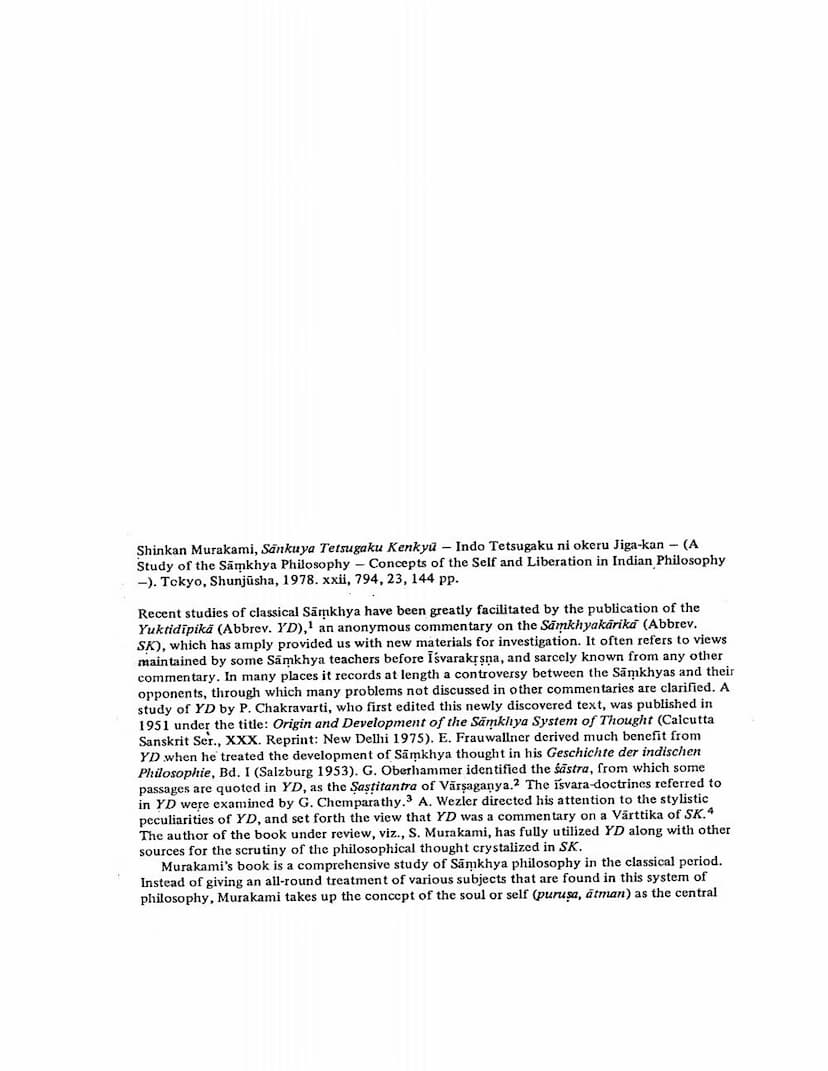
This is a book review of Shinkan Murakami's "Sankuya Tetsugaku Kenkyu - Indo Tetsugaku ni okeru Jiga-kan" (A Study of the Samkhya Philosophy - Concepts of the Self and Liberation in Indian Philosophy). The review highlights the book's comprehensive nature, its focus on the concept of the self (purusa) in classical Samkhya, and its extensive use of the newly published Yuktidipika (YD) commentary.
Here's a breakdown of the review's key points:
Book's Strengths and Contributions:
- Comprehensive Study: Murakami's book is described as a voluminous and thorough study of classical Samkhya philosophy, particularly focusing on the concept of the self.
- Utilization of Yuktidipika (YD): The reviewer emphasizes the book's heavy reliance on the YD, a recently edited commentary that provides significant new material for understanding Samkhya, including debates with opponents and views of pre-Isvarakrishna Samkhya teachers.
- Structured Approach: The book is divided into three parts:
- Pre-Samkhya Purusa: Tracing the evolution of the concept of "purusa" from early Upanishads to classical Samkhya, with the reviewer noting Murakami's conclusion that early Upanishadic "purusa" is an animating corporeal principle, not a ghost-soul.
- Samkhya System in SK: A detailed examination of commentaries on the Samkhyakarika (SK), focusing on arguments for the soul's existence, its characteristics, and proofs for its plurality. It also analyzes the functions of sensory organs, mind, ego, and intellect.
- Specific Problems: Discussion of key issues such as the plurality and pervasiveness of the soul, its relationship with prakriti, and the nature of liberation and the knowledge leading to it.
- In-depth Problem Analysis: The reviewer commends Murakami for his persistent investigation into the problem of liberation and its related concepts, such as the negation of the self in SK 64, finding similarities with Upanishadic and Yogic ideas.
- Reflection Theory: A significant portion of the book is dedicated to the reflection theory, which explains how the unintelligent buddhi (intellect) appears intelligent by reflecting the purusa. The reviewer notes Murakami's successful clarification of the theory's development through various philosophical schools and its differing interpretations.
- Affinity with Early Buddhism: The review acknowledges the book's observation of a close affinity between Samkhya and early Buddhism, citing an instance where Samkhya liberation is identified with Buddhist nirvana.
Criticisms and Areas for Improvement:
- Unnecessary Repetition: The reviewer criticizes Murakami for translating all commentaries one by one, even when they offer similar explanations. This leads to tedious reading and could have been condensed by noting only significant differences.
- Extensive, Sometimes Unfocused Translations: While the abundance of translations is appreciated, the reviewer points out instances where lengthy passages are translated, sometimes deviating from the main topic of discussion. Examples include the ten-page discussion on the structure of bhoga and extensive translations of unrelated viparyaya types in the Yogasutra.
- Translation Deficiencies: The reviewer identifies several significant defects in Murakami's translations, particularly from the Yuktidipika. These include:
- Omissions of key terms (e.g., antahkaran).
- Misinterpretations of Sanskrit terms leading to nonsensical English renderings (e.g., "part" and "whole" for anga and angi).
- Failure to grasp the context of objections and arguments.
- Awkward quotation of Sanskrit passages to fit a perceived metrical structure.
- Literal word-for-word translations lacking coherence and meaning.
- Incorrect renderings of specific Sanskrit terms (e.g., ujjvalita, sanga, kādacitka).
- Limited Historical Scope: While Murakami attempts to trace the concept of purusa from the Upanishads, the reviewer notes that his investigation generally remains within the classical Samkhya period and doesn't delve deeply into the origins and evolution of some concepts.
- Reliance on Commentators: In interpreting concepts, Murakami is described as generally following the explanations of the commentators, suggesting a lack of independent critical analysis in some instances.
Overall Assessment:
Despite the criticisms, the reviewer acknowledges the book's usefulness due to its thorough discussion of essential Samkhya problems and the ample provision of supporting material. The reviewer hopes that future works by Murakami will feature better arrangement of materials, more accurate translations, and improved presentation. The book is noted for its helpful indices and English summaries.