
Book Reviews
Added to library: September 1, 2025
Summary
This document is a collection of book reviews published in the Indo-Iranian Journal in 1984. The reviews cover a range of scholarly works on Indian religions, philosophies, and languages. Here's a summary of each review:
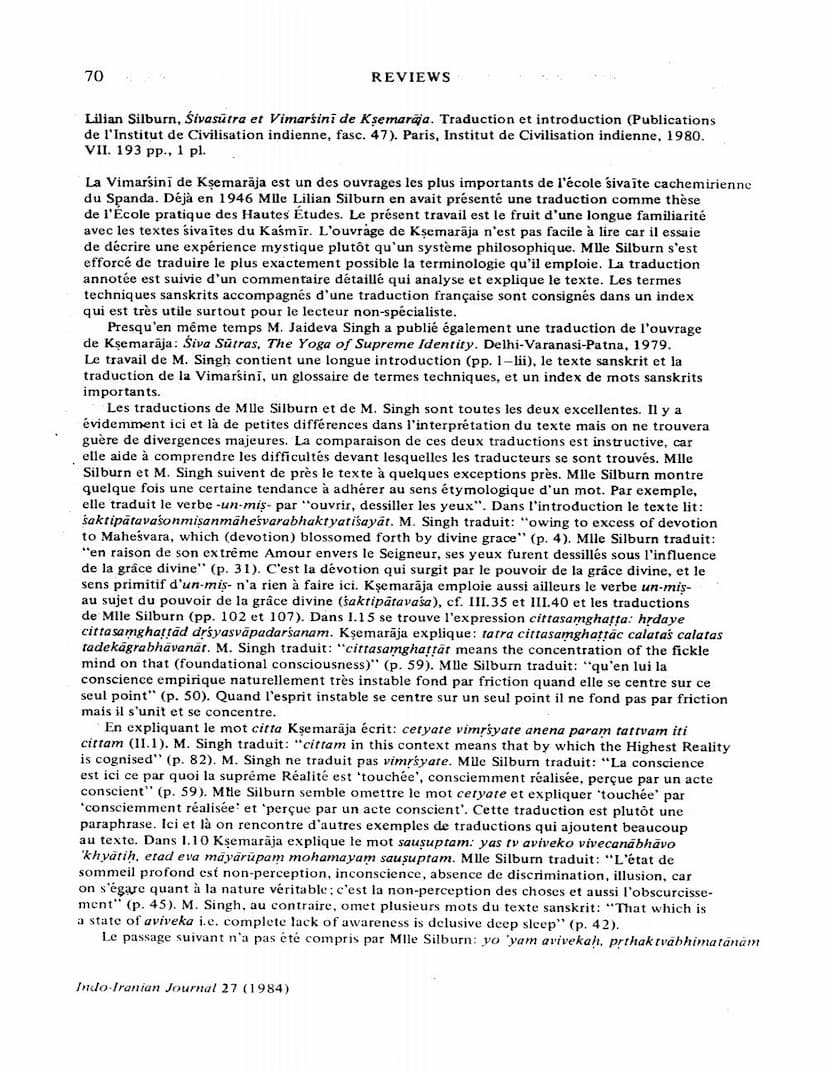
1. Lilian Silburn, Śivasūtra et Vimarsini de Kṣemarāja. Traduction et introduction
- Author: J. W. De Jong
- Content: This review compares two translations of Kṣemarāja's Vimarsini, a significant work of the Kashmir Shaivite Spanda school. The two translations are by Lilian Silburn (French) and Jaideva Singh (English). Both are praised as excellent, though minor differences in interpretation are noted. The reviewer highlights specific instances where Singh's translation is considered more accurate, particularly in understanding the mystical experience described by Kṣemarāja. The review also points out some instances where Silburn's translation might lean too heavily on etymology or paraphrases the original text.
- Key takeaway: Both translations are valuable, but Singh's appears slightly more nuanced in capturing the philosophical depth, while Silburn's is commended for its lucid and elegant French prose.
2. John S. Hawley, At Play with Krishna, Pilgrimage Dramas from Brindavan
- Author: J. W. De Jong
- Content: This review briefly introduces the book, stating that its essence is about "bhakti," the personal, direct experience of the divine in Hinduism. It highlights how the ideal devotee aims to intimately participate in the life of their chosen deity, and how presenting this divine life as a play is a way to achieve this connection. The reviewer notes the robustness of this dramatic tradition in Northern India, spurred by bhakti.
- Key takeaway: The book explores the devotional practice of bhakti through the lens of pilgrimage dramas from Brindavan, focusing on the intimate connection between devotees and their chosen deities.
3. Hertha Krick, Feuergründung. Eine Untersuchung des Rituals der Feuergründung im vedischen Ritual
- Author: Klaus Mylius
- Content: This review praises the posthumous publication of Hertha Krick's dissertation on the ritual of fire-founding in Vedic ritual. The reviewer emphasizes the work's diligence, thoroughness, and methodological exactness, calling it exemplary. Special commendation is given to the comprehensive indexes compiled by Chlodwig Werba, which include footnotes and various categories of entries (words, passages, names, subjects). The reviewer notes the careful printing of the complex text, with only minor correction suggestions. The work is seen as a lasting memorial to Krick, whose early death at 34 is lamented as a significant loss to Indology.
- Key takeaway: Krick's study is a highly regarded, meticulously researched work on Vedic ritual, made accessible by excellent indexes.
4. Richard Fox Young, Resistant Hinduism. Sanskrit sources on anti-Christian apologetics in early nineteenth-century India
- Author: J. W. De Jong
- Content: The review discusses Young's book, which analyzes the "Mataparikṣā Controversy" as a chapter in Hindu apologetics. It details the book's structure, covering John Muir's treatise on Christianity and Hinduism, counterattacks from Hindu authors (Somanātha, Haracandra Tarkapancānana, Nīlakantha Goreh), discussions between missionaries and Hindus, and the efforts to create Christian terminology in Sanskrit. While appreciating the book's contribution to an understudied area and its useful comments on Hindu traditions, the reviewer expresses significant disappointment with the author's inadequate Sanskrit knowledge, which leads to "elementary blunders" in translations and misinterpretations of key terms and passages. The review also notes that some of the primary texts are inaccessible and suggests collaborative critical editions.
- Key takeaway: Young's book is an important exploration of Hindu apologetics but is unfortunately marred by significant errors in Sanskrit translation, diminishing its scholarly value despite its interesting subject matter.
5. Nalini Balbir, Dānāstakakathā. Recueil jaina de huit histoires sur le don
- Author: J. W. De Jong
- Content: This review focuses on Balbir's edition and translation of the Dānāstakakathā, a Jain collection of eight stories illustrating the benefits of giving to monks. The reviewer notes the text's significance in Jain literature, as it is one of the few works solely dedicated to the theme of giving. The introduction details Balbir's analysis of parallel Sanskrit and Old Gujarati collections and her hypothesis about the Dānāstakakathā's origin. The review discusses the manuscript variations, the mix of Prakrit and Sanskrit, and the grammatical features of the text. While praising Balbir's meticulous edition and translation, the reviewer points out several instances where the translation or interpretation of specific passages could be improved, including the meaning of terms and the understanding of certain narrative elements.
- Key takeaway: Balbir's work is a valuable contribution to Jain studies, providing a well-edited and translated text with an insightful introduction. However, the review highlights a few areas where the translation's accuracy could be debated.
6. Wilhelm Halbfass, Indien und Europa. Perspektiven ihrer geistigen Begegnung
- Author: J. W. De Jong
- Content: This review describes Halbfass's book as a comprehensive examination of the intellectual encounter between India and Europe. The first part explores the reception of Indian philosophy in European thought from antiquity to the present, contrasting the exclusion of Indian thought in many modern histories with the engagement of figures like Hegel and Schopenhauer. It praises Halbfass's detailed characterizations of scholars like al-Biruni and Schlegel. The second part delves into India's "search for and discovery of Europe," analyzing the Indian self-understanding, attitudes towards the foreign, and the reinterpretation of concepts like darśana and dharma in relation to Western terms like "philosophy" and "religion." The reviewer highlights the book's in-depth analysis of "traditional Indian xenology" and the reactions of key Indian thinkers to the West. While acknowledging the book's excellence for both general readers and specialists, the reviewer regrets that its German language might limit its reach in India and the Anglo-Saxon world, given English's role in current intellectual dialogue.
- Key takeaway: Halbfass's book is a major work on the historical and philosophical dialogue between India and Europe, offering deep insights into both traditions' self-perceptions and intellectual exchanges.
7. Jion Abe, Sankhepatthajotani Visuddhimaggacullaṭīkā Sīla-dhutanga
- Author: J. W. De Jong
- Content: This review discusses Abe's contribution to the study of the Visuddhimagga's commentaries. Abe's work focuses on the Sankhepatthajotani, a lesser-known commentary. The reviewer notes that Abe's introduction highlights the Sankhepatthajotani's unique explanations not found in Dhammapala's main commentary. The review commends Abe's critical edition and the careful listing of variant readings. It also mentions the appendices, including comparative tables of different commentaries. While finding Abe's work a "useful contribution," the reviewer points out some discrepancies in citations and the need for further research into potential influences from other commentaries.
- Key takeaway: Abe's edition of the Sankhepatthajotani is a valuable scholarly undertaking, making a previously unpublished commentary accessible and contributing to the understanding of Visuddhimagga scholarship.
8. Index to the Kathāvatthu, Compiled by Tetsuya Tabata, Satoshi Nonome, Toyoaki Uesugi, Shokū Bando and Genshoh Unoke
- Author: J. W. De Jong
- Content: The reviewer praises this as the first complete index of a Pali text, meticulously listing each word with references to the PTS edition. The review notes the detailed separation of compound words into components. However, it also points out inconsistencies, such as the omission of some common words and the incomplete separation of certain types of compounds. The reviewer also identifies a few errors and omissions in the indexing but concludes that the index is "very carefully compiled" and will be of "great use to Pāli scholars."
- Key takeaway: This is a significant and largely successful effort to create a comprehensive index for a major Pali text, despite some minor inconsistencies.
9. Padmanabh S. Jaini (ed.), Paññāsa-Jātaka or Zimme Pannäsa (in the Burmese Recension). Vol. II
- Author: J. W. De Jong
- Content: This review covers the second volume of Jaini's edition of the Burmese recension of the Paññāsa-Jātaka. The reviewer notes that the introduction provides less on sources and linguistic peculiarities than promised, referring readers elsewhere for linguistic details. However, Jaini's added indexes and the analysis of the fifty jātakas, including their connections to other literature, are highlighted as valuable. The review discusses the dating and recensions of the text, noting a potential discrepancy in dating between Lama Geshe Wangyal's preface and other sources.
- Key takeaway: Jaini's second volume is a scholarly edition that contributes to the study of the Paññāsa-Jātaka, particularly with its detailed analysis of the stories, though the introduction could have been more comprehensive.
10. Erich Frauwallner, Kleine Schriften
- Author: J. W. De Jong
- Content: The reviewer welcomes the publication of Frauwallner's collected "Kleine Schriften" (Minor Writings), which makes his significant contributions to the history of Indian philosophy more accessible. The volume contains 38 articles and 4 reviews, chronologically arranged. The reviewer notes the importance of his studies on Vedic literature, Upanishads, Samkhya, and Buddhist logic. It's emphasized that these collected works are an "indispensable supplement" to his major published histories of Indian philosophy. The review also mentions articles published after 1962 that are not included and expresses hope for their separate publication.
- Key takeaway: This collection is a crucial resource for scholars of Indian philosophy, consolidating the influential work of Erich Frauwallner.
11. M. Nagatomi, B. K. Matilal, J. M. Masson, and E. C. Dimock Jr. (eds.), Sanskrit and Indian Studies. Essays in Honour of Daniel H. H. Ingalls
- Author: J. W. De Jong
- Content: This review hails the volume as a fitting tribute to Daniel H. H. Ingalls, a renowned Sanskrit scholar and teacher. The fourteen essays cover diverse areas of Indian studies, including Buddhist philosophy, Indian philosophy, poetics, grammar, Vedic ritual, mythology, and literature. While the reviewer found some articles (like Pingree's on astronomy) specialized, most were deemed accessible and profitable. However, the review points out numerous misprints in Sanskrit texts and "careless" translations in some contributions, particularly Potter's. A significant critique is directed at the bibliography of Ingalls's works, which is described as having many errors and omissions. The review concludes by appending a revised bibliography and highlighting Ingalls's extensive supervision of theses, showcasing his impact on the field.
- Key takeaway: A valuable collection honoring Ingalls, but marred by textual inaccuracies and an incomplete bibliography, underscoring the need for careful editing and proofreading.
12. David Seyfort Ruegg, The Literature of the Madhyamaka School of Philosophy in India
- Author: J. W. De Jong
- Content: The reviewer praises Ruegg's book as the first modern history of the Madhyamaka school of Buddhist philosophy. It's noted as a significant advancement over previous, briefer treatments. The review outlines the book's structure, covering the early, middle, and later periods of Madhyamaka thought, including detailed analyses of Nagarjuna's works, the Prasangika and Svātantrika schools, and syntheses with Yogacara and Vajrayana. The reviewer commends Ruegg's profound knowledge of Sanskrit and Tibetan sources and his ability to synthesize vast amounts of material. Minor points regarding textual references and scholarly debates are also noted.
- Key takeaway: This is an indispensable and masterly survey of Madhyamaka literature, setting a new standard for scholarship in the field and serving as a crucial resource for future research.
13. Pratapaditya Pal, A Buddhist Paradise. The Murals of Alchi Western Himalayas
- Author: J. W. De Jong
- Content: The review acknowledges the beauty of the color plates in Pal's book but expresses significant disappointment with the text. While mentioning existing studies on Alchi, Pal's bibliography is noted as incomplete, particularly regarding Japanese publications. The main critique is of Pal's "Religious Background" section, which reveals a lack of acquaintance with Buddhist literature. The reviewer specifically points out a factual error regarding Santarakṣita's Tattvasamgraha, which is incorrectly linked to Yogatantra and its translation. The review concludes that while the book is visually appealing, the accompanying text is "much less satisfactory."
- Key takeaway: The book is visually stunning due to its high-quality photographs of Alchi murals, but the accompanying scholarly text is considered weak and contains factual errors.
14. The Prince Who Became a Cuckoo. A tale of liberation by the Lama Lo-drö of Drepung. Translated by the Lama Geshe Wangyal
- Author: J. W. De Jong
- Content: The reviewer contrasts Lama Geshe Wangyal's translation of this Tibetan Buddhist tale with that of Jacques Bacot and Dieter Schuh. While acknowledging the story's popularity and the existence of previous translations and synopses, the reviewer finds Wangyal's translation to be "very free," omitting phrases, and sometimes inaccurate. Bacot's translation is noted as being closer to the Tibetan text. The review also points out a chronological discrepancy in the preface regarding the writing date of the story. The reviewer hopes for an edition of the Tibetan text and suggests Wangyal's translation might be useful for readers interested in the story itself rather than a precise translation.
- Key takeaway: Lama Geshe Wangyal's translation of "The Prince Who Became a Cuckoo" is considered too free and inaccurate, with earlier translations offering greater fidelity to the original Tibetan text.
15. G. W. Houston (tr.), Wings of the White Crane. Poems of Tshangs dbyangs rgya mtsho (1683-1706)
- Author: J. W. De Jong
- Content: This review examines Houston's translation of the songs of the Sixth Dalai Lama. It acknowledges the work's fame and previous translations. Houston's translation is based on a Tibetan block-print, and he also provides the Tibetan text and romanization. However, the reviewer finds Houston's edition and translation "unsatisfactory." Critiques include a lack of clarity regarding the source block-print, inconsistencies between the Tibetan script and romanized texts, textual errors, and a misunderstanding of grammatical structures, leading to incorrect translations of key phrases. The reviewer notes that the songs' plain language still presents challenges even for Tibetans and expresses a desire for a more thorough analysis of style and vocabulary.
- Key takeaway: Houston's translation of the Sixth Dalai Lama's songs is deemed inadequate, lacking accuracy and scholarly rigor, leaving a need for a more serious and precise study of this important work.
16. G. U. Thite, Medicine. Its Magico-Religious Aspects according to the Vedic and Later Literature
- Author: Not explicitly stated, but the placement suggests it's part of the Indo-Iranian Journal.
- Content: This is a very brief, descriptive entry, essentially an abstract rather than a critical review. It states that Thite's book studies the "magical" and magico-religious aspects of medicine in Vedic and later Sanskrit texts, including incantations, rites, sacrifices, amulets, and precautionary measures. It covers both explicitly medical texts and other relevant literature.
- Key takeaway: Thite's book investigates the intersection of magic and religion within the context of Indian medical practices throughout its history.