
Book Reviews
Added to library: September 1, 2025
Loading image...
Summary
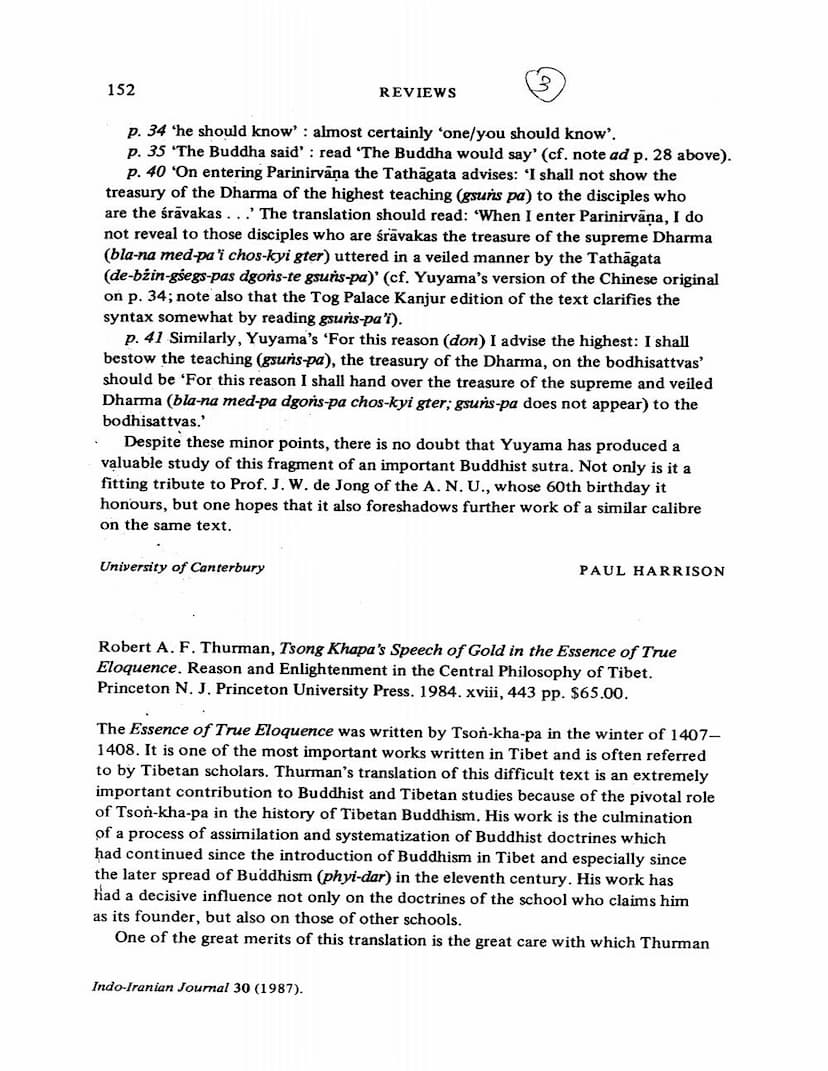
This document is a book review section from the Indo-Iranian Journal (Volume 30, 1987) that includes reviews of two scholarly works.
Here's a breakdown of the content:
Review 1: On a Study of a Buddhist Sutra Fragment
- Reviewer: Paul Harrison (University of Canterbury)
- Subject: A study of a fragment of an important Buddhist sutra, published in honor of Prof. J. W. de Jong's 60th birthday.
- Key Points:
- The reviewer offers specific textual corrections and suggestions for the reviewed work, focusing on precise translations of Buddhist terminology (e.g., "he should know" to "one/you should know," "The Buddha said" to "The Buddha would say").
- Particular attention is paid to the translation of a passage concerning the Buddha's advice on entering Parinirvana, with detailed proposed emendations to reflect the original Sanskrit/Tibetan meaning more accurately.
- Despite these minor points, Harrison concludes that the study is valuable and a fitting tribute to Prof. J. W. de Jong, expressing hope for further high-quality work on the same text.
Review 2: Tsong Khapa's Speech of Gold in the Essence of True Eloquence by Robert A. F. Thurman
- Reviewer: J. W. De Jong (Australian National University)
- Subject: Robert A. F. Thurman's translation and study of Tsong Khapa's Essence of True Eloquence.
- Key Points:
- Significance of the Work: De Jong highlights the importance of Tsong Khapa's text in Tibetan Buddhism, describing it as a culmination of the assimilation and systematization of Buddhist doctrines in Tibet, with a profound influence on Tibetan Buddhist thought.
- Merits of Thurman's Translation:
- Technical Terminology: Thurman is praised for his meticulous definition and translation of technical terms, supported by an English-Sanskrit-Tibetan glossary.
- Extensive Notes and Introduction: The detailed introduction (over 170 pages) and numerous notes are recognized as highly beneficial for understanding Tsong Khapa's complex work.
- Analysis of Madhyamaka Philosophy: The introduction's analysis of fundamental problems in understanding the Madhyamaka school, particularly the distinction between neyartha and nitārtha, the process of vipaśyanā, and the problem of ultimate truth, is considered of "greatest importance."
- Thurman's Interpretation of Madhyamaka: De Jong discusses Thurman's rejection of both "monistic absolutist" and "existential relativist" interpretations of Nagarjuna. Thurman's view is that Nagarjuna teaches that everything is "empty of intrinsic reality," and the "intuitive wisdom" recommended is not uncultivated intuition but "critical investigation of facts" (dharmapravicaya). De Jong largely agrees with this but hesitates to follow Thurman's absolute rejection of mysticism, suggesting that intellectual or speculative mysticism exists that doesn't reject reason.
- Criticisms and Minor Blemishes: While acknowledging Thurman's immense effort and skill, De Jong points out several areas for improvement:
- Knowledge of Chinese Versions: Thurman's limited knowledge of Chinese Buddhist texts is noted, leading to an error regarding Yuan-tsho's commentary.
- Sanskrit Misspellings: Numerous misspellings and incorrect diacritics in Sanskrit quotations are highlighted, making them difficult to use without consulting the original editions.
- Translation Errors in Mahāyānasūtrālamkara: De Jong meticulously analyzes several passages from the Mahāyānasūtrālamkara that Thurman translates, identifying "serious mistakes" and offering more accurate translations. He notes that Thurman failed to identify Tsong Khapa's specific references to certain commentaries.
- Translation of Candrakirti and Dharmakirti Passages: De Jong points out mistranslations and misinterpretations in Thurman's rendering of passages from Candrakirti's Prasannapadā and Dharmakirti's Pramāṇavārttika, attributing some errors to a lack of attention to the Sanskrit text.
- Overall Conclusion on Thurman's Work: De Jong concludes that despite these "minor blemishes," Thurman is an "extremely gifted scholar" from whom more excellent work is expected. He encourages Thurman to maintain his attention to Sanskrit studies, as they are fundamental to understanding both Indian and Tibetan Buddhism.
In essence, the document presents two academic reviews of scholarly works related to Buddhist studies. The first is a brief note offering textual corrections, while the second is a more extensive critique of a significant translation and analysis of a key Tibetan Buddhist text, praising its strengths while identifying specific areas for improvement.