
Book Reviews
Added to library: September 1, 2025
Summary
This document is a book review by J. W. De Jong, focusing on two distinct works.
Part 1: Review of Hélène Brunner-Lachaux's Somasambhupaddhati
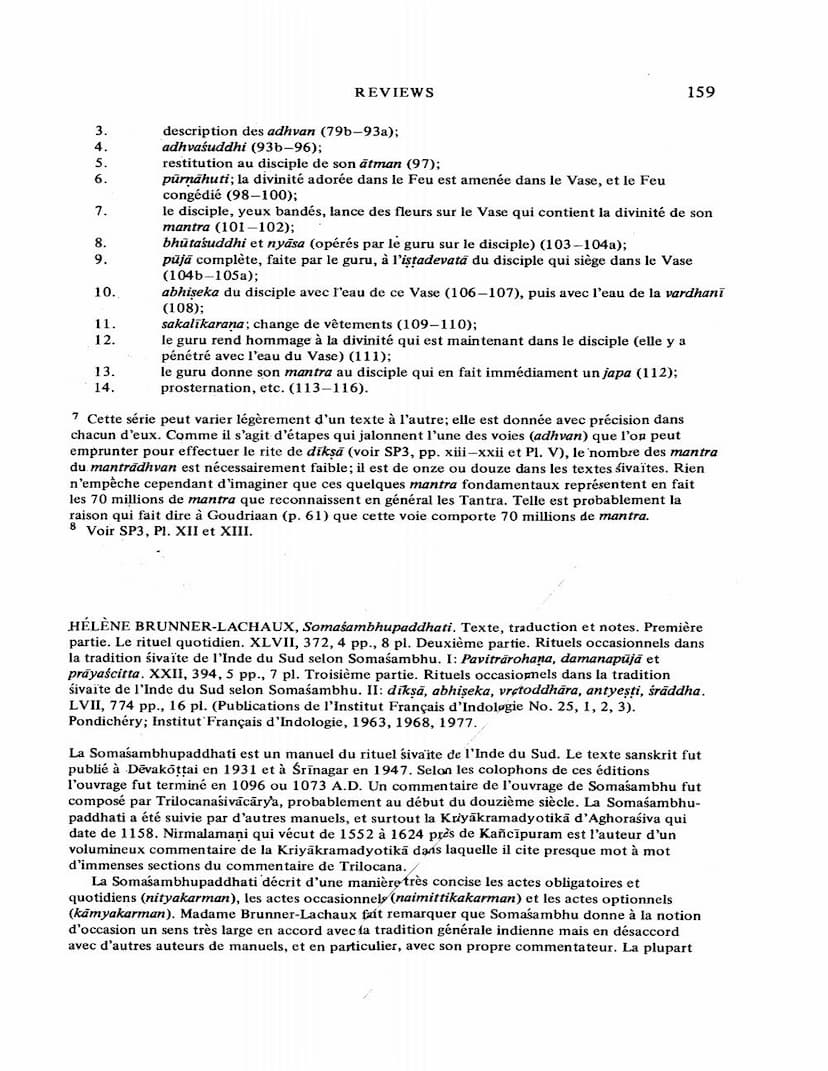
The first part of the review discusses Hélène Brunner-Lachaux's multi-volume translation and analysis of the Somasambhupaddhati, a manual of South Indian Śaiva ritual.
- Significance of the Work: The reviewer highlights the immense importance of Brunner-Lachaux's undertaking, noting that it delves into a largely unexplored area of research that is expected to significantly renew our understanding of Hinduism. The Somasambhupaddhati itself is a foundational text for South Indian Śaiva priests, dating back to the late 11th century AD.
- Brunner-Lachaux's Approach: The review details Brunner-Lachaux's meticulous approach to translating and interpreting the text. She utilized various editions and manuscripts, including those of the original paddhati and its commentaries, as well as original agama and upagama texts that influenced Somasambhu. Her work involved extensive textual criticism to establish correct texts, often necessitating collation of manuscripts due to the poor condition of available sources.
- Content and Scope: The Somasambhupaddhati describes daily rituals (nityakarman), occasional rituals (naimittikakarman), and optional rituals (kamyakarman). The review notes that Somasambhu adopts a broad definition of "occasional" rituals. Most rituals described are private, with exceptions like the annual pavitrārohana and damanapūjā.
- Detailed Analysis and Explanations: Brunner-Lachaux's work is praised for its detailed analytical introductions and extensive explanatory notes. These notes often delve into specific ritualistic details, offering valuable documentation for the study of South Indian Śaiva ritual. The reviewer specifically mentions detailed notes on the netrabandha (blinding of the eyes), Śivahasta (Guru's imposition of Śiva's hand), the meaning of viṣuva in dīkṣā (initiation), the relationship between Śiva's guṇas and aṅgas, the role of the putraka, and the status of the ācārya (guru).
- Sources and Interpretations: Brunner-Lachaux's explanations primarily draw from the Sanskrit tradition of South Indian Śaivism, distinguishing it from the Tamil Śaiva-siddhānta. While she initially consulted gurukkals (temple priests), her reliance on scriptural sources increased over time, likely due to the simplification or obsolescence of certain rituals in modern practice. The reviewer questions whether the highly complex ritual structure described represents a once-living tradition, acknowledging the Indian tendency for theory to shape practice.
- Scholarly Contribution: The review concludes by emphasizing the monumental nature of Brunner-Lachaux's endeavor, stating that it has completed two-thirds of an enormous task. Her work is considered a significant contribution that will be highly valued by future generations of Indianists studying South Indian Śaivism.
Part 2: Review of Ludwik Sternbach's Unknown Verses Attributed to Kṣemendra
The second part of the review focuses on Ludwik Sternbach's publication of verses attributed to the Kashmiri poet Kṣemendra.
- Scope of the Work: Sternbach has collected 415 verses attributed to Kṣemendra, including those he cited in his own works and those found in subhāṣitasamgrahas (collections of sayings). Of these, only 170 are found in Kṣemendra's extant works. Sternbach publishes the remaining 245 verses in four annexes.
- Annexes and Verse Attributions: The review details the content of each annex, which categorize verses based on their source (Kṣemendra's own non-extant works, general attribution to Kṣemendra, or attribution to specific extant works) and their identification in known works. The reviewer clarifies some of the headings and notes potential discrepancies in the total count of new verses.
- Textual Issues and Authorship: The review highlights issues of attribution and authenticity. Sternbach identifies verses wrongly attributed or doubtful. The reviewer notes that Kṣemendra's Bṛhatkathāmañjarī was likely not the source for many verses attributed to it in anthologies. The paternity of some verses is deemed doubtful or possibly belonging to Kṣemendra's son, Somendra.
- Kṣemendra's Works: Sternbach's introduction lists Kṣemendra's works, estimating 39 in total, with 20 no longer extant. The reviewer compares this with previous scholarly lists (Sylvain Lévi, Aufrecht, Botto, Suryakanta, Raghavan) and discusses the challenges in establishing definitive lists of both extant and non-extant works.
- Published and Non-Extant Works: The review lists Kṣemendra's published works and those mentioned as non-extant by Kṣemendra himself. It also examines eight other works mentioned by Sternbach, critically assessing their attribution to Kṣemendra and suggesting that some may be misattributed or have different titles. The reviewer notes that further examination of manuscripts for works like Kādambarīkathāsaṁkṣepa and Dānapārijāta is needed, and the attribution of Kṣemendraprakāśa and Lokaprakāśa is questioned.
- Scholarly Value: The review acknowledges Sternbach's meticulous work in compiling and analyzing these verses. However, it also points out areas where clarification or further research is needed regarding attributions and the completeness of the identified works.
In essence, the document presents a review of two significant scholarly works, one focusing on the detailed and complex ritual traditions of South Indian Śaivism, and the other on the challenging task of reconstructing the literary corpus of a classical Indian poet.