
Book Reviews
Added to library: September 1, 2025
Summary
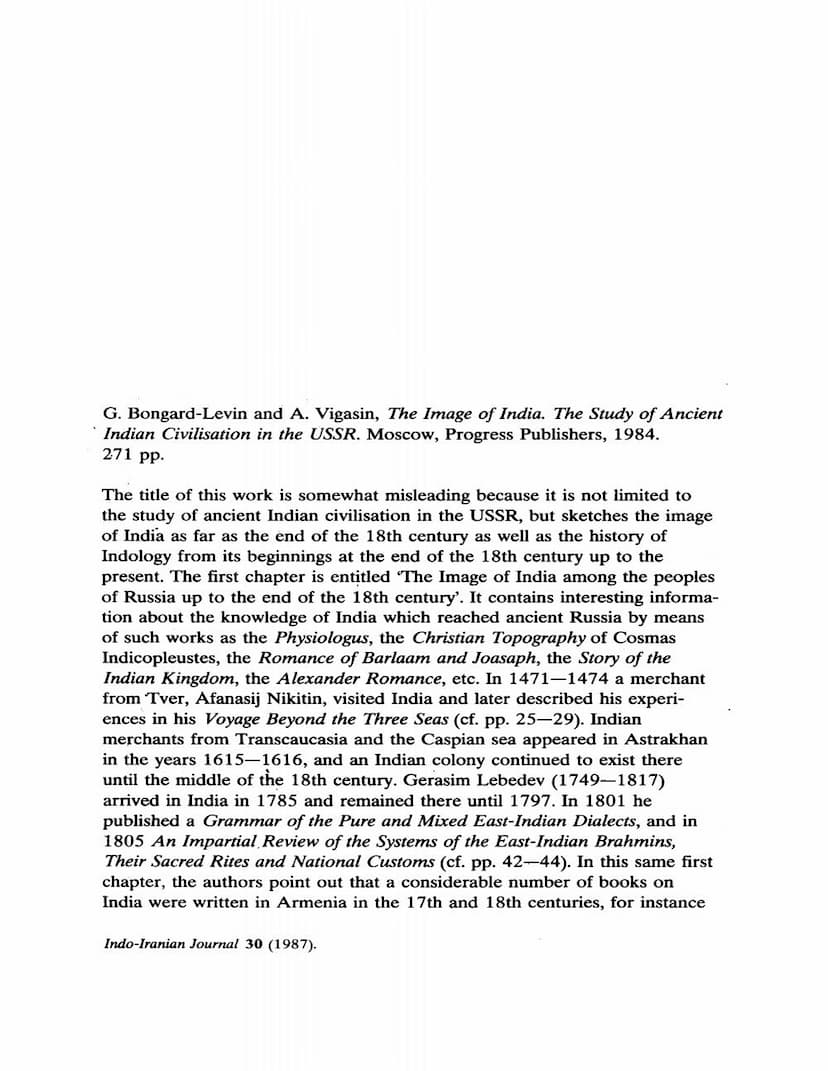
This is a book review of "The Image of India: The Study of Ancient Indian Civilisation in the USSR" by G. Bongard-Levin and A. Vigasin, written by J. W. De Jong. The review, published in the Indo-Iranian Journal, details the contents and significance of the Soviet work.
Here's a comprehensive summary:
Overall Scope and Purpose:
The book "The Image of India" by Bongard-Levin and Vigasin offers a broad survey of how India and its civilization have been perceived and studied in Russia and the USSR, spanning from ancient times up to the present day. While the title suggests a focus on ancient Indian civilization, the authors actually cover a much wider period, including early perceptions of India, the development of Indology from the late 18th century, and contemporary research.
Key Thematic Areas and Content:
-
Early Perceptions of India (Up to the 18th Century):
- The first chapter explores how ancient Russia learned about India through various religious and literary works, such as the Physiologus, Christian Topography, and the Romance of Barlaam and Joasaph.
- It highlights the travel accounts of individuals like Afanasij Nikitin (15th century) and the presence of Indian merchant communities in Astrakhan.
- Gerasim Lebedev, who visited India from 1785 to 1797, is recognized for his early linguistic and ethnographic work on Indian dialects and Brahminical systems.
- The review also notes the significant amount of work on India produced in Armenian during the 17th and 18th centuries, including a geography and a chronology of Indian kings.
- The travels of Georgian nobleman Rafail Danibegashvili, who visited India multiple times, are also mentioned.
-
Development of Indology in the 19th and Early 20th Centuries:
- This section focuses on the foundational period of Russian Indology, with special emphasis on Ivan Minaev as the founder of the Russian school of Indology and Buddhist studies.
- The review points out other less internationally known but important scholars of this era, including Vsevolod Miller (on the Asvins), Dmitrij Ovsjaniko-Kulikovskij (on Soma cult and Vedic fire cult), and Dmitrij Kudrjavskij (on Grhyasūtras).
- The ethnographic work of the Mervart couple in South India and Ceylon is also recognized, with a particular mention of A.M. Mervart's highly regarded, though rare, "Grammar of the Spoken Tamil Language."
-
Key Figures in Soviet Indology: Sergej Oldenburg and Th. Stcherbatsky:
- Chapters III and IV delve into the scholarly activities of Sergej Oldenburg and Th. Stcherbatsky, acknowledging their well-known contributions but also noting the limited English-language literature on their lives.
- The review highlights insights into Stcherbatsky's philosophical development, influenced by Kant, Bergson, and Husserl, as presented in articles by his contemporaries Nikolaj Konrad and Vladimir Kal’janov.
- Kal’janov's account explains Stcherbatsky's decision to write his works in English to ensure wider accessibility for scholars globally, especially in India.
-
Recent Indological Research in the USSR (Post-1950s):
- Chapter V discusses the significant advancements in Soviet Indological studies from the mid-1950s onwards.
- It highlights the contributions of Stcherbatsky's students, such as Obermiller, Tubjanskij, Vostrikov, and Semičov, in fields like Buddhist logic and philosophy.
- The review notes specific research on Vasubandhu's logic by Vostrikov and Semičov's work on rūpa in Buddhist texts, as well as a translation of the Abhidharmakośa by Semičov and Brjanskij.
- The breadth of contemporary Soviet Indological research is emphasized, covering Vedic studies, epics, poetics, philosophy, Sanskrit literature, Dravidian studies, dharmaśāstras, Arthaśāstra, and social/economic/political history.
-
Archaeological Work and Manuscript Collections:
- The review specifically mentions the importance of archaeological work undertaken in Soviet Central Asia, including studies on Harappan writing and proto-Indian civilization.
- An appendix detailing collections of Indian manuscripts in the USSR is also noted.
-
Challenges and Opportunities:
- The authors express regret about the lack of awareness regarding the history of Indology in Russia and the accessibility issues for European and Indian scholars due to language barriers.
- The reviewer concurs, adding that even recent Russian publications can be difficult to obtain, and scholarly articles are even harder to locate without access to specialized libraries.
- The importance of collecting seminal articles by leading Russian scholars like V. V. Ivanov and V. N. Toporov is stressed.
- A major ongoing project mentioned is Tatjana Elizarenkova's complete translation and commentary of the Rigveda, which will necessitate Russian language proficiency for Vedic scholars.
-
Reviewer's Comments:
- J. W. De Jong commends the book as a "stimulating account" and acknowledges the English translation by Peter Greenwood, though he makes a minor note on the use of the word "relic" for pamjatnik.
- He emphasizes the value of the work for Western scholars and suggests that an expanded version with a detailed, systematic bibliography would be extremely beneficial.
In essence, De Jong's review highlights "The Image of India" as a crucial work that sheds light on the rich and often overlooked history of Indological studies within Russia and the Soviet Union, showcasing the significant contributions of its scholars across various disciplines of Indian studies.