
Book Reviews
Added to library: September 1, 2025
Summary
Here's a comprehensive summary of the provided text, which consists of book reviews by J.W. de Jong:
This document contains two book reviews by J.W. de Jong, published in the Journal of the International Association of Buddhist Studies (JIABS). The reviews focus on works related to Tibetan and Chinese Buddhism.
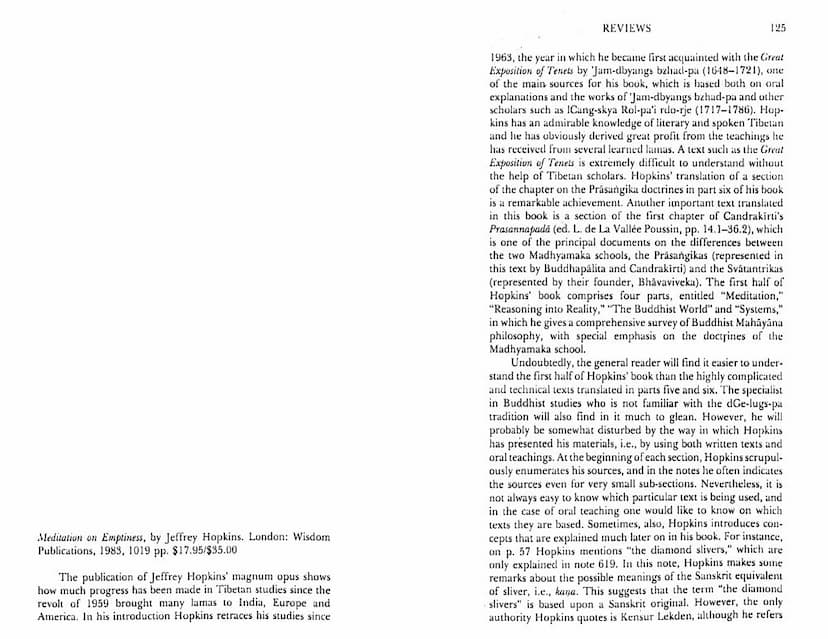
1. Review of Jeffrey Hopkins' "Meditation on Emptiness" (1983)
J.W. de Jong begins by acknowledging that Jeffrey Hopkins' "Meditation on Emptiness" is a remarkable achievement and a testament to the progress in Tibetan studies following the 1959 Tibetan revolt. Hopkins, who became acquainted with key Tibetan texts like 'Jam-dbyangs bzhad-pa's "Great Exposition of Tenets" in 1963, demonstrates an admirable knowledge of literary and spoken Tibetan and has benefited from teachings by learned lamas.
De Jong highlights the difficulty of understanding texts like the "Great Exposition of Tenets" without scholarly assistance, praising Hopkins' translation of a section on Prasangika doctrines as a significant accomplishment. He also notes the inclusion of a section from Candrakirti's "Prasannapada," crucial for understanding the differences between Prasangika and Svatantrika Madhyamaka schools. The first half of Hopkins' book provides a comprehensive survey of Mahayana Buddhist philosophy, with a focus on Madhyamaka, which de Jong believes will be more accessible to general readers and specialists unfamiliar with the Gelukpa tradition.
However, de Jong expresses several reservations:
- Methodology: He finds Hopkins' presentation, which blends written texts and oral teachings, potentially problematic. While Hopkins meticulously cites sources, de Jong desires more clarity on the specific texts underlying oral explanations and further detail on the written sources for specific terms.
- Translation Issues: De Jong points out several unsatisfactory or inaccurate renderings of technical terms. Examples include translating "budha" as "damage, harm" instead of the correct "refutation, annulment," and "siddha" and "prasiddha" as "renowned" instead of "accomplished" or "established." He provides a specific example where Hopkins' translation of a Sanskrit passage from the "Prasannapada" deviates significantly from the original meaning. He also criticizes Hopkins' translation of a passage from the "Dharaniśvararājarparipṛcchāsūtra," suggesting it gives a wrong impression of the original, partly due to an imperfect Tibetan translation and Hopkins' misunderstanding of terms like "daksiniya." Another instance involves a misreading of the Tibetan text leading to an incorrect translation concerning Arhats and their Buddha lineage.
- Neglect of Indian Sources: De Jong strongly advises against relying solely on recent Tibetan works and oral explanations. He emphasizes the importance of engaging with Sanskrit texts studied by generations of scholars and a deeper understanding of the technical vocabulary in those Indian sources. He argues that a profound knowledge of the Indian background and frequently quoted Indian texts is indispensable for studying Tibetan Buddhism, particularly the Gelukpa school.
Despite these criticisms, de Jong reiterates that Hopkins' work is a remarkable achievement and could be even more valuable if greater attention were paid to Indian texts and their associated vocabulary.
2. Review of Diana Y. Paul's "Philosophy of Mind in Sixth Century China. Paramartha's 'Evolution of Consciousness'" (1984)
J.W. de Jong reviews Diana Paul's monograph on Paramartha, a significant translator of Indian Buddhist texts into Chinese. Paramartha, active in the 6th century, was a proponent of the Yogācāra school, founding the She-lun school in China.
De Jong acknowledges the impressive range of primary and secondary sources used in Paul's book, including Sanskrit, Chinese, and Japanese materials, as well as Japanese scholarship. He notes that the book covers Paramartha's life, the dissemination of his ideas, his views on language and the philosophy of mind, and concludes with an analysis and translation of his "Chuan shih lun."
However, de Jong raises significant concerns about the accuracy and interpretation of Paul's scholarship:
- Inconsistent and Inaccurate Information: He highlights contradictions and inaccuracies in Paul's presentation of historical dating and biographical details. For example, he points out inconsistencies regarding the translation of Vasubandhu's "Abhidharmakośa" and the role of Hui-k'ai, suggesting Paul's interpretation clashes with available biographical data and scholarly consensus (citing Ui Hakuju).
- Mistranslations and Misinterpretations of Technical Terms: De Jong provides numerous examples of what he considers major errors in Paul's translations of Chinese Buddhist texts, particularly concerning the concept of "amalavijñana" (unblemished consciousness). He cites instances where Paul misinterprets the meaning of terms and fails to recognize standard translations. He contrasts Paul's flawed translations with more accurate ones from scholars like Paul Demiéville and Ui Hakuju.
- Unsubstantiated Interpretations of Sanskrit Texts: He also criticizes Paul's interpretation of Sanskrit texts, deeming some of her grammatical and semantic suggestions as "completely unacceptable" and "unwarranted." He contrasts her novel interpretations with those of established scholars like Sylvain Lévi and Wogihara.
De Jong concludes that while Paramartha is an important figure, Paul's study leaves much to be desired in its interpretation and handling of sources. He suggests that future work on Paramartha should include complete translations of his biography and those of his disciples, along with parallel translations of corresponding texts by Xuanzang, and extensive use of critical commentaries like Ui Hakuju's work.
Diana Paul's Reply and De Jong's Rejoinder:
The document includes a brief exchange where Diana Paul defends her work, stating that de Jong's review misrepresents her project, focuses on minor points, and fails to acknowledge the book's central themes regarding Paramartha's contribution to understanding the structure of the mind. She defends her interpretation of biographical details and the historical dating of translations, emphasizing her adherence to the primary biography and presenting her arguments as dealing with "unsolved puzzles."
J.W. de Jong replies, maintaining his criticisms. He refutes Paul's claim that certain biographical details are found in Paramartha's biography, showing they are from the biography of Hui-k'ai. He also reiterates that Paul's translation of a key verse is incorrect and that his initial criticisms are well-founded, supported by other reviewers and scholarly consensus. He concludes that Paul's reply further confirms the issues he raised regarding her handling of Chinese sources.