
Book Reviews
Added to library: September 1, 2025
Summary
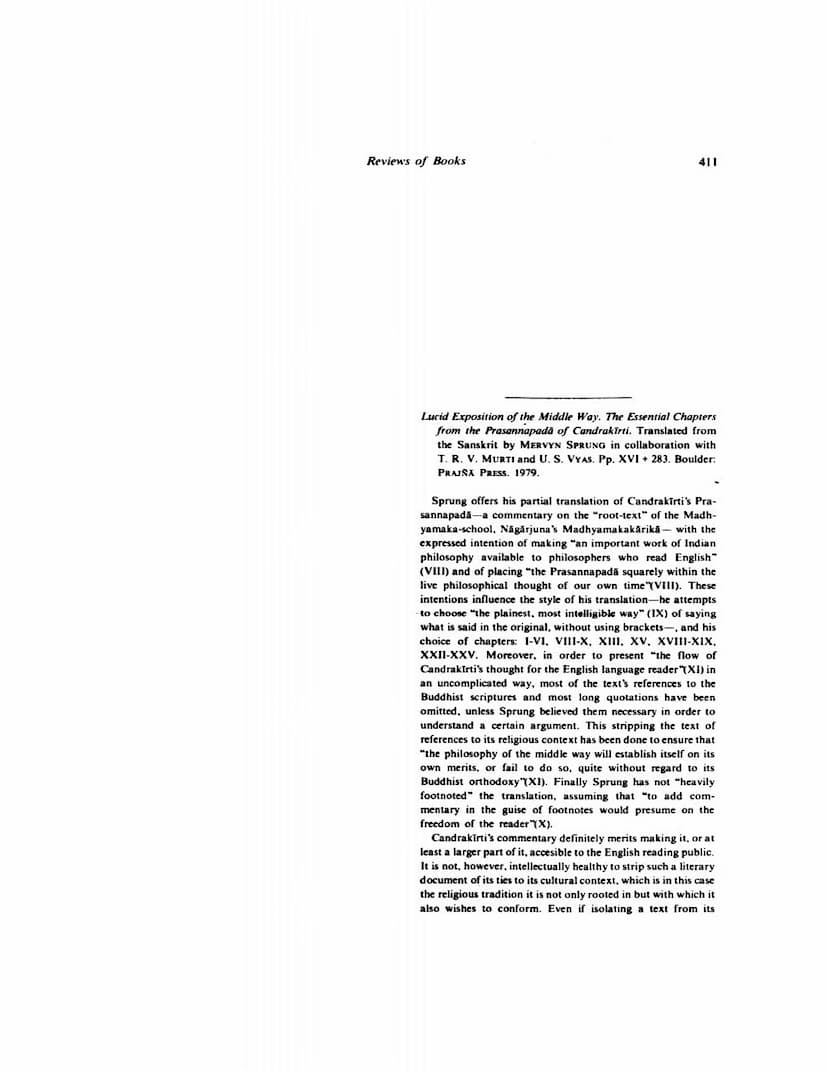
Here's a comprehensive summary of the provided book review by Ernst Steinkellner of Mervyn Sprung's translation of Candrakirti's Prasannapadă:
Overall Assessment:
Ernst Steinkellner's review of Mervyn Sprung's translation of selected chapters from Candrakirti's Prasannapadă is largely critical, despite acknowledging Sprung's laudable intentions. Steinkellner argues that Sprung's attempt to make Candrakirti's complex philosophical work accessible to English-speaking philosophers by stripping it of its religious and cultural context and simplifying its language, ultimately results in a translation that is often inaccurate, misleading, and fails to preserve the logical coherence of the original text.
Sprung's Intentions and Methods:
- Goal: To make an important work of Indian philosophy accessible to English-speaking philosophers and to place Candrakirti's thought within contemporary philosophical discourse.
- Translation Style: Aimed for plain, intelligible language, omitting most scriptural references and long quotations unless deemed essential for understanding an argument. The translator deliberately "stripped the text of references to its religious context" to allow the philosophy to stand on its own merits.
- Footnoting: Minimal footnoting, believing that adding commentary in footnotes would infringe on the reader's freedom.
- Chapter Selection: Sprung translated chapters I-VI, VIII-X, XIII, XV, XVIII-XIX, and XXII-XXV.
Steinkellner's Criticisms:
-
Intellectual Incompleteness: Steinkellner contends that it is "not intellectually healthy" to isolate a philosophical text from its cultural and religious context, especially when that context is integral to its meaning and aims.
-
Translator's Role vs. Reader's Freedom: Steinkellner disagrees with Sprung's approach to reader freedom. He believes a translator's primary duty is to present the original meaning truthfully and clearly in the new language, thereby limiting the reader's freedom of interpretation by faithfully conveying the original's intent, not by allowing for broad interpretive space.
-
Loss of Original Meaning and Logical Structure: This is the most significant criticism. Steinkellner identifies numerous instances where Sprung's translation:
- Dissolves Syntactical Units: While splitting sentences can be legitimate, Sprung often breaks down the original's syntax in a way that disrupts the implicit logical sequence of the argument.
- Misinterprets Key Terms: Steinkellner highlights specific examples like the translation of anupalambha (non-perception). He argues Sprung leans towards an intentional, subjective interpretation, whereas Candrakirti emphasizes a non-intentional aspect tied to non-existence. This leads to a distortion of the soteriological significance of the concept.
- Reverses Causal Sequences: Sprung's interpretation leads him to invert the logical or causal flow of arguments.
- Inconsistent Terminology: Sprung proposes new translations for terms but fails to apply them consistently, causing confusion for the reader (e.g., "I-ing" vs. "the sense of I").
- Neglects Crucial Words: Important words that carry significant meaning or indicate the purpose of an argument are often omitted or mistranslated (e.g., eva, tatra).
- Misunderstands Verses and Arguments: Steinkellner points out specific passages where Sprung misunderstands the underlying philosophical argument, the relation between verses, or the meaning of key terms like skandhas.
-
Failure to Utilize Predecessors' Work: Despite Sprung's claim of help from earlier scholars, Steinkellner finds little evidence of this, suggesting that many of the translation's flaws could have been avoided by carefully consulting previous work.
-
Careless Editing of Sanskrit Terms: The review notes numerous errors in the Sanskrit terms included in the book, even in the glossary, indicating a "loose relationship to the original" and a lack of diligent proofreading.
-
"Being without effect (sic!)" Example: The review cites the translation of hetuka as "being without cause; being without effect (sic!), i.e., non-causal," as an example of misinterpreting a term by focusing on only one aspect.
Conclusion:
Steinkellner concludes that Sprung's translation, while making an effort towards clarity and attempting to "lift the burden of stern scholastic Sanskrit," ultimately serves as a "setback rather than a step forward" in promoting general knowledge of the Middle Way. He believes the translation fails to capture the "linguistic testimony of his understanding of reality" and the nuanced arguments that characterize Candrakirti's work. The review suggests that a good translation should not only be clear but also act as a reliable guide to the philosopher's thought and methods.