
Bibliography Of Studies Connected With Avasyaka Commentaries
Added to library: September 1, 2025
Summary
This document, "Bibliography of Studies Connected with the Āvaśyaka Commentaries" by Klaus Bruhn, serves as a foundational guide to understanding the complex textual tradition of the Āvaśyaka literature within Jainism.
Core Subject: The bibliography focuses on the exegetical literature surrounding the Āvaśyaka, a crucial part of the Svetāmbara Jaina canon. This literature includes the original Āvaśyaka Sūtra and its subsequent commentaries.
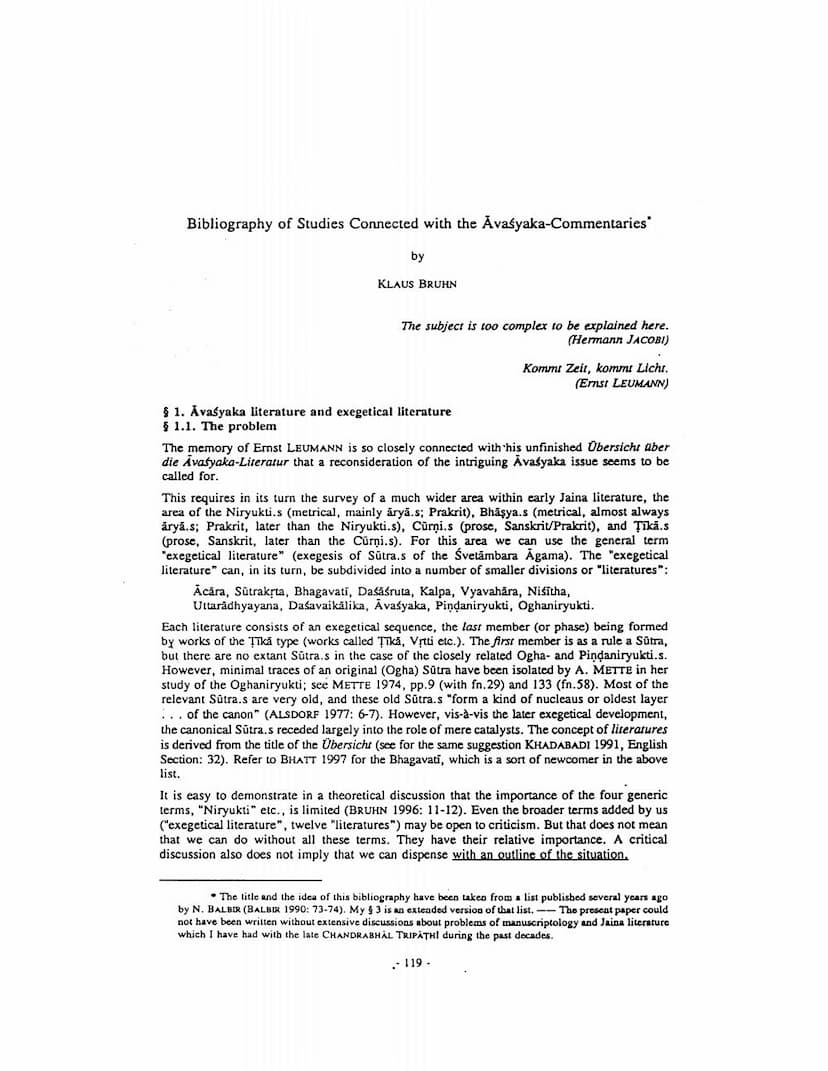
Key Components of Āvaśyaka Exegetical Literature: Bruhn outlines the hierarchical structure of this commentary tradition, which includes:
- Niryukti: Metrical commentaries, primarily in Prakrit, often in ārya meter.
- Bhāṣya: Metrical commentaries, usually ārya, following the Niryukti.
- Cūrṇi: Prose commentaries, in Sanskrit/Prakrit, appearing after the Bhāṣya.
- Ṭīkā: Prose commentaries, in Sanskrit, the latest phase of this tradition.
The "Literatures" Concept: The author adopts a concept of distinct "literatures" based on the exegesis of specific canonical works (Sūtras). Examples include Ācāra, Sūtrakṛta, Bhagavatī, and crucially for this bibliography, Āvaśyaka. Each "literature" typically begins with a Sūtra and culminates in works of the Ṭīkā type.
The Significance of Ernst Leumann: A central theme is the groundbreaking, albeit unfinished, work of Ernst Leumann. His Übersicht über die Avaśyaka-Literatur (Overview of the Āvaśyaka Literature), published in 1934, is considered a seminal, though highly technical, study. Bruhn emphasizes that Leumann's work laid essential groundwork, but requires extensive interpretation and a more accessible pedagogical approach. Leumann's research spanned decades and involved meticulously collecting and analyzing Jaina manuscripts, demonstrating a pioneering spirit in the field of Jainology.
The Āvaśyaka Sūtra and its Commentaries:
- The Āvaśyaka Sūtra is the foundational text, a short, semi-ritualistic composition.
- The Āvaśyaka Niryukti is identified as the central exegetical work, built upon the Āvaśyaka Sūtra. It's characterized as "pseudo-exegetical and para-exegetical" with various expository tools like didactic stories, dvāra-gāthās, nikṣepas, etymologies, and caturbhangas. Leumann identified distinct textual layers within the Niryukti.
- A Mūla-bhāṣya (256 verses) was later added to the Niryukti.
- The Viśeṣāvaśyaka Bhāṣya, composed by Jinabhadra (6th/7th century CE), is a significant commentary on the first half of the Āvaśyaka Niryukti, comprising around 4300 verses.
- Prose commentaries include the Cūrṇi (attributed to Jinadāsa) and various Ṭīkās, with Haribhadra being a prominent commentator. These prose works often supplement narrative material and comment on both the Sūtra and the Niryukti.
Challenges and Ongoing Research:
- Bruhn acknowledges the inherent complexity of the Āvaśyaka literature and the difficulty in providing definitive answers about its structure and the precise meaning of terms like "Niryukti."
- He highlights the need for detailed comparative studies to understand the relationships between different strata of the Āvaśyaka literature and external canonical texts.
- The text discusses the "Āvaśyaka orbit," a broader category encompassing literature outside the direct exegetical sequence.
- The bibliography aims to provide a starting point for further research, referencing foundational scholars like Georg Bühler and Albrecht Weber, who were instrumental in introducing and cataloging Jaina manuscripts, thus enabling modern Jainological studies.
- The work also points to significant editorial efforts in India and the ongoing study of Leumann's extensive unpublished materials.
The Purpose of the Bibliography: This bibliography is intended to guide scholars through the vast and intricate body of secondary literature on the Āvaśyaka commentaries. It categorizes and lists studies, offering brief descriptions of their content and relevance to the Āvaśyaka tradition, with a particular focus on the foundational work of Ernst Leumann. It aims to make this complex field more accessible and to stimulate further research.